Obsidian is a strong tool. It is flexible, local-first, and clearly works well for a lot of people.
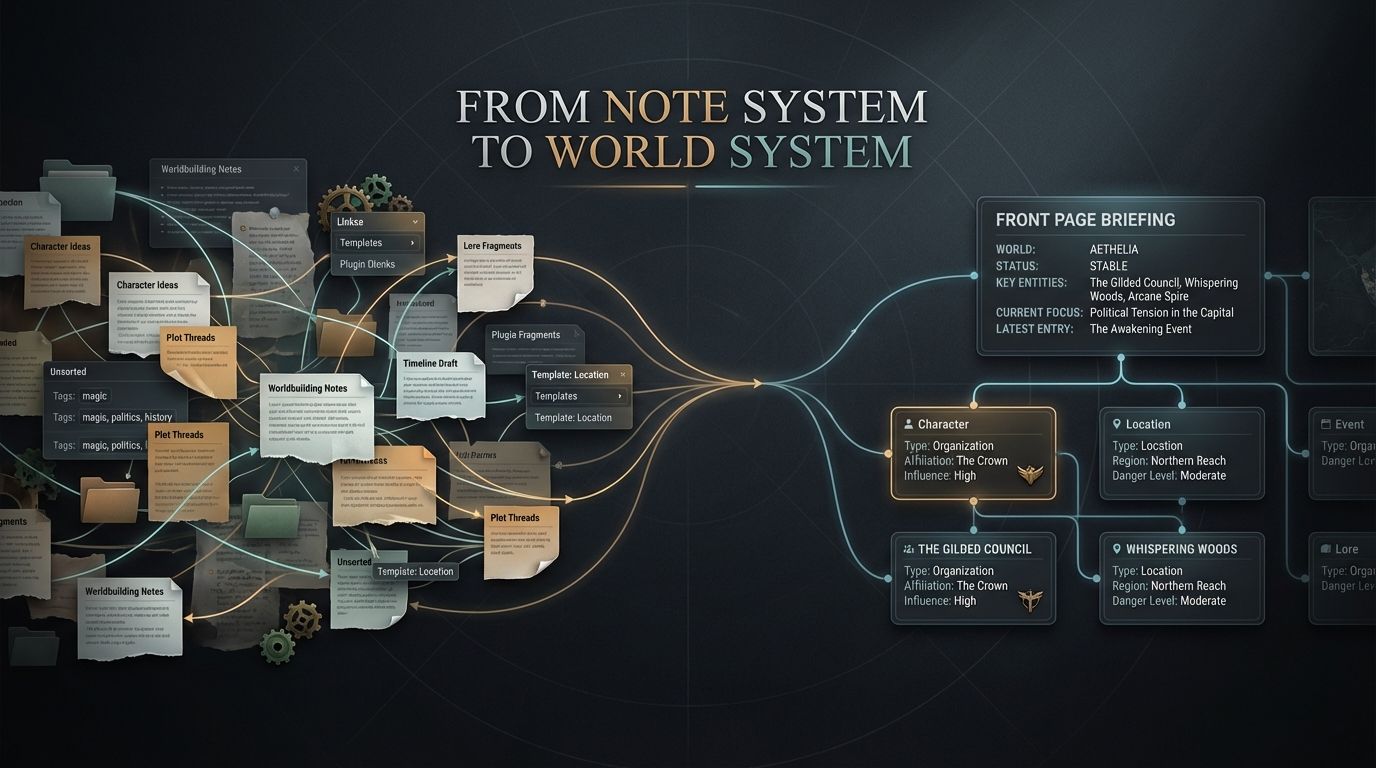
But as I looked at how people were using it for worldbuilding, the tradeoff became hard to ignore: many were spending as much time assembling the system as building the setting. That is where Codex Cryptica comes from. Not from the idea that Obsidian is bad, but from the idea that worldbuilding deserves a tool shaped around it from the start.
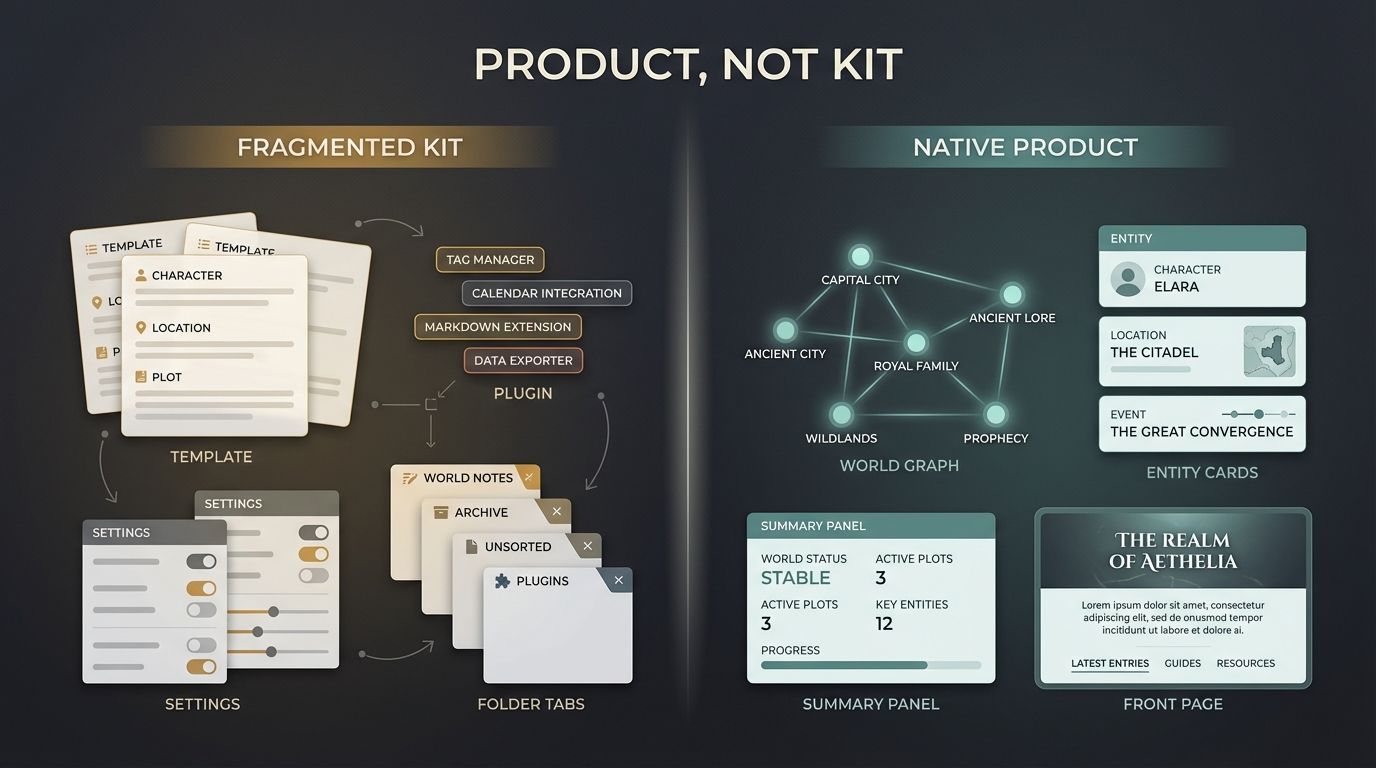
Note: the images in this post are illustrative concepts, not literal screenshots from Codex Cryptica.
1. The Setup Tax
Obsidian gives you a blank slate. For some people, that is the appeal.
For worldbuilding, it also means a lot of the workflow has to be built by hand: templates, metadata conventions, folder structures, naming rules, and plugins. That can be satisfying if you like designing systems. It is less satisfying if you just want to start building your world.
Codex Cryptica takes a different approach. Structure is built in. Entities, relationships, and graph-based exploration are part of the product from the start.
2. Product Versus Kit
A lot of Obsidian’s power comes from plugins. That is both its strength and its weakness.
Once your workflow depends on a stack of add-ons for core tasks, the experience can start to feel less like a product and more like a kit. Codex Cryptica is built around native worldbuilding workflows. The important parts are built into the core, not assembled later.
3. A Graph You Can Work In
Obsidian’s graph is visually impressive, but for many people, it is more of a visual layer than a real workspace. It shows that things are connected, but does less to help you work through those connections directly.
In Codex Cryptica, the graph is the workspace. It is where you explore, navigate, and understand the structure of your setting.
4. Relationships as Structure
In a standard note-taking tool, relationships are usually implied through links in text. That works, but it also means the structure of the world is often buried inside prose.
Codex Cryptica treats entities and connections as first-class structure. The point is not just to link information, but to make the world itself easier to navigate.
5. Growth Should Increase Discovery
As a note system grows, so does the maintenance burden. More notes, more links, and more metadata mean more chances for drift.
Codex Cryptica is built around a different idea: growth should increase discovery, not maintenance. The larger the setting gets, the more important it becomes for the tool to surface structure clearly instead of forcing you to manage it by hand.
The Real Difference
Obsidian gives you a flexible foundation. Codex Cryptica aims to give you a worldbuilding architecture.
That means:
- Less setup
- Less plugin hunting
- Less manual maintenance
- More time spent building the world
That is why Codex Cryptica exists.
Enter the Codex
If you have reached the point where note-taking is no longer enough, Codex Cryptica is built for what comes next.