How to
How do I introduce children to D&D without overwhelming them?
Start playing before you teach the whole ruleset. Give each child a readable pregenerated character with two or three clear abilities, open on a choice they can act on straight away, and introduce a rule only when a decision needs it: you describe the situation, the child says what their character tries, and you ask for a d20 roll plus the relevant modifier only if the outcome is uncertain. Plan a short adventure with a clear ending, allow talking or helping as an alternative to fighting, and add attacks, saving throws, spells and initiative in later scenes or sessions as the children ask for them.
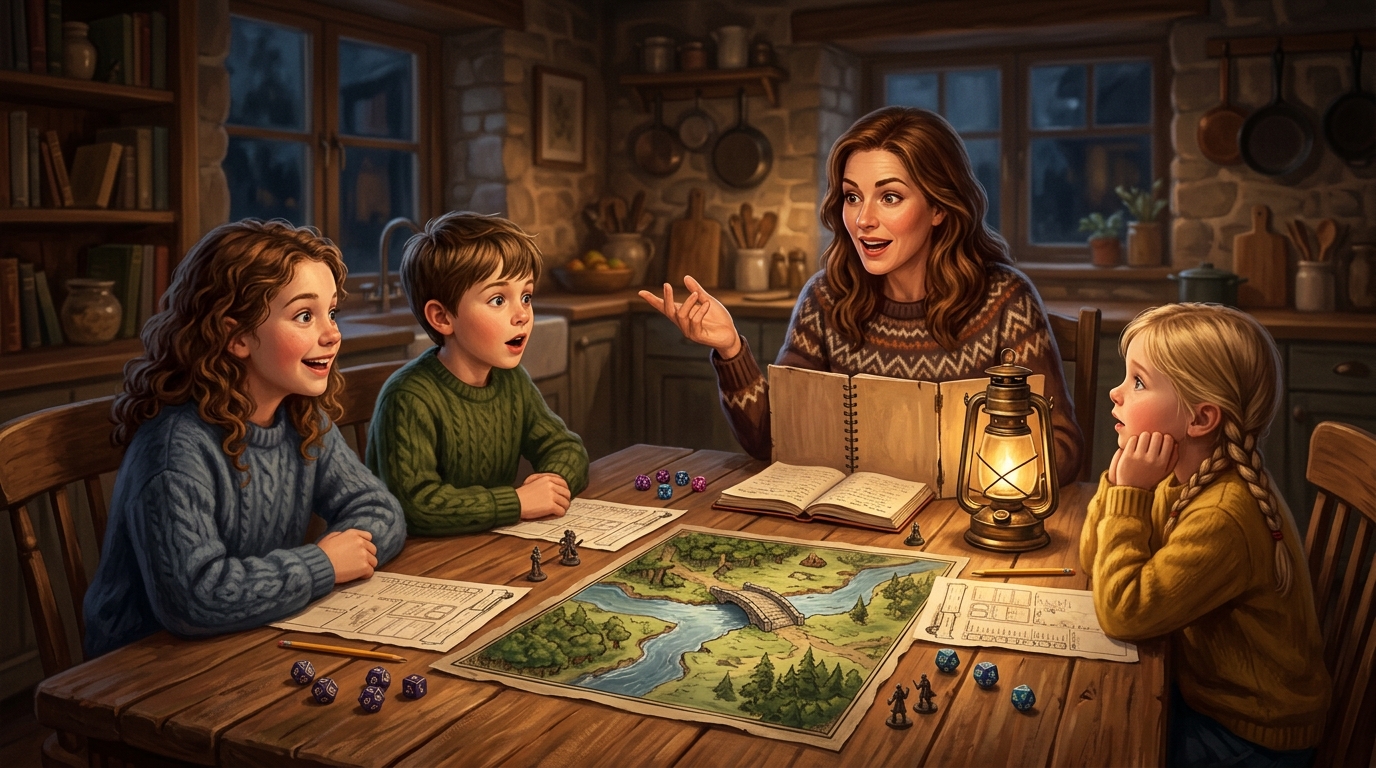
Start playing before you teach the rules
The rules examples here use the 2024 D&D Free Rules. If your table uses the 2014 rules, use the 2014 Basic Rules as your reference instead; some terms and character features differ. The DCs and creature statistics below are examples for this adventure, and the optional simplified turn order is a teaching choice rather than the standard combat procedure.
A first session for children aged roughly 8 to 12 fails most often before play begins, when character creation, dice notation and a long explanation of actions take the whole sitting. Children learn D&D the same way they learn a playground game: by taking a turn, seeing what happens, and taking a better turn next time. Your job in session one is to protect that loop and keep every child making decisions.
Open in the middle of a small problem, not at the start of a campaign. Say where the characters are, what has just gone wrong, and what they can see. Then ask one child: what does your character do? Accept answers in ordinary language. A child who says "I hide behind the barrel and watch the bridge" has understood the game, even if they have never heard the words Hide action or Stealth check.
Keep the first explanation brief. Name the twenty-sided die (the d20), point to the big modifier numbers on the character sheet, and explain that you will tell them when to roll. Everything else can wait until it matters at the table.
Introduce the rules in stages
Teach each rule at the moment a child needs it. The stages below follow the order most groups meet them in play:
- Stage 1: the basic conversation You describe a situation, the player declares what their character tries, and you describe the result. No roll is needed when the action is easy, impossible, or has no interesting cost for failure. "I look under the bridge" needs no roll if the lantern light is plainly visible underneath it.
- Stage 2: the ability check When the outcome is uncertain and failure changes the situation, ask for an ability check. The child rolls a d20 and adds the modifier you name. For example, crossing the slippery stones under the bridge might call for a Dexterity (Acrobatics) check against Difficulty Class (DC) 11. A roll of 13 plus a +3 modifier gives 16, which meets or beats 11, so the character crosses without slipping. On a total below 11, do not end the child's turn in embarrassment: they slip into ankle-deep water, make a splash that alerts whoever is below, and can still act from there.
- Stage 3: the attack roll, only if a fight happens An attack roll also uses a d20, but it is compared with the target's Armour Class (AC), not a DC you set for a task. If a giant fire beetle (AC 12) lunges at the party and a child swings a shortsword with a +4 attack bonus, a d20 roll of 9 gives 13, which hits. Only then roll damage: 1d6 plus 2, so a four on the six-sided die deals 6 damage. A miss deals no damage; the character can use any remaining movement or available actions before their turn ends. Do not teach this sequence before the first fight, and do not require a d20 roll before every damage or healing effect: a spell or item does exactly what its description says.
- Stage 4: the saving throw, when something happens to them A saving throw is a d20 roll your players make to resist an effect, such as a Dexterity saving throw to jump clear of a falling lantern. Name the difference in one sentence: a check is for something you try, a saving throw is for something you resist, and an attack roll is for hitting a creature. That distinction is enough for session one.
- What to leave out for now Full initiative order, the complete action list, spell slots and spell preparation, opportunity attacks, conditions and levelling can all wait. Say so plainly: "We are leaving those out today so we can play. We will add them when we need them." Temporarily omitting a rule is a teaching choice, not a mistake, provided you are consistent within the session.
Use pregenerated characters children can read at a glance
Build or borrow pregenerated characters and let each child choose by picture, job or favourite tool rather than by statistics. A readable sheet for this age group puts the character's name and one-line description at the top, followed by the three numbers they will use most (Armour Class, hit points and speed), their main attack or useful trick, and one special ability written as a plain sentence. For example: "Pip the rogue can hide as a bonus action and carries a coil of rope" tells a child more than a dense list of class features.
Offer three or four characters with obviously different jobs: one strong and sturdy, one sneaky and curious, one with a small amount of magic, and one who helps and heals. Give each a helpful item (rope, lantern, snack for an animal, small healing kit) so every child has something to contribute outside combat. Let children rename the character, choose how they look, and decide one thing the character likes. That small ownership matters more than an optimised build.
Do not ration choices. A simple sheet should make the first decision easy, not limit what a child may attempt. If a child asks whether their fighter can sing to the creature under the bridge instead of fighting it, the answer is yes: decide whether a Charisma (Performance) check is needed and play the result. An older or confident child who wants the full sheet, more spells or the job of tracking initiative should be allowed to take that on. Judge confidence child by child rather than by age alone: some eight-year-olds will track hit points happily, and some twelve-year-olds would rather describe actions and leave the numbers to you.
Example
A ready-to-run first adventure: the lantern under the bridge
This is one example of a short adventure for two to four children, and it needs no combat. The beat timings below are illustrative pacing options, not expectations. Read the boxed narration aloud or put it in your own words. If the children are enjoying a conversation, let it breathe and shorten the return journey instead.
Premise in three sentences: Tonight is Lantern Night in the village of Brambleford, when families hang paper lanterns along the river. The big golden lantern that leads the procession has gone missing from the market square. Small wet footprints and a trail of gold glitter lead from the empty hook towards the old stone bridge.
- Beat 1, the hook and first choice (illustrative: about 5 minutes)
- Read: "The market square smells of warm bread. Every stall has its lantern lit except the tall pole in the middle, where the big golden lantern should hang. Under the pole, glitter sparkles in a line of small wet footprints heading for the river. What do you do?" Likely actions include following the footprints, asking a stallholder what happened, or examining the pole. All three work. A stallholder, Mina the baker, saw a small figure hurry away hugging something glowing and is worried rather than angry. Following the footprints leads straight to Beat 2. Let each child contribute one observation or question before you move on.
- Beat 2, exploration and a person to talk to (illustrative: about 15 minutes)
- Read: "The footprints end at flat stones under the bridge. The river runs fast and the stones shine with green moss. From the shadows comes a small sniffling sound." Crossing the stones is the check described above (Dexterity (Acrobatics), DC 11) for any child who wants to cross; a child may also hold a rope, throw a plank across, or call out instead. Under the bridge sits Bram, a young goblin lantern keeper's apprentice, hugging the golden lantern. Bram took it because he is frightened of the dark walk home and thought one night's borrowing would not be missed. He is sorry, expects to be shouted at, and will hand the lantern back at once if the children are kind. If they accuse him, he cries and hides behind the lantern, which slows the conversation but does not block it: any apology, question about his walk home, or offer to walk with him reopens the talk.
- Beat 3, resolution and a clear ending (illustrative: about 10 to 15 minutes)
- The children decide what should happen. They might escort Bram home and then carry the lantern back together, persuade Mina to lend Bram a small lantern of his own, or ask Bram to carry the big lantern at the front of the procession and be thanked publicly. Any kind solution works and should be honoured at the table. End where their choice leaves them, and keep track of where Bram and the golden lantern are: if they escorted him home, end at his door, with the lantern still with the children to return to Mina if that was their plan; if they chose the procession, describe the golden lantern at the front, carried by Bram if that was their plan. Mention a small lantern only if Mina actually lent it to him. Then stop. A definite ending while the children are still pleased is better than stretching the session to fill an hour.
- Optional gentle combat, only if the children ask for a fight
- If the group wants action, use two beetles with these custom, simplified statistics (not an official monster block): Armour Class 12, 4 hit points each, and a +2 attack bonus. The beetles crawl towards the lantern's glow because they want its warmth, not a battle to the death. Each child takes a turn in an order you set by asking who acts first. Then each beetle takes one turn: the first attacks and the second noses towards the lantern; switch roles next round. The attacking beetle targets the character nearest to it, rolls a d20 and adds +2 against that character's AC; on a hit, it deals 1d4 plus 1 damage, which you subtract from the character's hit points. A miss deals no damage. A child can attack (shortsword +4 to hit, 1d6 plus 2 damage, as worked above), shoo a beetle with a waved cloak (Animal Handling or Intimidation check, DC 11), or, if Bram agrees to hand it over, carry the lantern away so the beetles follow its warmth and leave Bram's path clear. A successful shoo sends that beetle scuttling into a dark crevice. A beetle reduced to 0 hit points retreats to the crevice rather than being killed. These visible reactions let the children end the scene through their choices. The AC, hit points, attack bonus and simplified turns are custom teaching choices, not standard 2024 D&D statistics or procedure.
Running a mixed-age table without losing anyone
- Go round the table in the open Outside any fight, ask each child in turn what their character does before resolving any of it. Quiet children get a protected moment to speak, and confident children learn to build on a sibling's idea rather than replace it. In a short fight, keep the same round-the-table order so nobody has to learn initiative to take part.
- Plan for shorter attention, not lower ability If attention wanders, try changing the kind of problem or offering a small job, such as holding the map or rolling for the group, rather than giving a recap lecture. End on the planned closing beat even if you skip a middle detail.
- Use visual aids as props, not requirements A hand-drawn bridge, a few counters or figures, and dice each child can hold all help younger players follow where everyone is. They are optional. A sketch on scrap paper does the same job as a printed map, and a character can be a named bottle cap.
- Reward helping over winning Praise plans that combine two characters' abilities, and let a child who helps another add encouragement even before you teach any formal help rule. If one child dominates the dice, give the next decision to a different child by directing the question to their character specifically.
- Handle setbacks gently and briefly A failed roll should change the situation, not punish the child. Slipping on the stones means wet socks and a splash, not injury and ridicule. If a character is ever hurt, describe it plainly and move on. Keep any character from being knocked out in session one: at low hit points, have the opposition back off, flee or accept surrender instead.
Agree comfort boundaries before the dice come out
Before play, tell the adults and children involved what kind of story this is: a friendly adventure where the characters help people, nobody has to fight if they would rather talk, and any player can pause the game. Ask directly whether anything should stay out of the story, such as spiders, deep water, or being chased. With children, keep this short and concrete rather than formal. "If anything feels too scary or not fun, say pause and we will change it" is a complete safety rule for a first family session, and you must honour it the first time it is used so the children learn it is real.
Be clear that characters can be in pretend danger without anything bad happening to the player, and agree what happens if a character is badly hurt. Many family tables rule that characters get knocked down, captured or chased off rather than killed, at least until the group decides together that they want higher stakes. Do not assume every child enjoys fighting: the lantern adventure above can be finished entirely by following tracks, crossing stones and talking, and a child who prefers that route should reach the same happy ending as one who wanted the beetles.
Finish by asking each child what their favourite moment was. That tells you what to offer more of next time and ends the session on their choices rather than your narration.
Starter kits and maps are resources, not a checklist
If you already own a starter set, the Player's Handbook or a published adventure, you do not need to run all of it, in order, before the children are allowed to enjoy it. Take one small piece: the first location, one friendly non-player character (NPC), or a single map, and run only that portion with the staged rules above. A starter adventure's opening scene works well if you cut the first fight down to one or two opponents and let the party talk or sneak where the text assumes combat.
Nothing extra needs to be bought for session one. Dice can be shared or rolled with a free dice roller, characters can be handwritten on index cards, and the bridge in the adventure above can be three books on the table. Buy or print more only when the children ask to play again and you know what actually slowed your table down.
Minimum preparation checklist
Use this as a minimum preparation list. Add detail only where your group needs it:
- A three-sentence premise you can read aloud: what has gone wrong, where the trail leads, and who is involved. The lantern premise above is ready to use as written.
- One simple map or sketch: a market square, a river and a bridge on one sheet of paper is enough.
- Two or three NPC details each: Mina the baker is worried and kind and saw a small figure at dusk; Bram is frightened of the dark, sorry, and will cooperate if treated kindly.
- Pregenerated characters, one per child plus a spare, each with a main attack or trick and one helpful item written in plain language.
- The slippery-stones check (Dexterity (Acrobatics), DC 11) and, if you use the optional fight, the two beetles' custom statistics (Armour Class 12, 4 hit points each, +2 to hit, 1d4 plus 1 damage). Only one beetle attacks each round. Bram cooperates when treated kindly; no roll is needed for that response.
- One d20 per child if you have them, a spare six-sided die for damage, and pencils. Shared dice are fine.
- A clear ending and a sentence that closes the session when you get there.
- A pause rule the children have heard before play starts, and your decision that no character will be killed in this first session.
Was this useful?
Related
Topic Hubs
Other answers
- How do I start GMing for the first time?
- What should a new D&D player learn first?
- What should a new D&D player know before their first game?
- Can you play a tabletop RPG in 30-minute sessions?
- How do I read a D&D character sheet as a beginner?
- Which dice do I roll in D&D, and when?
- How can I practise being a Dungeon Master without a group?