Framework
How do I run the different character roles that show up in an investigative horror RPG?
Run investigative horror roles through what each one changes about the case. Let the investigator deepen a clue, the journalist decide who else learns it, the occultist explain what it costs to know, the doctor make it a medical decision, the authority open a door that comes with scrutiny, the witness carry personal risk, and the fixer trade access for a favour. Keep expertise as better, faster, or safer information rather than exclusive permission to learn, and bring every discovery back to a shared decision.
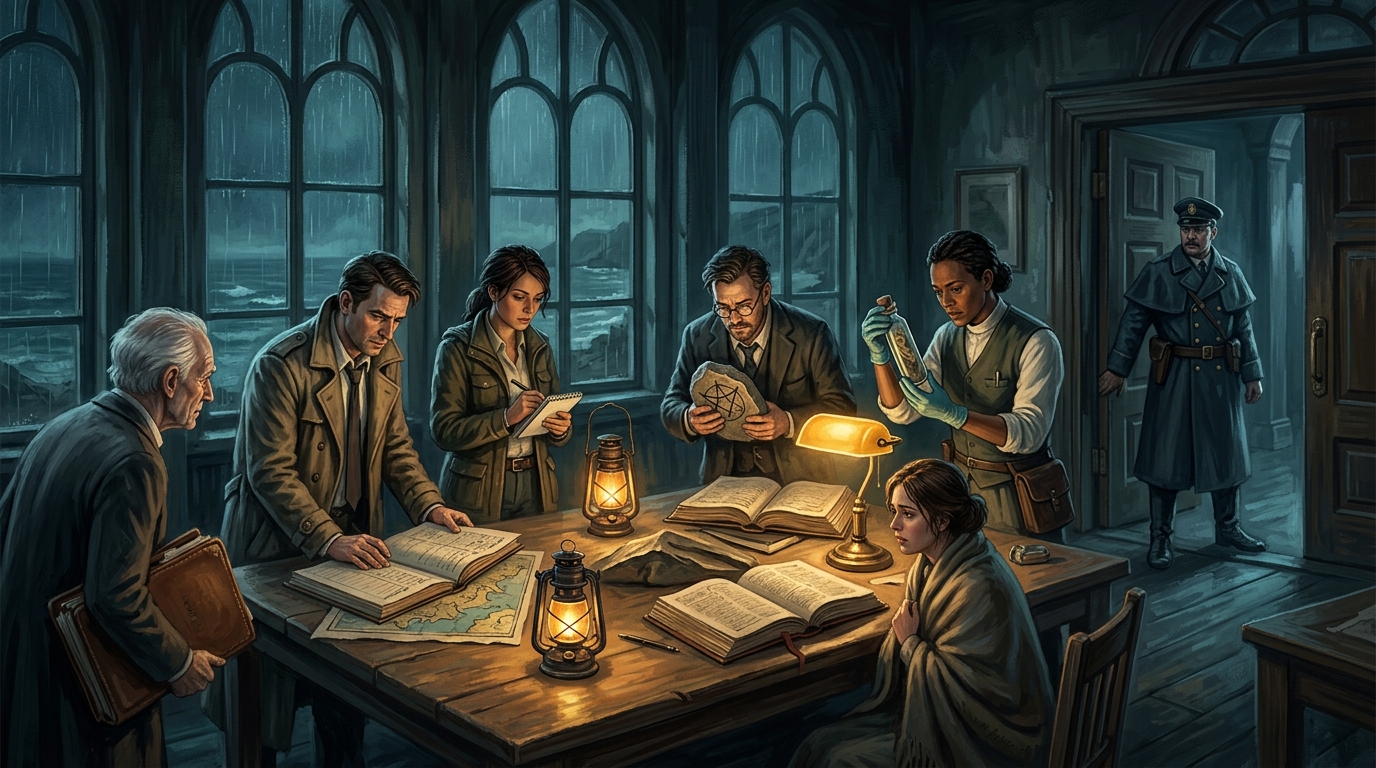
Roles share a case but change what is at stake
Investigative horror puts the same mystery in front of a mixed group: a detective who notices contradictions, a reporter with a contact book, an academic who has read the wrong journals, a doctor who can read a wound, an officer who can order a door opened, a witness who was there last time, and a local who knows which archive drawer sticks. The question at the table is not which role is most useful. It is what each role changes about clue flow, authority, danger, and spotlight when that character acts.
This page assumes you have already chosen a system. For help picking a game for this style of investigation, see the system comparison for investigative horror. For structure of the mystery itself, pair this with the mystery without railroading and conspiracy campaign guides. The framework below stays system agnostic and works whether you run Call of Cthulhu, Delta Green, Trail of Cthulhu, Vaesen, Brindlewood Bay, or another game that supports this genre.
Core principle from the specialist spotlight framework: Specialist acts, situation changes, others respond, party decides, return to specialist. As scenario design, do not make critical progress depend on one specialist succeeding at one exact roll. Use the chosen system's clue and failure procedures, while giving necessary conclusions resilient routes so one failure or absent specialist does not end the investigation. Let expertise make information better, faster, safer, or richer rather than granting exclusive permission to learn.
The roles and how to run each one at the table
Treat these as flexible archetypes rather than fixed classes. A character may combine several, and different games will name them differently. For each role, identify contribution, distortion to watch for, a practical technique, and a pressure that keeps it in shared play:
- Investigator or Detective Contributes: connects evidence, spots contradictions, and notices what does not fit. Distortion: one roll owns every clue while the table waits for a theory. Technique: use Find, Interpret, Decide. As scenario design, give necessary conclusions more than one route; use the system's own clue rules. The investigator can add specialist detail such as blade type, toxin, or a rehearsed phrase. State what the character can establish; let the table decide what it means unless the system explicitly resolves that interpretation. Pressure: tunnel vision, a compromised chain of custody, or a suspect who realises someone is close. Deep dive: how to run an investigator without sidelining the party.
- Journalist or Reporter Contributes: turns what the party knows into who else knows, through sources, corroboration, and publication choices. Distortion: the group becomes an audience for a chain of private interviews, or publication acts as an automatic win. Technique: use the reporting loop of access, verification, publication choice, and visible reaction. The reporter decides what to publish, delay, narrow, share privately, or withhold. Others help gather proof, protect sources, and prepare for the response. Pressure: a deadline such as a council vote, a source who fears exposure, or an outlet that must defend a claim. Deep dive: how to make a journalist or Media character matter.
- Occult expert or Scholar Contributes: places a clue in dangerous context, from a symbol's history to a ritual's supposed purpose. Distortion: lore becomes a lecture that settles the question, or the expert learns too much too safely. Technique: offer better questions, not automatic answers. Name what the sign matches, what it might imply if the account is accurate, and what remains uncertain. A sensitive's impression is information produced by the chosen system, not privileged proof that overrides ordinary investigation. Pressure: a harmful text, a rival scholar, or knowledge that demands action while uncertain.
- Doctor or Scientist Contributes: turns a body, sample, or instrument reading into a decision with consequences. Distortion: technical knowledge becomes instant proof that bypasses the investigation or removes danger. Technique: make the finding create a medical or technical choice with limited resources. The doctor might confirm cause of death but face a choice about preserving evidence, treating a patient who cannot then travel, or using a single test kit. Pressure: a patient who needs care now, contaminated evidence, or a result that identifies what happened but not who ordered it.
- Authority figure, Police, or Agent Contributes: access, legal power, and institutional weight, from opening a scene to demanding records. Distortion: authority makes every locked door trivial, or it shuts down horror by making the party feel protected. Technique: pair access with jurisdiction, scrutiny, and constraint. Define what the badge authorises, who can countermand it, and what procedure must be followed. A warrant may open a house but require a reason on file that alerts a suspect. Institutional knowledge cuts both ways. Pressure: a supervisor who wants a result on record, a procedure that creates a delay, or an audience that now expects the authority to explain what was found.
- Protector, Soldier, Operator, or Enforcer Contributes: secures dangerous scenes, protects witnesses, creates escape routes, and buys time to investigate. Distortion: every threat becomes a combat problem while others watch the operator clear the room. Technique: make force create choices: protect the witness or pursue the attacker; preserve evidence or stop the threat; hold the exit or enter the unknown. Pressure: scarce resources, collateral risk, scrutiny, injury, escalation, or a problem force cannot solve.
- Witness, Survivor, or Sensitive Contributes: a witness or survivor brings personal stakes and memory; a sensitive offers an impression through the chosen system. Distortion: either becomes privileged proof that settles the mystery. Technique: treat experience as a source, not the answer. Separate what was observed from what it may mean, and test accounts or impressions against other evidence unless the system explicitly resolves them. Pressure: being noticed by whoever caused the harm, pressure to stay silent, or the cost of returning to a place tied to the event.
- Fixer, Local contact, or Archivist Contributes: a fixer trades relationships for access to people or places; an archivist or local expert knows where information lives and how it is recorded. Distortion: contacts produce whatever the party needs without delay or competing loyalties, or research automatically creates a favour debt. Technique: make a fixer's favour specific and track who expects repayment. An archivist may find a burial register through ordinary expertise; the record itself can still leave a trace. Pressure: a debt, a source who answers to someone else, or an archive others can check.
Keep expertise distinct without splitting the investigation
Several characters may be able to learn the same fact, but they do not need to do the same job. The investigator notices that a wound pattern matches a narrow blade. The doctor confirms cause of death and the time available before a sample degrades. The authority secures the scene legally. The journalist finds a second source who saw the vehicle. The archivist knows which ledger would record its number plate. Let those actions change the same meeting, deadline, or decision rather than building a separate scene for each role.
Cut between actions when new information, a cost, or a choice changes what someone else can do. If one character questions a source alone, keep the scene as long as it holds a choice or discovery, then return with information the group can act on. A brief private conversation can work when it ends with a decision the party must face together. Check with players about personal horror material and about secrets between characters before using hidden knowledge or competing loyalties.
Protect clue flow while keeping danger real
Use these checks when a role threatens to monopolise a clue, bypass a constraint, or remove risk:
- Clue flow As scenario design, do necessary conclusions have resilient routes if a specialist is absent or a roll fails? Use the chosen system's clue and failure procedures, and let expertise make the result richer, quicker, or safer.
- Authority When a badge or rank opens a door, does it also create a record, an obligation, or a person who will ask what was done with that access?
- Danger Does forbidden knowledge or physical exposure carry a cost the group can see, such as lost time, a worsening condition, or attention from the force behind the horror?
- Spotlight Does the specialist's success change the situation in a way that gives other characters something to do before the next decision point, using Specialist acts, situation changes, others respond, party decides, return to specialist?
- Truth Follow the mystery model of the chosen system. In fixed-truth mysteries, distinguish observation from interpretation, keep established facts stable, and give necessary conclusions multiple routes. In emergent-truth mysteries, do not secretly pre-solve the case: let clues constrain and inspire theories through the system's procedure. State what a character can establish; let the table decide what it means unless the system explicitly resolves that interpretation. Keep role expertise useful without overriding that procedure.
Example
Worked example: the chapel ledger
A coastal town prepares to reopen a storm-damaged chapel. Two workers report a pattern of night visits to its crypt. The party includes an investigator, a doctor, a reporter, an archivist, and a police constable. They need to learn what is being moved through the crypt and whether to stop the reopening ceremony.
- The role-by-role version
- The investigator examines the crypt alone and rolls to interpret the traces. The archivist separately checks parish records. The constable waits outside while the doctor studies a worker's injury. The reporter interviews a worker in a private scene. Each discovery is useful, but the scenes happen in sequence and the group meets only after the trail is assembled. By then the ceremony is hours away and the party must hurry to reconcile what each member learned alone.
- The shared investigation
- The scene offers several leads: fresh clay on the floor, a scuffed burial ledger with its last page cut rather than torn, and a river path with a night watch. Use the group's system to resolve what each character can establish. The investigator may recognise the clay as riverbank mould used for casting and the cut as deliberate; the archivist, who accompanies the party, knows the ledger should be locked in the vestry. The doctor examines the injured worker and establishes a recent brush with a narrow tool, but proper treatment delays the group's next move. The constable can demand the ledger formally, creating a record that alerts the churchwarden. The reporter can publish a narrow verified note about the discrepancy to pressure the warden, but risks exposing the worker. The party must choose whether to question the warden, secure the worker's safety, or verify the ledger in the town archive before the ceremony. If the system calls for a roll and the investigator fails, the group still has other leads; the delay in interpreting the scene lets the churchwarden move the contents of the crypt.
- Why it works
- The investigator deepens the clue without owning it. The authority creates lawful access at a cost of visibility. The reporter turns a private finding into a public consequence. The doctor makes medical knowledge a decision about time and care. The injured worker faces personal risk as a source. The archivist offers another route to the records without necessarily owing a favour. The group can keep investigating after a failed roll, using the system's procedures, and each choice leaves a trace the horror can respond to.
Before you run roles in an investigative horror session
- What can this role change that another character cannot change in the same way?
- Who notices, records, or judges the use of that role's access or expertise?
- Which other characters can add context, proof, protection, or a competing obligation in the same scene?
- As scenario design, do necessary conclusions have resilient routes if a specialist is absent or a roll fails, while expertise improves quality, speed, or safety?
- What is directly observed and what remains an interpretation the players can debate?
- How does the chosen system handle failure, and what scenario routes keep one failed roll from ending necessary progress?
- What visible choice or consequence brings this scene back into shared play, and how does it raise the horror's pressure?
Was this useful?
Keep roles, clues, and obligations linked between sessions
Investigative horror campaigns produce a web of evidence, sources, records, and debts that outlasts any single session. The same structure that connects a clue to its source and the faction behind it can also record which role opened the door, what promise was made to keep it open, and which contact now expects repayment.
Record each discovery as a linked entity rather than a line in a notebook, so the next time you prep you can see at a glance which roles contributed, what remains unverified, and where exposure still sits. That makes it easier to return a publication's consequence, a badge's scrutiny, or a scholar's risky text to play without losing the thread.
Explore the RPG knowledge graphRelated
Tools
- Rumour Generator Whispers that point the party at people and places worth investigating.
- Secret Society Generator Hidden organisations with motives, methods, and ranks for conspiracy horror.
- Faction Generator Groups with goals and resources that can apply pressure to investigators and their contacts.
Guides
- Codex Cryptica for investigative campaigns Keep witnesses, evidence, archives, and debts connected across a long-running horror investigation.
- Codex Cryptica for Call of Cthulhu Notes and worldbuilding for groups running classic cosmic horror investigation.
- Codex Cryptica for cosmic horror Broader support for dread, unnatural entities, and slow-burn campaigns.
Other answers
- What RPG should I play for investigative horror?
- How do you run a mystery without railroading?
- How do you run a conspiracy campaign?
- How do I run an investigator or detective without making other PCs irrelevant?
- How do I make a journalist or Media character matter in an RPG campaign?
- How do I give specialist characters spotlight without sidelining the party?
- How do you create a secret society for an RPG campaign?
- How do I make a diplomat, noble or courtier useful in an RPG without relying on one social roll?
- How do I run spies and infiltrators in an RPG?
- How do I run hackers or netrunners without splitting the party?
- How do you generate useful RPG rumours?
- How do I run common character roles in a sci-fi or space-opera RPG?