Framework
How do you run an RPG campaign in one city?
Run a campaign in one city by trading breadth for depth: prepare a handful of districts instead of a whole map, build a small recurring cast the party keeps running into, let locations change permanently when the party acts, and layer secrets so each one implicates people the table already knows. A city campaign works when the same names, streets, and debts keep resurfacing rather than when new ones get introduced every session.
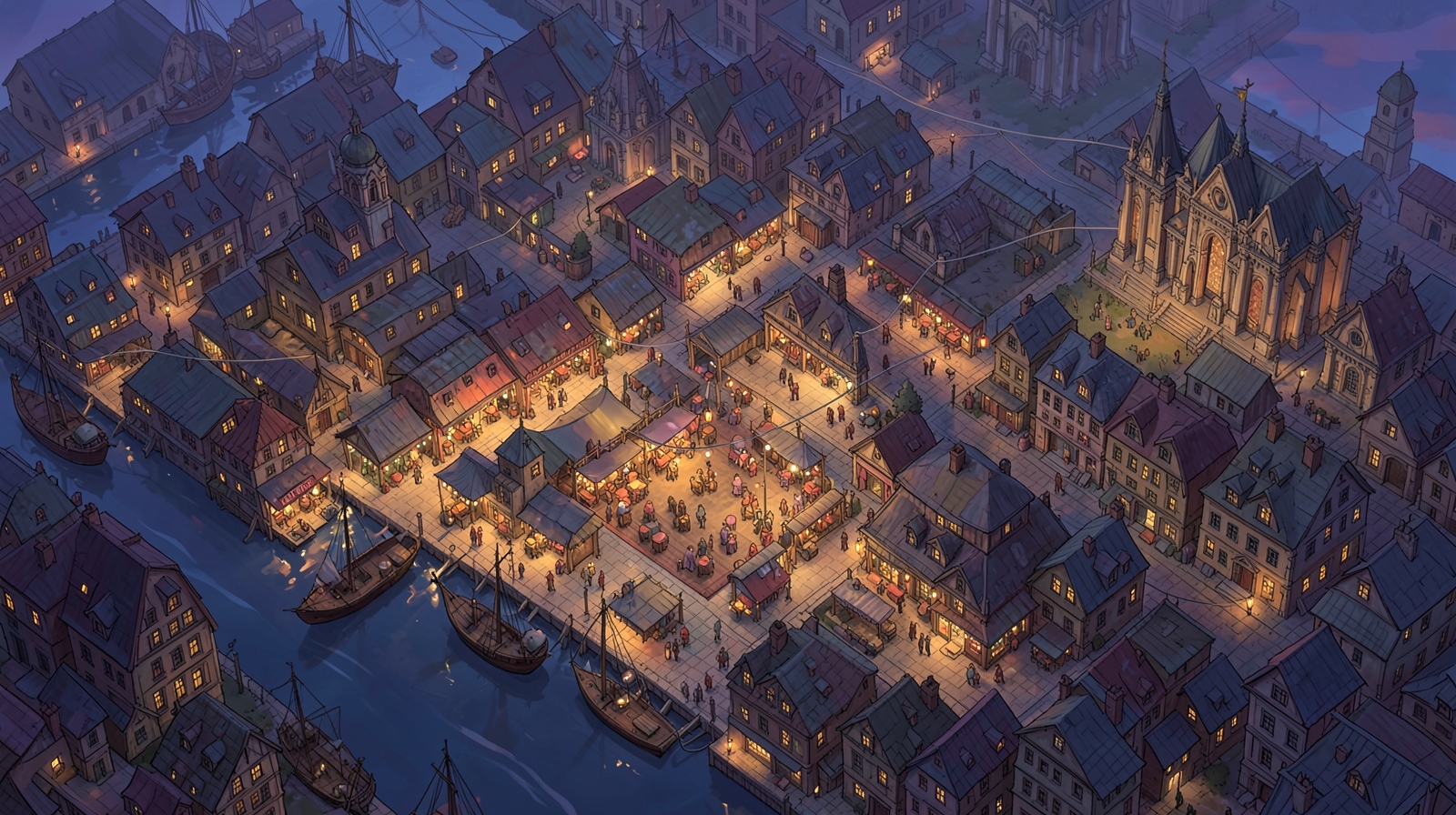
The city becomes a hub, not a setting
The usual failure is not underprepping a city; it is overprepping it the wrong way. A GM drafts a dozen districts, a guild for every trade, and a council with a dozen seats, then discovers the party only ever visits three streets. The rest sits unused, and worse, nothing in those three streets connects back to anything the party has already touched, so every session introduces new names instead of paying off old ones.
A city sustains a whole campaign the same way a good ensemble cast sustains a long-running show: a small, fixed set of places and people who keep returning, each carrying more history every time. Scope shrinks; depth grows.
Four things that make a city hold a campaign
Build these once, then spend every session deepening them rather than adding new ones:
- Three to five districts, not a map Pick districts the way you would pick locations for a settlement: each one earns its place by doing a job for the city (docks, markets, temple quarter, slums, the seat of power). Prepare each to the same shallow depth as a single settlement page. Do not draw streets between them; the party moves by scene, not by grid.
- A recurring cast of six to eight Fewer named NPCs than a sandbox campaign would use across a whole region, because the same few have to carry the whole campaign. Give each one a want, a district they are tied to, and at least one relationship to another NPC on the list, so pulling one thread moves a second person.
- Locations that change and stay changed When the party burns down the smugglers' warehouse, sinks a rival's ship, or gets a magistrate removed, that change has to still be true three sessions later. A city campaign proves itself is real by never quietly resetting a consequence the party caused.
- Secrets layered across the cast, not hidden in one NPC Instead of one villain holding one secret, split a single conspiracy across several of the recurring NPCs, each knowing a partial, plausible piece. Following any one lead should point toward someone else on the cast list rather than dead-ending or pointing somewhere new.
Example
The same guild problem, played wide versus played deep
A dockworkers' guild is skimming cargo tariffs. Compare running that as a one-off encounter against running it as part of a single-city campaign's recurring cast.
- Played wide
- The party exposes the guild in one session. The guildmaster is arrested, a new NPC replaces them off-screen, and the campaign moves to an unrelated problem in a different district next week. The city has not become more familiar; it has simply produced its next plot.
- Played deep
- The guildmaster is one of the eight recurring NPCs, already tied to the temple quarter's chief inquisitor through an old debt. Exposing the skimming does not end the guild; it forces the guildmaster to call in that debt, which pulls the inquisitor into direct conflict with the party three sessions later over an unrelated favour. The docks district itself changes: tariffs rise, a rival guild moves into the gap, and the change is still visible when the party passes through months afterward.
- Why it works
- Nothing new had to be invented to escalate the second version. The consequence travelled along a relationship that already existed, which is what makes a city feel inhabited rather than generated on demand.
Resist the urge to add a new district
The strongest instinct to fight in a single-city campaign is reaching for a new location whenever a session runs short on material. A city with six well-worn districts and eight NPCs the players can predict the reactions of will outlast a city with fifteen thin ones. When a session needs fresh material, it almost always comes cheaper from an existing NPC's unresolved want than from a new street.
Keep a single page per district and per NPC listing only what has changed since the last time the party interacted with them. That page, not a map, is what makes the city legible six months into the campaign.
The city is ready to sustain a campaign when
Confirm before session one:
- You have three to five districts, each with a job the city needs done.
- You have six to eight named NPCs, each tied to a district and to at least one other NPC on the list.
- At least one past consequence the party could plausibly cause is written down as permanent, not resettable.
- A citywide secret is split across at least two NPCs rather than held by one.
- You can name what changes in a district if the party ignores it for a month of game time.
Was this useful?
Systems built for this
- Blades in the Dark
The crew sheet ties scoundrels to a specific district hunting ground and claims map, while heat, entanglements, and faction status ensure that every score permanently alters standing across the city without allowing characters to evade local consequences.
- Urban Shadows
The debt economy and faction circles turn city politics into a mechanical web of social leverage, where calling in or refusing favours forces players into ongoing entanglements with the same recurring local power brokers.
- Vampire: The Masquerade
Coterie domain rules and the boon hierarchy define the party's territory, hunting rights, and political debts within a single municipality, ensuring that rival kindred and local obligations remain the permanent focus of play across long chronicles.
Keeping a whole city consistent across a long campaign
A single-city campaign lives or dies on continuity: whether the guildmaster's debt to the inquisitor is still there in session twenty, and whether the docks are still short-staffed after the party's raid. Codex Cryptica's campaign graph holds districts, NPCs, and factions as connected entities, so a consequence recorded once stays visible everywhere it touches instead of depending on session notes you have to reread.
The settlement generator is a fast way to seed each district with a reason to exist; the NPC and faction generators can build out the recurring cast and the relationships that tie them together.
Try the settlement generatorRelated
Tools
- Settlement generator Free, no login. Districts and neighbourhoods with a reason to exist, across any genre.
- NPC generator Build the recurring cast, with motives, mannerisms, and relationship hooks.
- Faction generator Create the guilds and power groups the recurring cast belongs to.
Guides
Other answers
- What should an RPG settlement contain?
- How do you create a fantasy city that feels alive?
- How do you create a cyberpunk city district?
- How do you run factions in a sandbox campaign?
- How do you organise NPC relationships?
- How do you prepare a sandbox RPG campaign?
- How many NPCs does an RPG town need?
- How do I run exploration in a huge ruined city?
- How do I portray a believable modern city in an urban RPG?