How to
How do you use player backstories in an RPG campaign world?
Break each backstory into reusable pieces (specific people, places, debts and goals) and wire them into the world you already run, rather than building a subplot around one character. Bring those pieces back through consequences that surface naturally in play, not through sessions engineered to spotlight a single backstory, and every player gets material without any one of them owning the campaign.
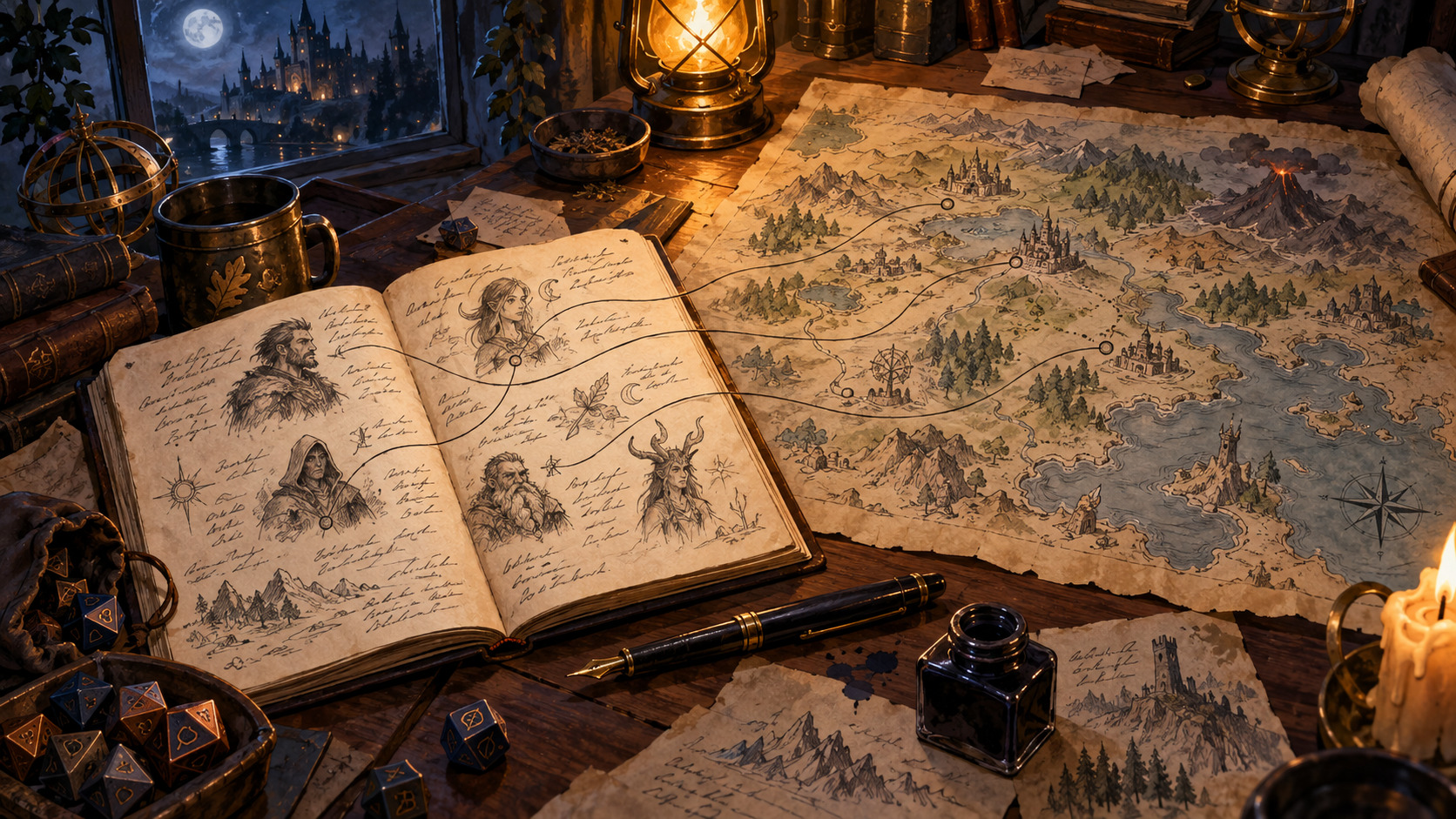
A backstory is raw material, not a subplot
The failure mode at both ends is visible from across the table. Ignore backstories entirely and players learn their character sheet's history section was decoration; the world clearly does not know or care who they are. Build a full arc around one player's backstory and the other three spend several sessions watching, which teaches them the same lesson from the opposite direction: their own history does not matter as much as this one does.
The fix is not more attention or less. It is treating a backstory the way you treat any other worldbuilding input: extract the concrete, reusable parts, and let them sit in the world alongside everything else you have already built, available to surface whenever they are the most useful thing in the room.
What to extract from a backstory
Most backstories, however long, reduce to a handful of usable elements.
- Named people A mentor, a rival, a parent, a lover left behind. Each is a potential NPC with a name and a plausible current status: alive, dead, changed, or missing, which is itself a hook.
- Named places A home village, a temple, a battlefield. Each is a location that can exist somewhere on your map, be visited, or be reported as destroyed, occupied or transformed since the character left.
- Debts and obligations Money owed either way, a promise made, a favour never repaid. These are the cheapest hooks to reuse because they come with a built-in reason for someone to make contact.
- Goals and open questions What the character still wants from their past: revenge, reconciliation, an answer nobody gave them. Unlike a debt, nobody else has to initiate this one; the player can chase it themselves if you make it reachable.
- Unresolved wounds The thing the backstory left unfinished on purpose or by accident. Not every wound needs closure, but every one is a lever, since a wound the character avoids talking about is exactly what a rival would try to exploit.
Link it to what already exists before inventing something new
A backstory element that sits in its own isolated pocket of the setting stays inert, for the same reason an unconnected faction stays inert: nothing else touches it, so nothing brings it back on its own. The useful move is to attach it to a faction, location or NPC you already run, so that the character's history and the ongoing campaign are the same graph rather than two separate stories running in parallel.
A mentor is more useful as a member of a faction the party already deals with than as a standalone NPC who only ever appears in flashback. A childhood debt lands harder if the moneylender who holds it also happens to work for the guild currently blocking the party's current goal. You are not inventing new material to do this; you are choosing which existing thread the backstory element gets tied to.
Example
A worked example: one debt, wired in
A player's backstory states their character borrowed heavily to pay for a sibling's medical treatment, years before the campaign starts.
- Extracted
- A debt, a named sibling, and an unnamed moneylender.
- Linked
- The moneylender is written in as a junior partner in the Ninefold Assize, the magistrates' guild the party already deals with over an unrelated matter.
- Reintroduced
- Three sessions later, the Assize needs a favour collected quietly and sends the moneylender to call in the debt, offering to forgive it in exchange for the party's silence on something they have already seen.
- Why it works
- No session was built around the debt. It surfaced because the party was already dealing with the Assize, it cost the table one scene, and it gave one player a personal stake in a plot that would have run without them.
Reintroduce through consequence, not spotlight
Bringing a backstory element back does not require a dedicated session. A letter arriving in the post, an NPC recognising a name, a faction's records turning up a familiar debt: each does the job in a scene or two, and the table's attention stays on whatever the party is doing rather than pausing for one character's history.
Rotate deliberately. If one player's backstory keeps generating hooks because it connects easily to what you already run, check whether the others' backstories have been extracted and linked with the same care, rather than assuming they simply had less usable material.
Backstories ready to use at the table
- Every PC backstory has at least one named person, place or debt written down as a usable element.
- Each element is linked to an existing NPC, faction or location rather than floating on its own.
- You can name the next scene where one of these elements plausibly resurfaces.
- No single backstory has consumed more than one full session on its own.
- Every player at the table has at least one backstory element wired into the world, not just the loudest one.
Was this useful?
Keeping backstory threads findable
The technique above only works if you can actually find the debt, the mentor or the sibling months after the session where a player mentioned them. A vault that holds characters, NPCs, factions and locations as connected entities turns that lookup into a search rather than a memory test, which is the difference between a callback landing and an opportunity quietly going unused.
Linking a backstory element directly to the faction or location it now belongs to means the graph surfaces it again on its own, the next time you are looking at that faction for an unrelated reason.
See the RPG knowledge graphRelated
Tools
- RPG knowledge graph Where backstory people, places and debts live as connected entities, so they resurface when the faction or location they touch comes up again.
- NPC generator A fast way to give a backstory character a want and a role once you decide they need one.