Comparison
What are the pros and cons of becoming a Dungeon Master?
Becoming a Dungeon Master may appeal if you enjoy setting up situations, improvising around unexpected player choices, and helping the group have memorable moments at the table. The role brings different responsibilities from playing: you prepare situations, make rulings, and share attention fairly. A low-risk way to find out is to run a short standalone one-shot for your group or a few friends while you keep playing in your current campaign.
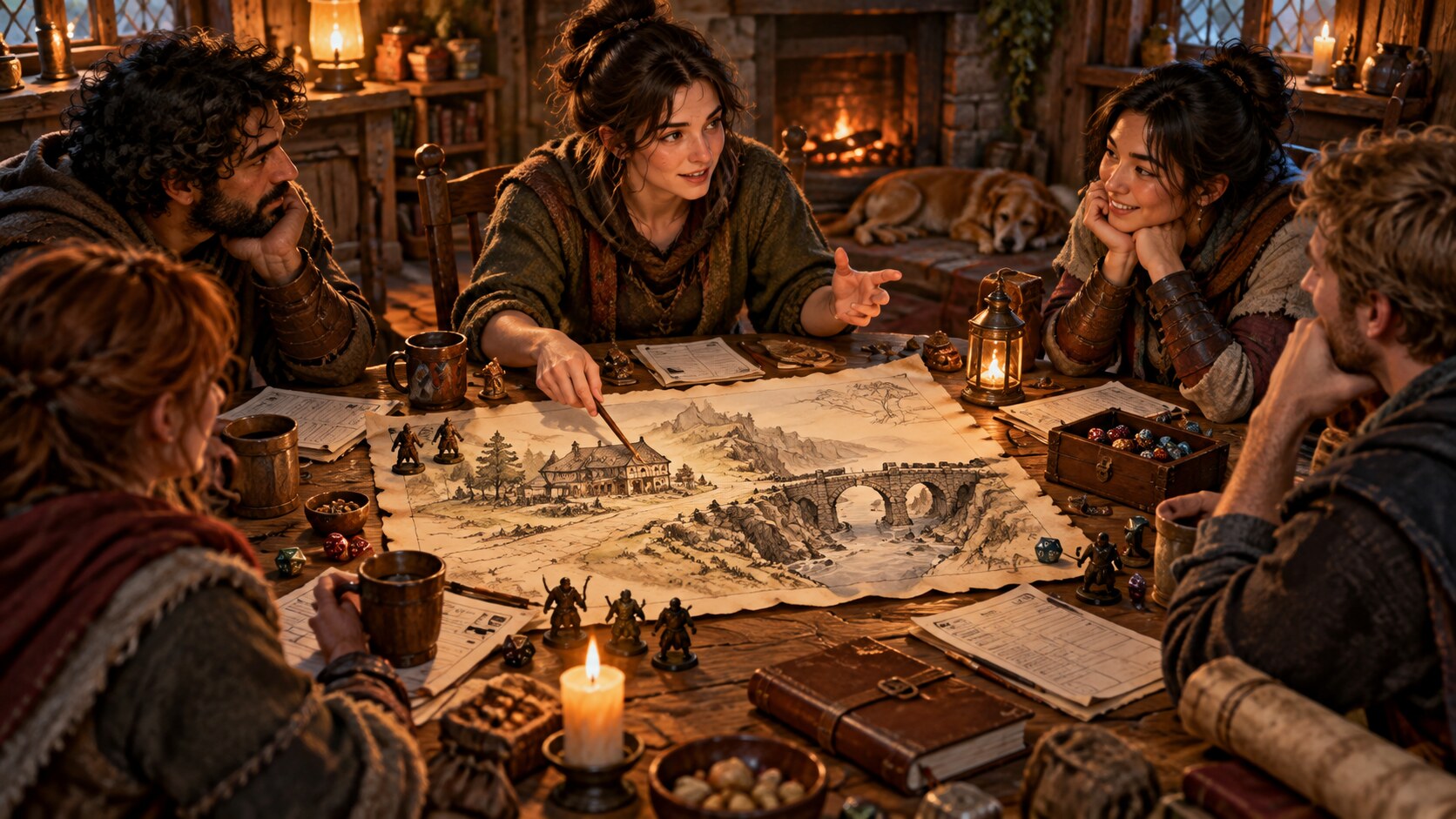
Would you enjoy running a game?
You have played a few sessions, like the game, and are wondering whether you would enjoy running it. Deciding whether to try is separate from learning how to run a first session, pick a system, or write an adventure.
Notice what makes you curious: sketching a place, adapting a published adventure, or wondering how different players would tackle the same problem. Original preparation is one possible attraction, not a requirement for enjoying DMing. The group can share scheduling, hosting, and note-taking, so running does not make you responsible for every practical job. If it sounds like homework, playing may already give you what you want from D&D.
Why people love DMing
Dungeon Masters often point to the same handful of satisfactions:
- Creative freedom with constraints You design places, people, and problems, then watch players approach them in ways you did not expect. The enjoyment comes from seeing your material tested and reshaped at the table, not from delivering a fixed story.
- Shared storytelling you facilitate The best moments at a D&D table are often things the players did that you enabled: a clever plan, a risky decision, a character choice that changed the group's direction. DMing lets you set up the conditions for those moments and react when they happen.
- Building NPCs and locations players remember A shopkeeper with a clear want, a rival with a convincing reason to push back, a small town with two competing needs. These pieces are quick to sketch and they give every session something concrete to play with.
- Learning the game from the other side Running rulings, pacing, and attention at the table teaches you how D&D works in practice. Many DMs say they became better players because they understood what the referee was juggling.
- A different kind of social contribution Some people enjoy bringing everyone together and keeping play moving. You help make the table considerate and give everyone room to contribute.
What can be difficult
The same role brings pressures that are easy to underestimate before you try it:
- Preparation takes time and judgement You decide what to prepare and what to leave flexible. Early on, it can be hard to judge how much your group needs, and learning that takes practice.
- Session logistics take time Agreeing expectations and keeping momentum between sessions takes coordination. The group needs a date, a venue or call link, and a clear start and end time, and gaps can make it harder to resume.
- You make rulings in the moment Players will ask for things the rules do not spell out. You choose a consistent approach, explain it briefly, and keep play moving. You can revisit a ruling after the session, but at the table a calm decision matters more than a perfect citation.
- You balance attention Every session requires sharing the spotlight so that quiet players get turns and confident players do not dominate. It is a live facilitation task, not a preparation task, and it can be tiring when energy is uneven.
- Expectation management and burnout Players may expect voices, elaborate maps, or long arcs because they have seen them elsewhere. Sustaining that every week is not required and can lead to fatigue if you try. A modest, playable standard that you can maintain is more enjoyable than an impressive one you cannot.
Player and Dungeon Master side by side
| Aspect | As a player | As a Dungeon Master |
|---|---|---|
| Creative control | You create and develop one character and their choices within the situation | You create the situation itself and the people who want things inside it |
| Preparation | Learn your character, note your key abilities, turn up ready to play | Prepare a playable situation, a few NPCs with wants, and a clear objective for the session |
| Responsibility at the table | Focus on your turn, support the group, respond to what is described | Set up choices, make rulings, keep pace, and share attention across the group |
| Improvisation | Improvise what your character does next | Improvise how the world responds when every player does something you did not plan |
| Kind of fun | Immersion in a character, tactical decisions, and moments of personal risk and success | Designing problems and reacting to how others solve them, often with surprise on both sides |
| Social weight | You contribute to the evening and help others shine | You bring the game material and hold its structure |
Can you try DMing while staying in your current campaign?
You can stay a player in your existing group and run a separate one-shot or short adventure for some or all of the same players, or for other friends. A separate evening or spare slot keeps the games distinct.
If you want to offer your current Dungeon Master a break, frame it as an extra, not a replacement. Say that you enjoy playing and would like to try one short session. Ask whether they would like a week off, whether they would enjoy playing for once, and whether the group is interested. Do not imply that the campaign needs fixing or that you expect to take it over. If they would rather keep running, accept that and arrange your trial separately.
Agree the date, length, and plan with the group rather than assuming everyone wants to switch. You can learn whether you enjoy the role while keeping the existing game intact.
Critical Role, Tal'Dorei, and expectations
Critical Role can inspire attentive facilitation, character voices, and setting detail, but its professional production is not a home-table expectation. At home, you describe a room, listen to players with different ideas, and make rulings so play can continue. You do not need acting skill or a memorised canon.
The Tal'Dorei setting, like other published worlds, gives you names, geography, and conflicts to draw on. Use a town, a faction with a pressing problem, or a wilderness area with a clear objective; you need not recreate the whole world or run it as someone else does.
Example
Worked example: the same one-shot idea, two preparation approaches
A new DM who enjoys designing situations decides to test the role with a one-shot for three friends. The premise is simple: a roadside inn cut off by a washed-out bridge, with supplies running low and two groups who disagree about what to do next.
- The fixed-sequence approach
- The DM sketches the inn, gives its keeper a reason to need the bridge repaired, and prepares clues to the damage, a storehouse with rope, and a guard who objects to a risky crossing. They expect the party to discover the damage, fetch the rope, then persuade the guard. Instead, the players ask a local to guide them along the riverbank. The prepared clues no longer fit the order of events, and the DM is unsure what the party can learn or whether the route is safe.
- The focused situation approach
- The DM sketches the inn and river crossing, then notes a few NPCs with competing aims: an innkeeper who wants the road open but will not risk guests, a caravan master willing to pay for help, and a guard worried about the crossing. The objective is to get help or supplies across. A stranded traveller may know another route, while continued rain may raise the river and increase the cost of delay. These developments follow from the situation but are not required scenes. Pre-made level 1 or 2 characters can help the DM estimate the party's capabilities. If the players have an immovable rod, they can use it as a fixed rope anchor; otherwise, they might find a suitable anchor. The DM hears their plan, describes what they find along the bank, and calls for a roll only if a specific part of the attempt is uncertain.
- Why it works
- The second version prepares people with aims and a visible cost to delay, so the DM can respond to the route the players choose. First-session nerves and unfamiliar rules can still be tiring. If you remain curious, try a published adventure or ask for more help; if you prefer playing, there is no obligation to continue.
Your low-stakes experiment
A one-shot lets you try the role while keeping your campaign intact:
- Pick a straightforward situation with a clear objective, such as reaching a place, rescuing someone, or resolving a local dispute. Use a published micro-adventure or a single location of your own with two or three scenes.
- Offer pre-made characters or ask players to bring level 1 or 2 characters built under the same rules. Share them ahead of time so players can choose quickly and you know what the party can actually do.
- Prepare a short note if useful: a location sketch, a few optional NPCs with a want and something useful they know, and possible developments tied to the situation, such as continued rain raising the river. Treat these as prompts, not scenes to force in.
- Book a short session with a defined end point, roughly two and a half to three hours. Agree that it is a standalone trial, with no obligation to continue, even if it goes well.
- Run the game, make steady rulings, and note what you enjoyed and what tired you. Afterwards ask players what they found clear and what they wanted more of. That feedback is a better guide to your next prep than any self-assessment in isolation.
Where this points next
If you want to run again, learn how to start GMing with a first-session plan and frame a D&D campaign as a playable opening situation. The links below cover both.
If you prefer playing, tell your current DM what you appreciated about the trial and what you are excited to bring back to your character.
Was this useful?
Keeping a small experiment useful
A one-shot produces only a few notes that matter: the NPCs the players actually engaged with, the places they cared about, and the threads they left open. Codex Cryptica is built for that scale. Sketch a settlement, note a faction want, and link an NPC to the place they inhabit, then keep only what the table made real. Small graphs stay readable and grow cleanly if you decide to run again.
Explore generators and the campaign workspaceRelated
Topic Hubs
Tools
- NPC generator Quick wants and hesitations for the few NPCs your test session actually needs.
- Settlement generator A small place with competing needs to anchor a one-shot situation.
- Quest generator Turn a simple objective into a hook with a patron, a cost, and a complication.
Guides
- Dungeons & Dragons Keep D&D NPCs, places, and quests linked between sessions when your one-shot grows into more.
- Fantasy worldbuilding Use a small settlement and its competing needs to anchor your test session.
Other answers
- How do I start GMing for the first time?
- How do I start a D&D campaign?
- How much prep do you need for an RPG session?
- How do I prepare a D&D session?
- How do I run a successful Session 0?
- Can you play a tabletop RPG in 30-minute sessions?
- How do I pace an RPG one-shot?
- What should a new D&D player know before their first game?