Framework
Where do worldbuilding ideas come from, and how do I find inspiration?
Worldbuilding ideas usually come from noticing something ordinary and changing it: a job, a landscape, a custom, a historical event or a scene from a story, followed by the question of what would happen if one part worked differently. People think of all this in the first place by borrowing a spark from observation, history, geography, science, mythology or media, combining it with something unrelated, then following the consequences for settlements, trade, politics, belief and one affected person until the result stops resembling its source.
Where the sparks come from
Very few settings begin with an author inventing a continent from nothing. They begin with material that already exists: a harbour that empties at low tide, shepherds who move flocks between winter and summer pasture, a licensing queue at a town hall, an old law nobody has repealed. The creative step is noticing that material and asking what follows if you change one part of it.
Reading, watching and playing more widely can add to that stock, and a varied diet of stories, documentaries, maps and non-fiction gives you more to combine. It helps only when you pay attention to how a place or society works, though. Hours of passive watching can leave nothing behind because you never stopped to note the detail that interested you or to ask why it worked. You do not need to consume a set amount of media before you are allowed to start. A single remembered journey, local custom or news report, examined closely, can supply a first setting.
Keep two jobs separate in your mind. Generating an idea means finding a promising spark. Developing it means following consequences until the spark implies places, institutions and people. Most beginners who feel blocked are attempting both at once, and judging a rough spark by whether it already looks like a finished world.
Borrow the spark, then change enough that it becomes yours
Taking inspiration means borrowing a starting point and building different consequences from it. You might take the tidal rhythm of a real harbour and invent a market that opens only when the mud is firm, with porters who memorise safe paths and merchants who time contracts by the tide. Copying means lifting the recognisable arrangement of someone else's place, culture or plot and renaming the parts. The practical test is whether your version makes different choices. Change the environment, the problem people face and the way they organise around it, and the result will move away from its source as you develop it.
Take extra care with living cultures. A garment, ritual, food or naming pattern carries meaning for the people who practise it, and lifting surface details for exotic colour can produce a setting that reads as careless to readers who recognise the source. Research how the practice fits the life around it, borrow at the level of underlying pressures (climate, scarcity, kinship, belief) rather than sacred or identifying details, and consider asking a knowledgeable reader to check your draft. The same care applies to recent tragedies and to sacred material: some sparks should change more, or be left alone.
Four ways to turn a spark into a setting idea
Use any one of these on a noted spark. Each produces a different kind of starting point, so pick the one that matches what you already have:
- Ask a specific what if Change one rule and state it plainly enough to test: mountains migrate a few fields each winter, or practising magic without a licence is a criminal offence. A narrow change gives you consequences to trace. A broad question such as what if everything were magical needs narrowing before its consequences are easy to trace; decide which part of daily life changes first.
- Follow the consequences Take your changed rule and ask what it does to where people settle, what they trade, who holds power, what they believe and how an ordinary day runs. Then ask what those answers change in turn. If mountains move, fields need fresh boundary stones each spring, which makes surveyors powerful, which makes a falsified boundary a serious crime. Second and third consequences are where a borrowed spark becomes distinctive, because your sources rarely traced the same chain.
- Start from a person or a tension Give one person a desire and something standing in the way, then ask what the world must contain for that conflict to exist. A ferryman who wants to retire but is the only person licensed to cross a haunted river implies a licensing body, a reason nobody else will take the licence, and whoever profits from the crossing staying rare. Institutions, histories and customs appear because the person's problem needs them.
- Combine unlikely ingredients Put two or three unrelated starting points together and look for the connection. Seasonal livestock migration plus a river delta that shifts its channels each flood gives you herders who navigate by water as well as pasture, and markets that move to wherever the banks settled this year. The friction between ingredients that do not obviously belong together often supplies the tension a setting needs.
Example
Worked example: the river that will not stay put
One idea carried from a noted spark to a place with politics and a character, using the steps above.
- The sparks
- Two unrelated observations: herders who move livestock between low winter pasture and high summer pasture as the seasons turn, and a river delta where spring floods cut fresh channels and silt up old ones, so last year's navigable route is this year's mudflat.
- The what if
- What if the river always shifts enough each flood season that no channel, ford or fertile bank can be relied on two years running?
- Place and daily life
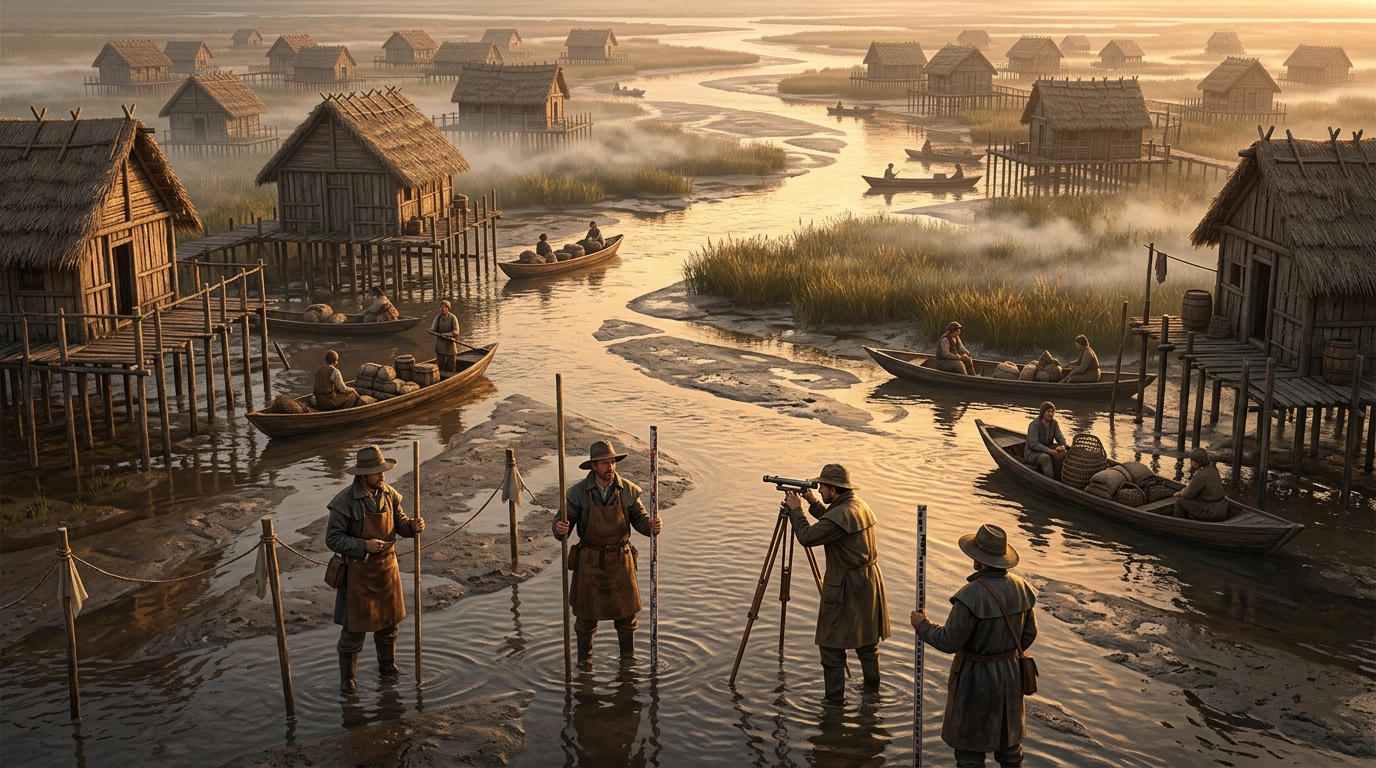
- Towns cannot anchor to a bank, so families live in houses on tall stilts or on lashed rafts that ground on the mud when the water falls. Children learn channels the way other children learn streets, and they relearn them every spring. Grain travels by flat boat because carts have no reliable crossings, and a good landing place is rented by the season rather than owned outright.
- Politics and belief
- Power sits with the surveyors who walk the delta after each flood, certify which channels are navigable and mark where new banks have formed. Their maps determine which claims the authorities recognise and where families may moor or plant; a bribed or careless surveyor can leave a village without access to its fields. Some delta families leave an offering at the first new channel each year, partly in thanks and partly in the hope that the river will be gentle near their moorings. A dispute over a falsified survey gives you a conflict that needs no villain from outside the setting.
- The person
- Toma, an apprentice surveyor in her second season, wants her full licence before her family's current mooring permit expires. Checking an old reach, she finds water naturally returning to a channel abandoned a generation ago, where her grandmother's village stood before it was evacuated. Her family still holds an inherited claim to moor there; recording the channel as navigable would make that claim official again. The returning water may flood newer fields another family has planted on the silt, and her examiner, whose survey approved those fields, wants Toma to mark the reach unsafe so the claim stays off the map. Her choice forces the setting's questions about land, memory and who the survey serves into one decision she has to make this week.
- What was deliberately left undecided
- The wider kingdom, the river's source, the full calendar of festivals and any magic system. The example needed a geography, a livelihood, an institution and one person's problem. The rest can wait until a story or scenario actually reaches it.
Capture sparks, then test one before building more
Keep a notebook or a single note on your phone for sparks: a phrase, a photograph of an odd building, a job you had never thought about, a historical detail. Write down why it caught your attention, because the reason is usually the part you will develop. Review the notebook when you need a starting point and combine entries that were recorded months apart.
Then test the most interesting consequence rather than designing the whole world. Write a short scene in which someone pays the falsified survey fee, sketch the delta showing this year's channels against last year's, or describe the argument at the mooring office in a few paragraphs. A scene or sketch shows you quickly whether the idea produces decisions and friction. If it does, you have somewhere to keep building. If it stays inert, return to the notebook and test a different consequence of the same spark before discarding it.
Generators and prompt lists can supply a spark when your notebook is empty, and a random settlement or name can be a useful starting point. Treat the output as raw material for the steps above: change a rule, follow consequences, attach a person. The choices you make in that work are where the setting becomes yours, so keep hold of them.
An exercise for a first idea
Work through each step at your own pace, keeping each to a sentence or two. Rough answers are the point:
- Pick one spark from your notebook, your surroundings or a story you remember: a place, a job, a custom or an event.
- Change one thing about it and write the change as a single plain sentence.
- Write three consequences: one for where people live or work, one for who holds power or money, and one for an ordinary day.
- Name one person affected by those consequences, what they want, and what stands in their way.
- Stop and read it back. If the person's problem interests you, write a short scene, sketch a small map or describe the central conflict. If it does not, keep the page and try a different consequence tomorrow.
Where to go next with a developed idea
An idea you have tested this way is ready for the ordinary work of building a setting. Writers can shape it around a viewpoint character and an opening scene; the fiction-writing guide takes that next step. If the idea is for a game or interactive setting, a small local area with people who want conflicting things will carry early play. Cultures, geography and politics each reward a closer look once your consequences raise questions about them, and the linked answers below cover those in depth.
Was this useful?
Related
Other answers
- How do you start worldbuilding from scratch?
- How do I start worldbuilding for a novel or short story?
- How do I make different cultures feel distinct without relying on stereotypes?
- How do I design a geographically realistic town or village?
- How do you create a fantasy faction?
- How do you create a fantasy city that feels alive?