Supers games put pressure on different parts of a campaign. A villain's plan has to survive the evening news. A rescue can matter more than winning the fight. A masked hero may save the city and still lose something important when their civilian life is exposed.
That is the reason for the new Superhero / Comic Book theme. It is not a fantasy campaign with capes pasted on afterwards. It gives a supers campaign its own visual language, starting point, and generator material, while leaving the rules system and the details of the world in your hands.
Start with a city that already has pressure
Choose Superhero / Comic Book when starting a campaign and the quick-start constellation begins with the pieces a supers game needs to move:
- A city such as Halcyon City or the Meridian Ward.
- A headquarters where the team has history, resources, and vulnerabilities.
- A team with its own public role and internal obligations.
- A villain whose scheme creates a problem before the first punch is thrown.
The starter material deliberately points toward secret identities, public trust, and impossible choices. It is a useful first board for a street-level campaign, a bright four-colour series, or a larger city-based team game. Replace any part of it, of course. Its job is to give you something worth changing rather than an empty vault.
Two comic-book looks, one campaign
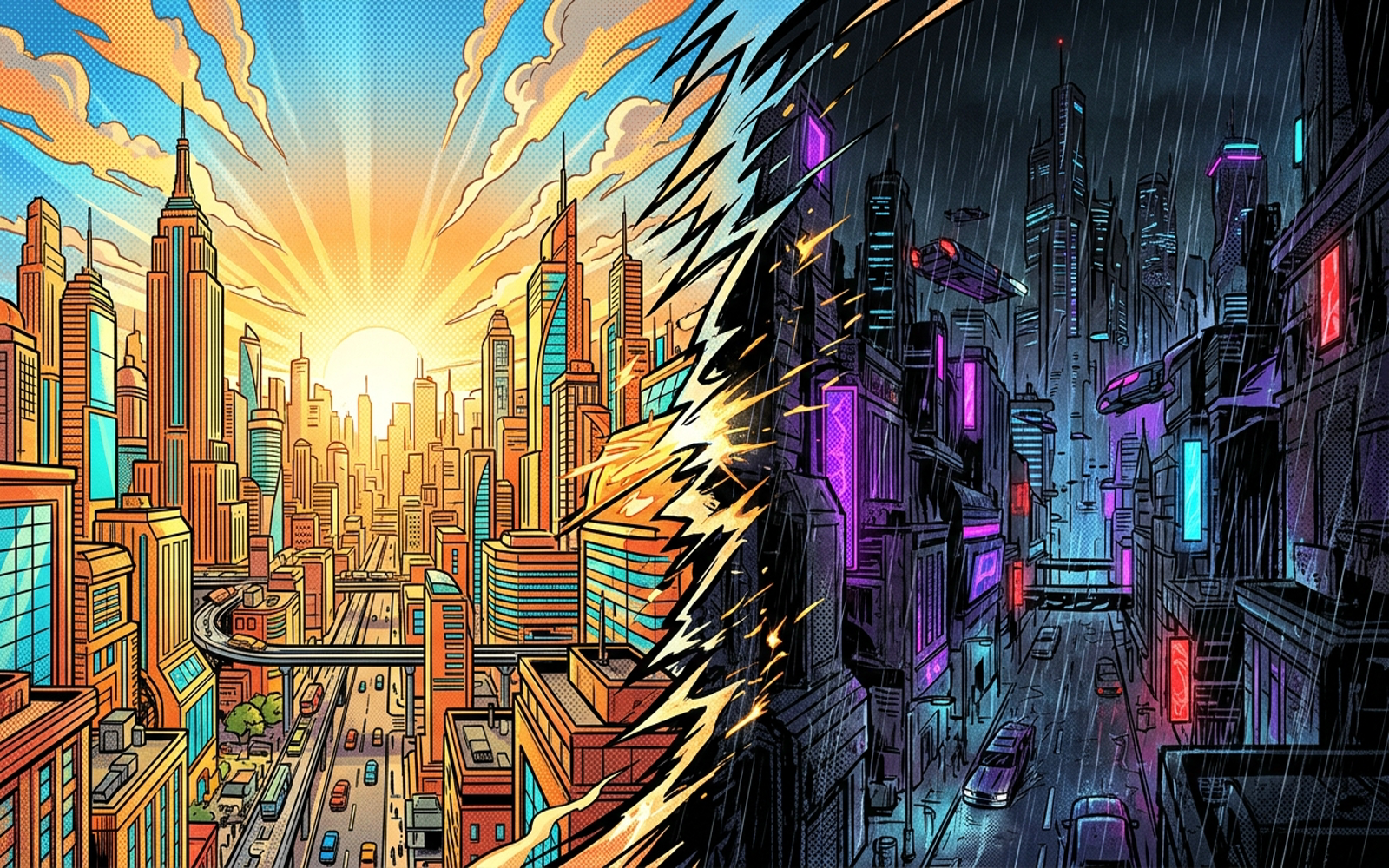
The light skin, Four-Color Dawn, uses bright paper, inked borders, primary colours, and burst-yellow accents. Its dark counterpart, Midnight Patrol, keeps the same comic-book language but shifts the city into black, crimson, blue, and signal gold.
They are a presentation choice, not separate settings. Switching between them changes the interface, graph styling, and the terms used around the vault, while your dossiers and connections stay the same. A Case File is still a Case File after sunset.
Generators that know what kind of trouble heroes face
Genre support matters most when a generator has to decide what a problem is about. The Superhero / Comic Book tables are built around exposure, responsibility, institutions, and escalation, rather than defaulting to curses, ruins, or a throne waiting to be claimed.
Adventures and villains
The Adventure Generator can begin with a staged public incident, a rookie hero's failure caught on camera, a former villain trying to go straight, or a city vote on hero oversight. Its complications include choices like saving everyone while the real target escapes, or watching a secret identity nearly slip in front of the wrong witness.
That gives you a starting situation with a cost, not merely a fight with a stronger opponent. A villain can have a legitimate grievance. The city can be split about the outcome. A win can leave a relationship or a public reputation damaged.
The villain and secret-society generators also accept the genre, so the same campaign can build outward from a central threat instead of treating the villain as a disconnected character sheet.
Bases, black sites, and the places beneath the city
The Dungeon Generator has a dedicated superhero table for places such as a villain command centre, a black-budget research facility, a metahuman prison, a decommissioned hero headquarters, or a containment site nobody admits exists.
Those locations come with the sort of evidence and hazards that make a supers investigation playable: a wiped access log, a power-suppression array, a trophy vault, a defence system that no longer knows who the enemy is, or survivors who do not agree on what should happen next.
Teams, agencies, and rogues' galleries
For factions, the available types include a Hero Team, Vigilante Cell, Rogues' Gallery, civic agency, corporate patron, and media network. Their motives lean into registration, public opinion, stolen origin samples, and the institutional machinery around extraordinary people.
That is useful even when the players are not heroes. A campaign about reporters, support staff, villains on probation, or civilians caught in the fallout still needs organisations with a point of view about powers in public life.
The Quest Generator can be used with the theme too. For now it draws on the existing Political Intrigue vocabulary rather than a dedicated superhero quest table, which is a sensible fit for oversight fights, cover-ups, and competing public agendas, but not the final word on supers mission design.
Templates are where the campaign becomes yours
The theme supplies genre-aware prompts and a visual home. It does not prescribe a power system, a setting canon, or a particular comic universe. That part belongs in your templates.
When you make an entity, the existing default Markdown outline gives you a quick place to start, and you can replace it with your own local template. A supers campaign might give every character sections for civilian identity, powers and limits, public reputation, obligations, and the people who know too much. A location template might track collateral damage, emergency access, and media presence. These remain ordinary Markdown in your vault, so you can make them as loose or structured as the table needs.
For details that benefit from fields rather than prose, use a reusable Stat Sheet Template. Define the structure once, then apply it to a hero team, a villain, or every powered NPC without copying the same layout by hand. One group might track stress, conditions, influence, and team resources; another can keep it light with a few text fields and a dice expression. The template stores the shape, while each entity keeps its own values.
There is not a built-in superhero Stat Sheet or superhero-specific default Markdown outline yet. That is intentional scope rather than a disguised rules engine: the theme is ready to support the framework your table already uses, without pretending it can decide what a power, condition, or consequence means in that framework.
A campaign can be bright without being simple
The first pass stays close to four-colour heroics and street-level pressure. It has room for cosmic threats, but the useful core is still a city, a public, and people who have to live with what happened after the fight.
Pick the Superhero / Comic Book theme from the campaign setup, then open the Adventure Generator, Dungeon Generator, or Faction Generator when you need the next problem. Start with the piece that sounds fun to run, connect it to the city, and let the campaign decide where the tone goes next.