Framework
How do I make roleplay more engaging in a tabletop RPG?
Make social scenes engaging by giving them more to decide, not more time to fill. Replace the single Persuasion check that settles a conversation with a situation built around a meaningful question: what might change because the party had this conversation at all. Give important NPCs a want, a reason to hesitate, something useful they know, and a boundary they will not cross, then let the players choose how to engage with those pressures and let the dice support the fiction when the outcome is genuinely uncertain.
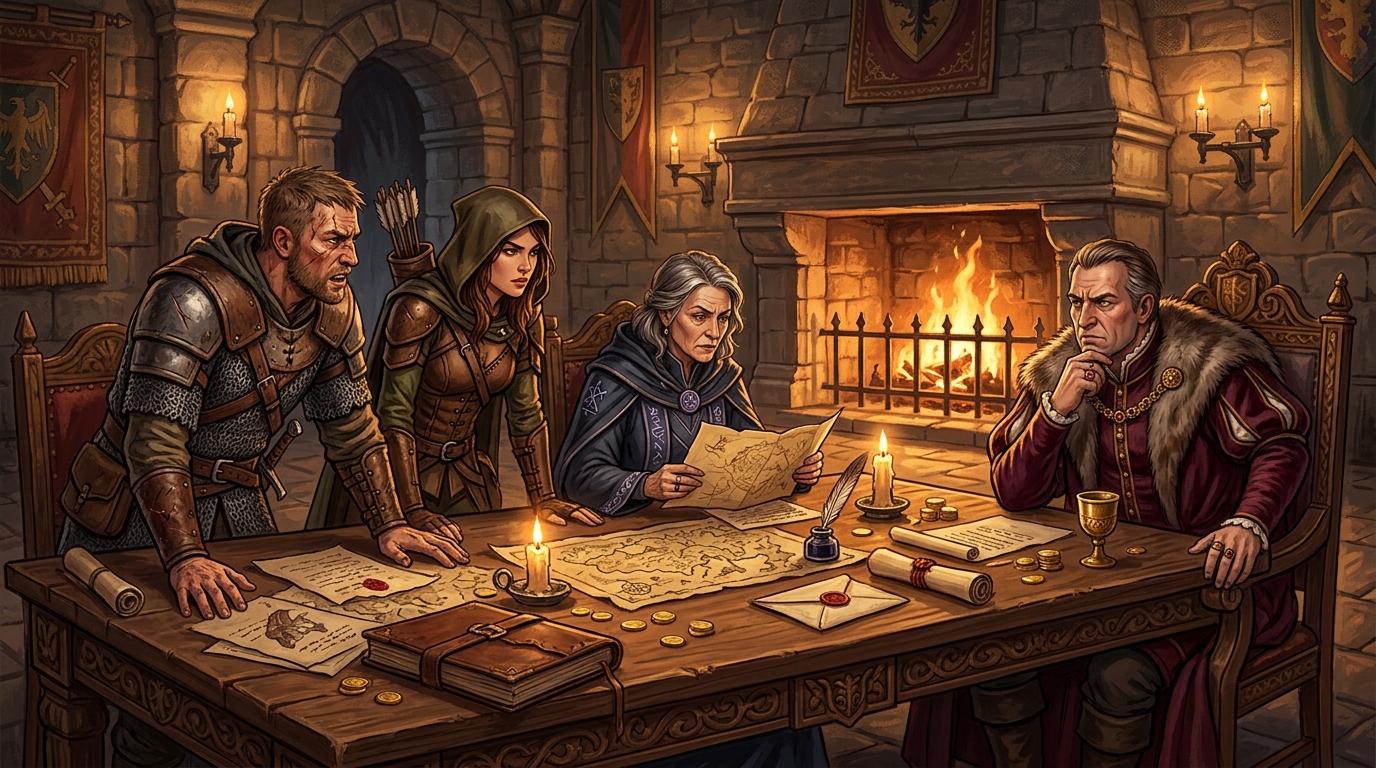
Short is not the same as flat
A social scene that resolves in five minutes is not automatically a failure. If the conversation changed who trusts the party, what it costs to proceed, or which future path is now open or closed, five minutes was enough. What feels flat is a scene where nothing could change except a yes or no, so the check is made and the table has nothing left to do with the result.
Before changing your whole campaign, check what "roleplay heavy" means at your table and whether the players want it. Some groups love extended in-character dialogue, others prefer crisp third person narration, and most have a mix. A player who says "my knight offers safe passage for the refugees and asks what the steward needs in return" is roleplaying. If you measure roleplay by minutes spent performing, you will miss the engagement that is already there and push a format enthusiasm alone cannot sustain.
The useful question is not how to make every conversation longer. It is how to make the next important conversation contain a choice the table will remember after the session.
Prepare situations, not scripts
You cannot script a good social encounter, because the players will not follow your lines. You can prepare a situation that holds up however they approach it.
For an NPC who matters to the current story, note four things before play. Write them on an index card or in a single note so they are usable in the moment.
A four-line NPC situation note
Keep these legible at the table. They are what you return to when the players do something you did not expect:
- Wants What this NPC wants from the PCs or from the current situation, in concrete terms. "Leave the north road open through winter" is playable; "wants respect" is not.
- Resists Why saying yes is not free. A recent loss, a debt, a rival claimant, a household that will suffer if they agree too easily. Not every NPC needs one, and a friendly NPC can simply be asked for more than they can give. Resistance is not stonewalling; it is the competing pressure that makes the conversation matter.
- Knows and can trade Useful information, access, or leverage the NPC holds, and what they might offer or withhold. A patrol schedule, an introduction, a sealed letter, the real reason the toll went up. Make this visible early enough that players can make an informed choice about it.
- Will not cross One clear boundary the NPC will hold even under pressure, and what it would cost them to break it. A steward might hazard displeasure from the lord but will not gamble the winter grain. Boundaries make concessions and consequences legible.
You do not need this for every shopkeeper. Use it for the handful of NPCs whose decisions affect the party's goals.
Give the scene a question that matters
A scene becomes engaging when the outcome changes something the players care about. Frame the encounter around a genuine question, not a single obstacle to pass:
- What might change Resources, relationships, reputation, access, or future obligations. If the only change is permission granted or denied, consider whether the negotiation is the point or merely the tollbooth before it.
- Competing goals Both sides want something, and giving one side what it wants costs the other. A concession on timing might protect a harvest; a cheaper toll now might mean a favour called in later. Let the trade-off be visible before the party is asked to choose.
- Terms, not just success The question is rarely whether help is possible but on what terms. A yes with conditions can be more interesting than a hard no, and a no that leaves a clear alternative route is more engaging than a silent wall.
- Revelation with consequence Information the NPC can share should change what the party does next: a safer route, a rival's true motive, a deadline they had not understood. A new fact without a new decision is exposition, not engagement.
Let mechanics support the fiction
Dice and fiction should work together. Use rolls when the outcome is both uncertain and consequential, and let the result change the terms available rather than skipping the conversation entirely:
- Roll when it matters If failure would change what happens next, or success would earn something specific, a check is worth making. If the outcome is clear or the cost of failure is negligible, resolve the exchange through description and agreed terms.
- A success changes the offer In many games a strong Persuasion, Deception, or Insight result might reduce a cost, extend a deadline, reveal a useful constraint, win a concession, or establish advantage for a follow-up action. It does not need to remove all interaction or override an NPC's core boundary, and in a different system the same principle applies under that system's social rules.
- Do not make players audition for a roll Do not require an improvised speech to earn permission to attempt a check, and do not treat a player's social confidence as equivalent to their character's capability. Let the player state intent and approach in whatever register they prefer, whether first person dialogue, third person summary, or a mix, then resolve it by the fiction and the game's procedure.
- Respect the game's social rules Follow the social procedures of the system you are running for when checks apply and what they can achieve. The guidance here is about scene design, not a new subsystem. A house rule that turns every conversation into mandatory multi-stage social combat adds rolls without adding choices.
Make the whole party relevant without requiring everyone to speak
A common worry when moving to roleplay heavy sessions is that one face character will do all the talking while everyone else waits. The fix is to distribute ways to change the negotiation, not to distribute lines of dialogue:
- Different leverage A veteran's reputation, a cleric's oath, a scout's report on the road, a scholar's reading of a contract, or a local tie to the household can each alter what the NPC believes is at stake or what guarantee the party can credibly offer.
- Principles and relationships A character's bond, vow, or rivalry can make a particular concession feel more or less costly. When a paladin refuses to pledge hostages or a ranger recognises the steward's village, the party faces an internal trade-off before it faces the NPC.
- Information already earned Evidence found earlier, a prior debt repaid, or a faction's current stance can be brought into the room to change the terms. Let discoveries from previous sessions do work in the conversation, so quieter exploration pays off here.
- Shared promises Keep the question of what the party will actually offer, risk, or guarantee with the group. The face may present the offer well, but the commitment belongs to everyone who will be bound by it.
Vary texture and know when to cut
Not every conversation deserves the same weight. Engaging roleplay is a matter of variety and judgement, not uniform length:
- Mix brief and spotlight exchanges A quick request at a gatehouse can resolve with a single check or none at all; a negotiation that will shape the next sessions deserves more time. Let the importance of the question set the scene length.
- Use reactions and consequences Show the NPC listening and being moved or unsettled: an offer repeated back with a new condition, a letter produced from a drawer, a glance toward the hall where a rival waits. Consequences the players can see or hear become the next reason to act.
- Cut when there are no more meaningful decisions When the party has made its choice and the terms are clear, summarise agreement and move on. Fast-forwarding once the decision is made respects the choice; dragging the scene out after it can undo it.
- Avoid defaulting to social combat A structured multi-stage procedure can help a complex negotiation, but applying it mechanically to every conversation turns small requests into slogs. Reserve heavier structure for scenes where competing goals genuinely need it.
Talk with the players before changing the campaign
If you have run dungeon focused campaigns for years, do not turn the whole next arc into sustained dialogue and hope the table follows. Name the shift you would like to try and ask what kind of roleplay appeals to them: extended in-character scenes, shorter third person negotiations, or a blend where only important conversations get full focus.
Start with one focused scene that contains a real choice, then check what landed. Did the players enjoy weighing the trade-off, or were they waiting for a check to settle it. Their answer tells you more about how to pace your campaign than any procedure for calibrating scene length.
Example
Worked example: asking a noble for passage
The same premise shows why adding decisions rather than minutes makes the conversation come alive. The party needs passage through Lord Halden's valley before winter closes the road. The table includes a charismatic bard and players who prefer brief, third person contributions.
- Before: one roll, no choice
- The party enters the hall. The GM asks for a Persuasion check. The bard rolls well, the lord grants passage, and the scene ends in four minutes. On a low roll, the lord refuses and the table must decide out of character whether to find a different route with no new information. The roll decided the outcome, but no decision inside the fiction changed the party's resources, relationships, or understanding of the valley.
- After: a situation with terms to weigh
- Lord Halden wants to help. He needs the road open for his own grain wagons, knows the mountain pass is already watched by a rival house, and can offer sealed letters of passage and two guides. He resists because letting an armed party through without surety will draw that rival's attention to his household. His boundary: he will not risk the winter grain. The steward lays this out plainly and Halden listens while the party considers. The party can offer collateral such as leaving horses or a hostage, bring evidence that the rival already knows they are moving, seek a concurrent favour from the river guild to offset Halden's risk, accept passage on condition they carry grain south, or walk away and take the exposed pass.
- How rolls support the fiction
- The table states intent before dice touch the table. If the bard presents the grain-carrying offer warmly, a strong Persuasion result might reduce the collateral or add the guides for no extra cost. If a scout lays out what they saw on the pass, that evidence can change the steward's understanding regardless of Charisma. If a cleric offers sanctuary as surety, the nature of the guarantee matters more than the wording. A weak result does not produce stonewalling: the steward holds firm on the grain but might offer one guide tomorrow if the party accepts a cost elsewhere. The outcome of any check adjusts terms, reveals a constraint, or establishes advantage for what follows; it does not pre-decide whether the negotiation is interesting.
- A short outcome is still good
- If the party quickly agrees to carry grain in exchange for letters and guides, the scene can end in six minutes and still be excellent. They have made a consequential choice about resources and obligations that will matter on the road. Equally, the negotiation can develop over a longer exchange if the table wants to press for better terms, reveal more of the rival's position, or bring another faction into the arrangement. Duration follows the number of meaningful decisions, not a target runtime.
- Why it works
- No additional dialogue was padded in. The conversation became engaging because three pressures were visible: Halden's desire to help, his political risk, and his hard limit around the grain. Players could act through different kinds of leverage, and any roll changed specific terms rather than bypassing the question of what the party was willing to risk. The noble remains consistent whether the party is persuasive, blunt, or quietly practical, and the steward's reactions and the later consequence on the road make the choice feel consequential.
Social scene prep checklist
For each NPC who will face a consequential conversation, check you have:
- What this NPC wants from the scene, stated as a concrete outcome.
- What it would cost them to say yes, with a named competing pressure or risk, if the scene needs one.
- Something useful they know, control, or can trade that the party can discover early enough to use.
- A clear boundary they will hold, and what it would cost them to break it.
- What will actually change if the conversation goes differently: resources, relationships, access, obligations, or future consequences on the road or in town.
- At least one way a non-face PC can change the terms through evidence, reputation, a guarantee, or a prior connection.
- A plan for when to cut: the decision point after which you will summarise agreement and move on.
Was this useful?
Keep social agreements where you can find them
The prep above creates promises and pressures that need to be remembered when the party reaches the next town, not just in the audience chamber. Recording an NPC's want, their boundary, and what the party pledged alongside the location and faction it affects turns a social scene into durable campaign state rather than a note you will hunt for next session.
A connected vault where NPCs, households, and factions link to those obligations makes it easier to bring consequences back on the road. Whether you draft a situation note before play or capture it after, having the who, the promise, and the deadline in one place is what lets a short, decisive conversation carry weight later.
Explore the RPG knowledge graphRelated
Tools
- NPC generator Create an NPC with a concrete want, mannerism, and hook you can place straight into a social situation.
- Faction generator Build the household or rival whose competing needs set the price of passage and support.
Guides
Other answers
- How do I get players to engage with my campaign world?
- How do I run a bard or face without sidelining the party?
- How do I make interviewing NPCs interesting in an investigation?
- How do I make a diplomat, noble or courtier useful in an RPG without relying on one social roll?
- How do you run a scene with multiple NPCs without talking to yourself?
- How do you make NPCs memorable without lots of prep?
- How do I give specialist characters spotlight without sidelining the party?
- How do you organise NPC relationships?