How to
How do you create a fictional language for an RPG?
Create a fictional language for an RPG by choosing a small set of sounds, repeatable naming patterns, three simple structural rules and a dozen words the party will encounter. Write a pronunciation key, build names from recurring roots, and tie greetings or titles to local customs. Test it on a sign, an NPC introduction and a place name before expanding the vocabulary.
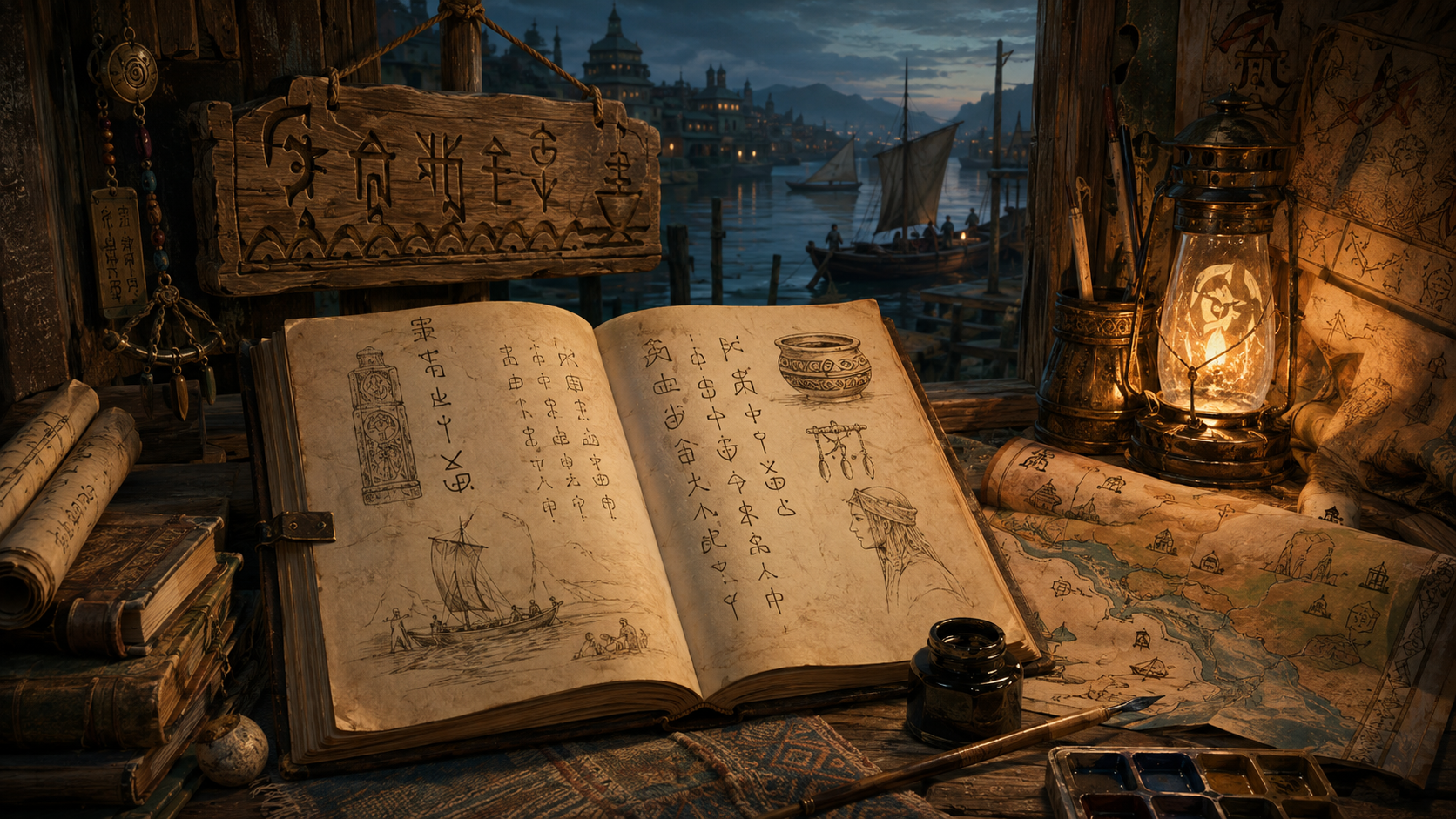
Decide what the language needs to do in play
Write down its next three appearances: a harbour sign, a ferryman introducing herself and a ruined watchtower on the map. Those uses give you a manageable vocabulary. Leave words for subjects the party will never discuss until you need them.
A full constructed language, or conlang, can support original conversation and translation through a much broader vocabulary and grammar. That is a separate creative project. For an RPG, a consistent naming system and a few phrases can do the job. Keep ordinary dialogue in your table's shared language and describe which fictional language the characters are speaking.
If a character knows the language, give their player the meaning. Do not require players to memorise vocabulary to use a character ability. An inscription can still contain a mystery about who wrote it or why it matters after its words have been translated.
Build a one-page language kit
- Sound and pronunciation Choose sounds you can repeat comfortably and a syllable pattern. For the invented port language below, use m, n, p, t, k, s, l, r and vowels a, e, i, o, u. Give the vowels the sounds in father, bed, machine, more and rule; these are table cues, so agree a pronunciation together. Use consonant-vowel syllables and stress the first syllable. Mera is MEH-rah. Read six names aloud and simplify any you stumble over.
- Names from recurring roots Keep personal names short, such as Mera and Tali. Give settlements a shared ending: -na means settlement. Sula means river, so Sulana is River Settlement; kela means stone, so Kelana is Stone Settlement. Keep the spelling of each root stable. Players can then recognise connections between names.
- Three structural rules For this kit, put describing words after nouns, use separate li before a noun for a plural, and combine roots with the main thing last. Sula kela means stone river; li sula means rivers; sula-na means river-settlement, written Sulana as a place name. These rules cover labels and names. Decide sentence word order only when you need to write a sentence.
- Vocabulary with a use Start with words for the actual scenes you prepared. Include a greeting, a warning and a title alongside place-name roots. Record each word's meaning and pronunciation in one glossary rather than inventing it again in each location note.
- A cultural reason to speak Choose who uses the language, where people learn it and when speakers switch languages. In these ports, boat crews share a trade language across several nations. Visitors address a ferry pilot by their work title before their name. A family may use a different language at home; borders and ancestry need not decide what everyone speaks.
A starter glossary for the river ports
These invented roots follow the same sound rules. The meanings are enough for the harbour scene; they do not define a complete grammar.
- Places and things sula: river; kela: stone; na: settlement; pala: boat; neri: gate; luma: lamp.
- People and obligations tala: ferry pilot; sana: guest; rima: debt.
- Speech at the dock sali: a greeting used when arriving; taku: stop, used as a warning; mali: safe, placed after the thing it describes. Li is the separate plural marker.
Example
Before and after: arriving at Sulana
The party needs a ferry to the stone settlement upstream. One character speaks the port language. Put the glossary beside the map and reuse it across the scene.
- Before
- The map calls the port Xz'qrath, its boats have unrelated invented labels, and the ferryman speaks a fresh string of syllables. The players have nothing they can recognise next time and cannot tell which details matter.
- After
- The map names Sulana and Kelana. A dock sign reads li pala mali, meaning safe boats. The pilot introduces herself as Tala Mera. A shouted taku warns the party away from a damaged gangplank. Tell the fluent character all those meanings immediately, and offer translations through Mera for the others.
- Why it works
- The settlement ending repeats on the map, the title returns whenever someone addresses Mera, and one warning has an immediate physical consequence. Players can recognise useful words without completing a language lesson. On their next journey, a damaged sign with pala still tells them they have found somewhere associated with boats.
Add variation when the campaign gives you a reason
Record one difference between formal and everyday use. Harbour officials insist on Tala Mera; her crew simply say Mera. An inland court might use an older place name on its tax records. Explain that mismatch through a guide or document so it becomes evidence about the setting rather than a spelling mistake the players must guess around.
For science fiction, use the same kit for station names, docking warnings and crew titles. A translator can convey literal words while your description supplies the custom: saying someone's job title first is courteous here. Avoid making a translator arbitrarily fail just to force a vocabulary puzzle.
Sounds do not establish a speaker's morality or intelligence. Give speakers different occupations and opinions, and avoid using an imitation of a real accent as shorthand for an alien or villainous people. Borrow a design idea such as repeated name endings, then write your own examples.
Before bringing the language to the table
- Read six names aloud and write pronunciation cues for the awkward ones.
- Check that every place name follows the chosen root and ending pattern.
- Translate one sign using only your glossary and stated rules.
- Prepare a greeting, warning and title that each appear in a scene.
- Note who speaks the language and how other characters can get a translation.
- Give fluent characters the meaning without testing their players' memory.
- Stop expanding once the next session's names and phrases are covered; add new words to the same glossary during play.
Was this useful?
Keep language notes connected to their speakers
Use the Fictional Language Generator to draft a sound profile, naming patterns and sample vocabulary, then check the result against your own glossary before using it. Keep the agreed rules in a worldbuilding entity and link it to the cultures, nations, settlements and NPCs that use them. Those links help you find the same naming rules when you return to a region.
Try the Fictional Language GeneratorRelated
Tools
Guides
- Fantasy worldbuilding Connect speakers, settlements and customs across a fantasy setting.
- Dystopian science fiction Keep station cultures, institutions and their terminology connected.