Framework
How do you make an alien species feel believable?
Make an alien species feel believable by linking its biology, environment, and social institutions into a single chain of cause and effect instead of relying on a single psychological gimmick. Start with the evolutionary pressures of their homeworld, derive physical constraints and sensory organs from those pressures, establish what resources their biology makes scarce, and build institutions around those needs. Give them competing factions and internal disagreements so the species never behaves as a monolithic monoculture at the table.
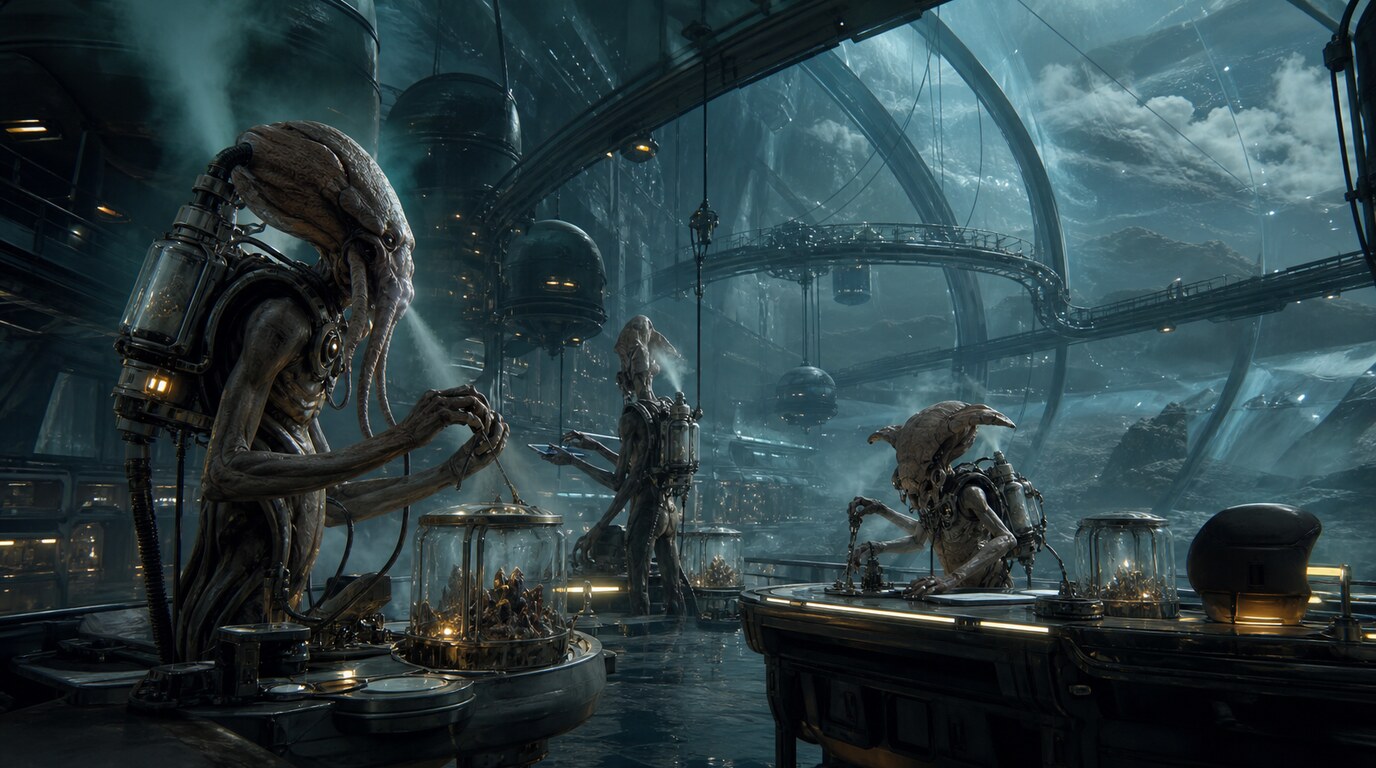
Start from evolutionary pressure rather than a personality trope
Too many science fiction species are built around a single exaggerated human mood: the warrior clan, the greedy merchant guild, or the aloof logician. At the table, these monocultures quickly become predictable cartoons because every representative reacts in exactly the same way to player propositions. Believability begins when cultural behaviour is treated as an adaptation to concrete survival conditions rather than an immutable moral alignment.
Begin with the homeworld environment. Gravity dictates skeletal density, limb configuration, and movement speed. Atmospheric composition and barometric pressure dictate metabolic rates, respiratory equipment, and acoustic range. A species that evolved in dense, subterranean methane caverns will not navigate by optical sight, and a species adapted to high-radiation tidal flats will structure its sleeping cycles around orbital eclipses. When physical form answers an environmental demand, the creature feels grounded before a single word of lore is spoken.
Six steps to construct a coherent species
Follow this sequence from physical foundation to cultural institution, making each tier answer the constraints of the tier below it:
- Homeworld conditions Define surface gravity, primary atmospheric gases, thermal range, and available solar radiation. Note what seasonal hazards or apex predators shaped their ancestral survival strategies.
- Body plan and locomotion Determine size, symmetry, limb count, and articulation. Ground their manipulation organs in their history: did they develop fine motor control from grooming feathers, climbing sheer basalt, or handling slippery marine prey?
- Sensory priority and communication Choose their primary sense. If they communicate through pheromone pulses, colour shifts across chromatophores, or ultrasonic clicks, decide how this affects their record-keeping, architectural privacy, and diplomatic exchanges with outsiders.
- Material needs and scarcities Identify what their biology consumes and excretes. A species that requires rare atmospheric trace elements to molt or clean their gills will build trade routes, territorial claims, and legal codes around securing those specific supplies.
- Social structures and values Build institutions that reflect their reproductive cycles and life expectancy. Short-lived species with huge broods develop collective care structures and swift dispute resolution, while solitary, long-lived scavengers place immense value on personal space and contractual non-interference.
- Internal diversity and schisms Divide the species by ideology, geography, resource access, and generational friction. A believable species contains traditionalists, heretics, commercial cartels, labour unions, and reformists who argue bitterly over how their ancestral customs apply to modern star travel.
Example
Worked example: The Qirathi of Sunken Basin
This worked scenario illustrates how replacing a single gimmick with biological and environmental pressures produces immediate tabletop encounters.
- First pass
- A species of proud reptilian scholars who never lie and look down on humans for being emotional. The crew meets a diplomat who speaks in riddles and gives them a translation device.
- Table-ready species
- The Qirathi evolved in the high-pressure, silt-heavy rivers of a super-Earth with double terrestrial gravity. They possess four broad, paddle-like walking limbs, a low-slung cartilaginous frame, and twin pairs of tactile barbel-frills around a central vocal siphon that communicates through low-frequency hydraulic resonance. Because water carries sound effortlessly while silt blinds optical vision, they have no concept of private spoken conversation within fifty metres of open water. Their social code does not value blunt honesty out of noble virtue, but because lying in their acoustic frequency causes involuntary muscle tremors across their respiration vents that any fellow Qirathi can feel. Inside the dry, low-pressure atmosphere of an orbital station, they must wear pressurised misting harnesses that dry out over six hours, making long diplomatic negotiations agonising physical endurance trials. Two factions now contest the docking port: the Deep Current Synod, which insists on flood-sealing the entire docking bay to conduct sacred water-speech, and the Vent Contractors, who have begun using artificial voice synthesisers to conduct secretive trade deals with human syndicates.
- Why it works
- Gravity explains their posture, habitat explains their senses, biology explains why they struggle to deceive each other, station physics creates an operational countdown, and two domestic factions give the crew conflicting choices instead of a uniform alien reaction.
Design architecture and tools around non-human biology
One of the quickest ways to break player immersion is placing an alien creature inside a human hotel room with human chairs, human doorways, and human touchscreen interfaces. Believable species construct physical artefacts that mirror their physiology. A four-limbed quadruped with manipulator pedipalps will build ramps instead of ladders, circular gathering pits instead of chairs, and tactile pressure pedals instead of wall-mounted light switches.
Consider how their primary senses affect their written records and art. If a species perceives thermal gradients rather than visible light, their legal contracts might be stamped into alloys of varying thermal conductivity that must be read by touch or temperature scan. When the players discover an alien relic or board an alien transport, the layout of the corridors and controls should immediately teach them something about who built it.
Alien species prep checklist
Before introducing a new species to your campaign, ensure you can answer these practical table questions:
- What planetary pressure produced their current limb structure, movement speed, and size?
- Which sense takes priority over vision, and how does that alter how they speak or store data?
- What biological requirement makes long stays aboard standard human stations physically uncomfortable?
- Why is their defining cultural value a logical solution to an ancient survival problem?
- What physical obstacle do human crew members face when trying to operate one of their vehicles or facilities?
- Which two domestic factions or philosophical schools within the species are currently in conflict?
Was this useful?
Ground your alien species in your campaign vault
Create your alien species using the Alien Race Generator, then import the resulting biological profile, sensory habits, and domestic factions into your campaign vault. Link the species to its native planet in the Sci-Fi World Generator and star system map. When players negotiate a trade concession or board a damaged alien scout vessel, Codex Cryptica keeps the species' biological vulnerabilities, current faction rivalries, and environmental requirements connected to the scene.
Try the Alien Race GeneratorRelated
Tools
- Alien race generator Build coherent alien biology, senses, homeworld conditions, culture, and adventure hooks.
- Sci-fi world generator Generate planets, moons, environments, hazards, and orbital outposts for your species' homeworld.
- Star system generator Map parent stars, asteroid belts, orbital zones, and transit routes across your setting.