Comparison
What RPG should I play for an over-the-top space opera?
There is no single best system for over-the-top space opera: the right pick depends on the table experience your group wants. For cinematic crew drama with jobs, flashbacks and a shared ship, Scum and Villainy fits best; for colourful tactical science-fantasy with deep character builds and proper starship combat, Starfinder Second Edition; for fast pulpy action your group can bend to any setting, Savage Worlds with its Science Fiction Companion; and for rules-light gonzo science-fantasy with almost no prep, Solar Blades and Cosmic Spells. Systems named here belong to their publishers; naming one is not an endorsement of Codex Cryptica by that publisher, or the reverse.
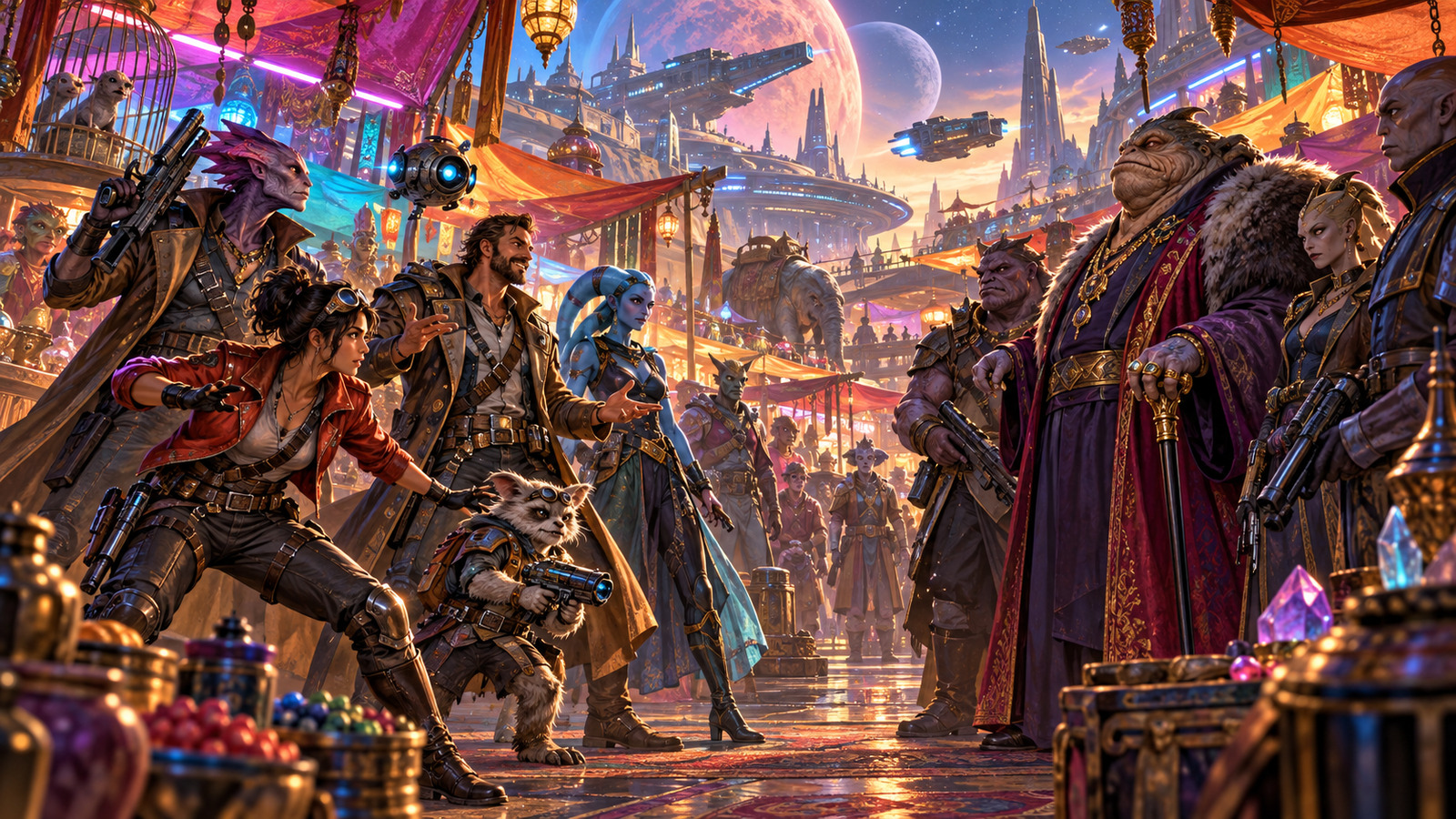
Start from the table experience, not the franchise
Borderlands and Guardians of the Galaxy feel the way they do because of structure, not set dressing: a loud crew with history, episodic jobs that escalate fast, strange planets that each get one strong idea, and villains with personality. A system earns the vibe when its default session already produces those things, without the GM bolting them on.
That is why the four systems below are not interchangeable. One organises play around crew jobs, another around tactical encounters and builds, a third around fast generic resolution you can point at any setting, and the last around rules-light old-school play. Match the engine to the evenings your group already enjoys and the space opera feeling follows.
If you want...
Each of these produces a different kind of space opera. Find the row that describes your group's best evenings.
- Cinematic outlaw crew and found-family jobs Scum and Villainy. This Forged in the Dark game structures play around crew jobs with position and effect resolution, flashbacks that replace planning sessions, and a shared crew sheet plus ship that the whole table advances together. It produces character drama and heist-shaped episodes, and asks the table to improvise more than it optimises.
- Colourful tactical science-fantasy Starfinder Second Edition. Paizo's d20 system pairs deep character builds and grid-based tactical combat with dedicated starship combat, including a quick-to-run cinematic mode in the GM Core book. Pick this when the group wants build depth, tactical fights and a big published setting to lean on; skip it when rules lookups already slow the table down.
- Fast pulpy action in any setting Savage Worlds with the Science Fiction Companion. The Adventure Edition core runs on exploding dice, bennies that let players soak damage or reroll at dramatic moments, and combat that resolves in minutes rather than hours, while the Companion adds starship construction, cyberware, power armour and setting toolkits. This is the flexible middle: pulpy rather than tactical, structured rather than freeform.
- Weird rules-light cosmic adventure Solar Blades and Cosmic Spells. Diogo Nogueira's Old Skull Engine game is a complete rules-light science-fantasy system with an old-school spirit: fast resolution, minimal prep, and gonzo planets, sorcery and fabled solar blades baked into the default setting. The trade is depth: there is less mechanical support for long tactical arcs or detailed ship management, so it suits groups who want to start playing tonight.
What gives a game the Borderlands or Guardians feeling
Strip away the franchise names and the feeling rests on a short list: strong character personalities with conflicting loyalties, an irreverent tone that survives danger, dangerous but colourful worlds, strange factions with memorable demands, a crew bound to one ship, and episodic jobs connected by a larger campaign arc. Fast escalation matters more than lore depth: every session should change something the players can point at afterwards.
Use that list as a test when reading a new system. Ask whether the rules give the crew shared procedures such as a ship sheet, a job structure or faction clocks, whether the default session ends with a visible consequence, and whether the reward mechanics favour bold play. A system that answers yes to most of that list will feel right at the table even if its cover art looks nothing like the films.
Example
Two groups, two different right answers
Two groups ask the same question and land on different systems, which is exactly the point.
- The tactical group
- Five players who love build guides, run long combat encounters on a grid, and have already sketched a capital-ship battle for their finale. They read the list above and recognise their best evenings: tactical fights, character optimisation, a published setting full of aliens and factions. They pick Starfinder Second Edition.
- The drama group
- Four players who plan nothing, love arguing in character, and once spent a whole session on a single negotiation with a crime boss. Prep time is near zero and nobody wants to learn a thick rulebook. They pick Scum and Villainy, where flashbacks cover the planning they never do.
- Why it works
- Neither group ranked systems against each other; each matched a system's default session to evenings they already enjoy. The tactical group gets the crunch they find fun, the drama group gets procedures that turn improvisation into progress, and both end up playing space opera instead of fighting their rules.
Before you commit to a system
Work through these with the group before buying rulebooks:
- Run a one-shot or a three-session trial before committing to a campaign; system feel shows up in play, not in reviews.
- Check who is willing to run it: a crunchy system with a reluctant GM stalls, while a light system with an eager one moves fast.
- Confirm the practical constraints: virtual tabletop support, the budget for core books, and how much rules-teaching the group will tolerate.
- Agree on tone explicitly: gonzo comedy, heroic adventure or something with sharper edges, since each system pulls toward a different default.
- Decide how much ship and crew management the table wants, because the four systems above range from a fully detailed vessel to a ship that is mostly set dressing.
Was this useful?
Systems built for this
- Scum and Villainy
Forged in the Dark job structure with flashbacks, shared crew and ship sheets, and heat mechanics that turn episodic outlaw work into campaign continuity.
- Starfinder Second Edition
d20 tactical combat with deep character builds, plus dedicated starship combat including a quick-to-run cinematic mode in the GM Core book.
- Savage Worlds Adventure Edition
Exploding dice, bennies and fast-resolving combat, with the Science Fiction Companion adding starship construction and genre toolkits for pulpy play.
- Solar Blades and Cosmic Spells
A rules-light Old Skull Engine chassis whose fast old-school resolution and built-in science-fantasy setting keep gonzo play moving with minimal prep.
Build the sector once the system is chosen
Once the group has picked its system, the remaining work is sector-building: strange planets with one strong idea each, factions with memorable demands, NPCs with conflicting loyalties, and rumours that turn a job board into a campaign. Codex Cryptica's generators produce these as linked material rather than isolated prompts, so a star system, its factions and its rumours can reference each other from the first session.
That material is system-neutral, so it survives a change of system: if the group tries one engine for six sessions and then moves the same crew to another, the sector, its factions and their grudges carry over unchanged.
Generate a star system for your crewRelated
Tools
- Star System Generator Strange planets with one strong idea each, ready to anchor an episodic space opera campaign.
- Faction Generator Strange factions with memorable demands to employ, oppose or double-cross the crew.
- Personality Generator Strong character personalities with conflicting loyalties for crewmates, patrons and rivals.
- Rumour Generator Rumours that turn a job board into a connected campaign arc.