Framework
How do you create a sci-fi star system for an RPG?
Create a sci-fi star system for an RPG by giving each major body a job in the local economy, then placing travel limits, competing factions, hazards, and a current dispute between those places. Start with three to five destinations the crew can reach, decide what moves between them, and make at least one route or resource worth fighting over. The system becomes playable when a journey changes who can act, what supplies cost, or which problem reaches the crew first.
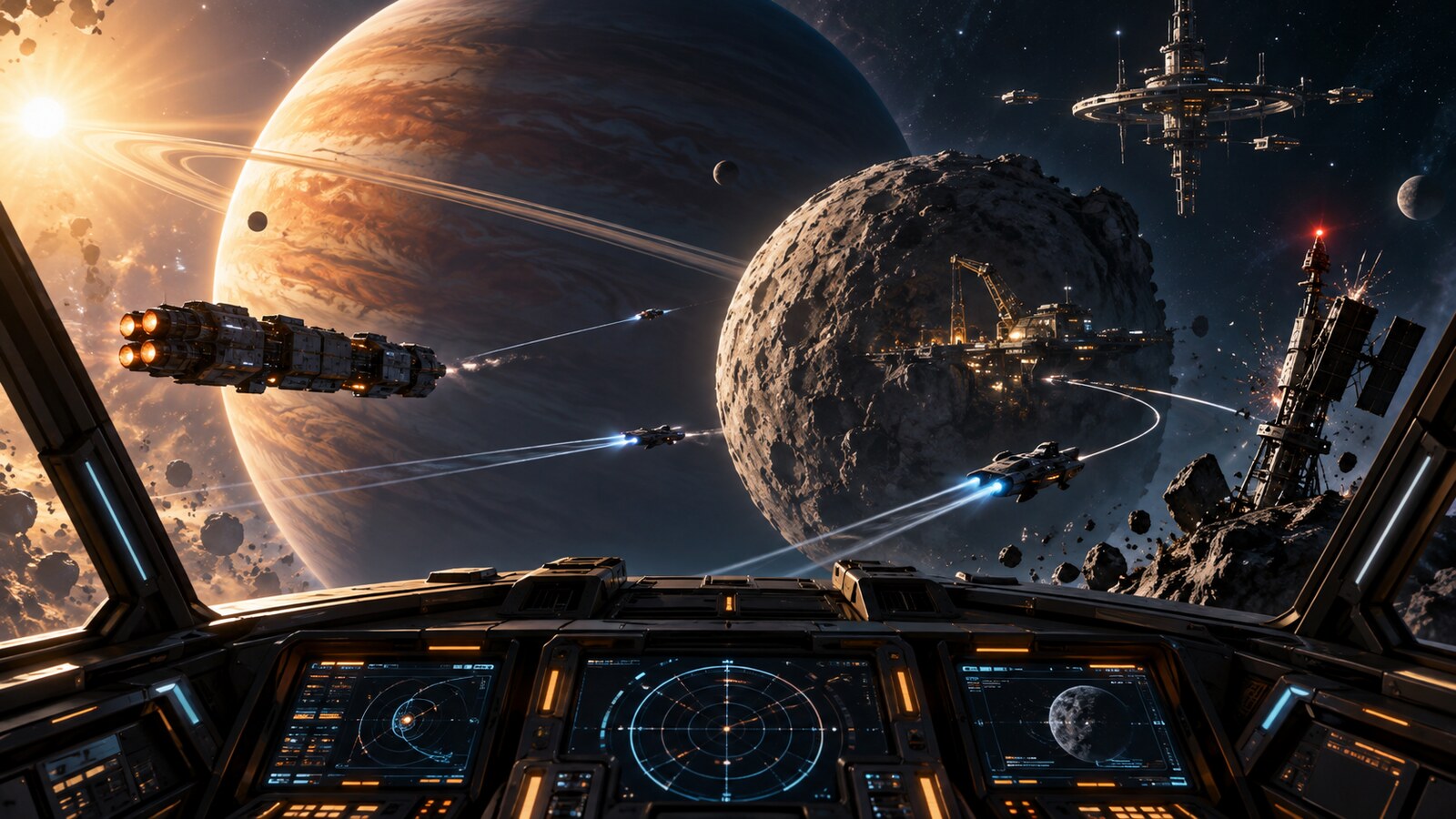
Build a system around movement and pressure
A list of planets gives the crew names to visit, but it does not give them reasons to leave a dock. Start with traffic. Decide what people, fuel, food, data, labour, contraband, or military force travels through the system. Then decide who depends on that movement and who profits when it slows down. A mining moon matters because ore haulers must leave before their heat shielding fails, not because its terrain has three unusual colours.
Keep the first version compact. Three to five destinations are enough for a campaign base: a settled world or station, a place that produces something valuable, a difficult frontier site, and perhaps a hidden or restricted location. Give each one a different answer to the question, 'Why would a crew go there this week?' This leaves room to add distant colonies once the players point their ship that way.
Use six system elements that create play
Sketch these elements on one page. Each should point towards a choice, a cost, or a person who needs something.
- Anchors Choose the bodies and installations that crews can name and reach: a trade station, refinery moon, garden world, gas giant skimming platform, wreck field, or listening post. Give every anchor a practical function before adding scenery.
- Routes and limits Mark the fast route, the cheap route, and the route that is currently unsafe. Transit time, fuel, heat, docking clearance, jump windows, and quarantine rules should make the crew choose rather than merely wait for a travel montage to end.
- Flow of value Name one resource or service moving between anchors. It can be ice, reactor parts, medical cultures, migrant labour, navigation data, or protection. When that flow is delayed, say who is paid, stranded, or exposed.
- Competing claimants Place at least two factions in the system with incompatible aims. A port authority wants inspection fees, independent haulers want an open lane, and a salvage union wants a wreck site left untouched until its own crews arrive.
- Hazard with consequences Use a hazard that changes plans: a radiation belt, debris field, solar flare season, sensor ghost, pirate ambush zone, or failing relay. Connect it to a route or resource so it creates decisions instead of background colour.
- Current flashpoint Set one problem in motion now. A convoy has vanished, a moon is about to lose life support, a tariff has doubled, or a restricted signal has appeared near a colony. Give each faction a different account of what happened.
Example
Worked example: The Kestrel Reach
The Kestrel Reach uses the same number of locations in both versions. The second version gives the crew a reason to plot a course before the briefing is over.
- First pass
- Kestrel has a blue gas giant, a mining moon, an orbital station, and an abandoned research base. Pirates sometimes attack ships near the asteroid belt. The setting has places to describe, but no clear jobs, time pressure, or sides to choose between.
- Table-ready system
- Nacre Station refines coolant from the gas giant and sells it to the mining moon Dross, whose excavators expose a rare isotope used in jump coils. The only fast corridor crosses a debris belt controlled by the station's contracted security fleet. A solar flare has blinded the public relay for six hours, while a Dross ore tender disappears carrying enough isotope to keep the station operating through winter. The station director blames smugglers, the miners blame security, and a salvage cooperative says the tender answered a call from the abandoned research base. The crew can take a slow safe route, bribe security for a forged transponder code, investigate the base, or escort the next coolant run before Dross shuts down its extraction tunnels.
- Why it works
- The system's economy explains why the anchors need one another. The flare and debris belt make travel a decision. Each faction offers information and work, while the missing tender provides a problem that can lead the crew to every major location.
Prepare information the crew can act on
Give the players route knowledge in usable terms. They do not need orbital mechanics unless that is the game you are running. They need to know that the patrol lane is fast but requires a transponder, that the ice haulers leave at dawn, and that the old relay makes a rescue call look like a pirate trap. Let scouts, dockworkers, charts, and rival crews reveal different pieces of the system.
Do not make every location equally dangerous or equally important. A reliable station gives the crew somewhere to return to, while a hazardous moon or restricted base gives them a reason to take risks. When the crew solves the flashpoint, change a route, price, faction relationship, or local rumour so the system records what they did.
Star system prep checklist
Before the first jump, make sure you can answer these questions at the table.
- Can you name three to five destinations and explain what each contributes to the system?
- What valuable thing moves between two locations, and what happens if it stops moving?
- Which route is fastest, which is safest, and what does each choice cost the crew?
- Which two or three factions want incompatible outcomes from the current problem?
- What hazard can change a journey or force an unexpected stop?
- What event is happening now that gives the crew a job, a warning, or a rumour?
Was this useful?
Systems built for this
- Traveller
The Universal World Profile procedure in the Traveller Core Rulebook generates one world's UWP and its physical, social, and technological characteristics (size, atmosphere, hydrographics, population, government, law level, and tech level) using a standardised dice method.
- Stars Without Number
The free core rulebook includes a full sector-generation procedure: roll for star systems, assign world tags (pairs of thematic pressures), create trade routes, and place factions with their own assets and goals, producing an interconnected sandbox with built-in conflict drivers.
- Coriolis: The Third Horizon
The GM chapter includes a star-system creation procedure that assigns system type, world characteristics, and portal network connections, then layers in faction control and trade goods, yielding a ready-to-navigate system with built-in political pressure.
Keep a changing star system connected
Use the Star System Generator to draft the bodies, routes, hazards, and hooks, then keep the settled worlds, stations, factions, and active jobs as linked campaign entries. When a route closes or a crew backs one claimant, those links make it easier to find the next affected location and update the system after play.
Try the Star System GeneratorRelated
Tools
- Star system generator Generate stars, major bodies, transit routes, factions, hazards, and a system-level problem.
- Sci-fi world generator Develop a planet, moon, colony, or orbital habitat once the system gives it a role.
- Faction generator Create the authorities, crews, unions, corporations, and rivals competing across the system.
Guides
- Codex Cryptica for Space Opera Organise starship crews, colonies, interstellar politics, and linked adventure locations.
- Codex Cryptica for Traveller Track subsectors, trade, patrons, ships, and the consequences of travel between worlds.
Other answers
- How do you make an alien species feel believable?
- How do you make travel interesting in a tabletop RPG?
- How do you start worldbuilding from scratch?
- What kind of ship should a sci-fi RPG party start with?
- What RPG should I play for an over-the-top space opera?
- How do I run common character roles in a sci-fi or space-opera RPG?