Framework
How do I build a believable post-scarcity civilisation?
Take the abundance seriously and follow its consequences. Decide which goods and services nobody can be deprived of, then name what stays finite: time, skilled attention, desirable places, trust, consent and the capacity to coordinate. Show who builds and repairs the systems that provide for everyone, how institutions change when survival no longer depends on wages or land, and where citizens still disagree. A prosperous civilisation becomes credible, and can still oppose the protagonists, when its conflicts come from competing values and policies rather than from a hidden cost that makes the prosperity fake.
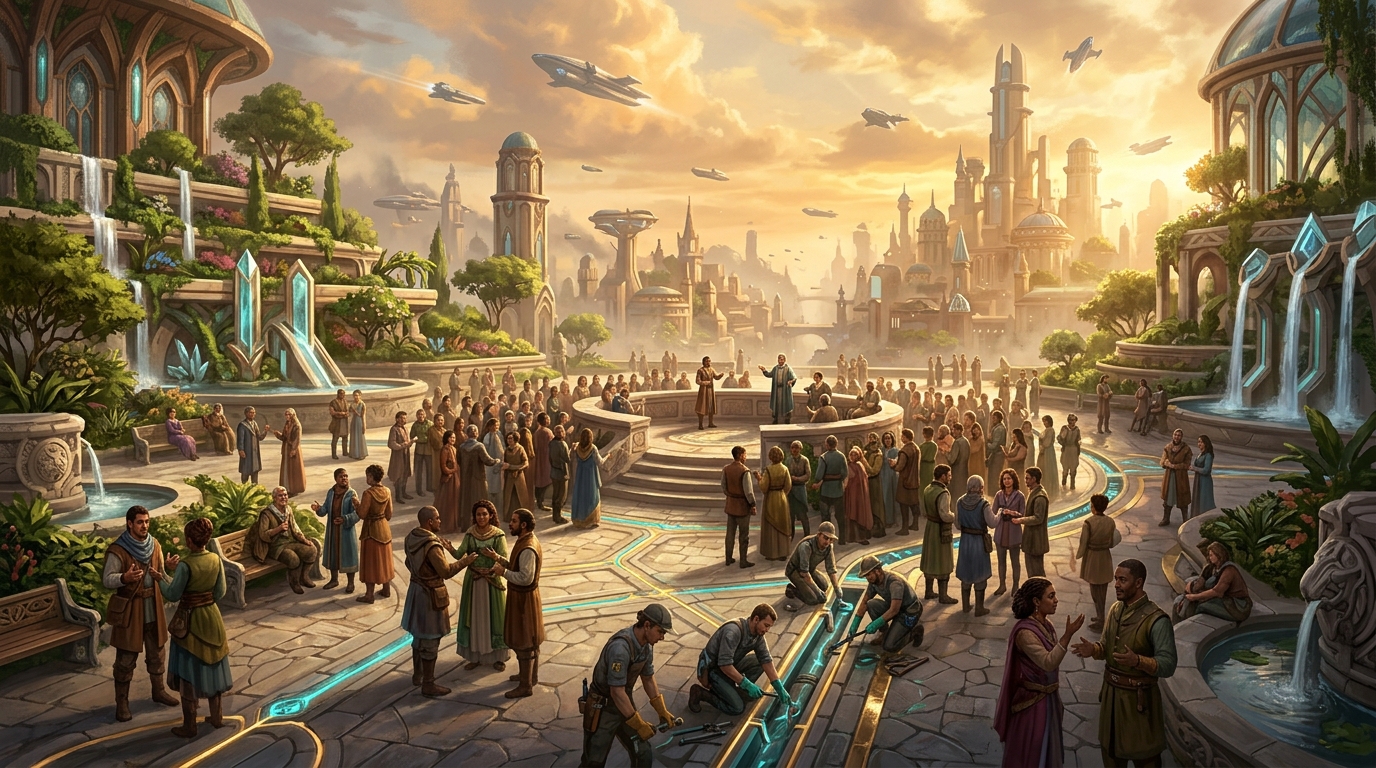
Start by believing your own premise
The common failure is to announce that hunger, disease and homelessness have ended, then write the society as a present-day state with better machines. Salaries still decide who eats. Landlords still control access to housing. Politicians still win support by promising basic security. If the material floor has genuinely changed, those pressures change with it, and the institutions built on them either adapt or lose their purpose.
The opposite failure is to protect the setting from its own premise by adding a secret price: the energy feeds on souls, the rulers drug the water, the abundance is about to run out. That can suit a horror story, but it is not required for conflict. A civilisation can be sincere, prosperous and still make choices that other peoples experience as coercion. Keep the prosperity real and look for friction in what people do with it.
Work from one chain: what is provided, who maintains the provision, which decisions remain contested, and what a visitor can see of all three. If a claim about the society has no maintainer, no contested decision and no visible sign, it is decoration rather than worldbuilding.
Define the abundance before you design the society
Post-scarcity rarely means that anything can be had in any quantity at any moment. Write down the boundary of the abundance first:
- What nobody can be deprived of List the guaranteed floor in concrete terms: food, shelter, medical care, education, energy, transport, communication, or fabrication time. State whether the guarantee is a legal right, an automated service, a religious duty or a custom so old that nobody remembers voting for it. Each basis gives a different answer when someone tries to withdraw it.
- What energy cannot simply create Abundant power does not manufacture a particular person's time, a view over a specific harbour, an original artwork, a trusted surgeon, a seat in a famous academy, or agreement between two councils. Land in a favoured district, skilled attention and unique objects stay limited even when copies are free, because a copy of a painting is not the painting the collector wants.
- What takes coordination rather than material A new orbital habitat, a terraformed valley or a galaxy-wide standard for medicine needs agreement, sequencing and maintenance long after its parts can be fabricated at no cost. Coordination is a real constraint: somebody must decide whose plan goes first, whose design is trusted and who carries responsibility when a shared system fails.
- What people may refuse Decide whether a citizen can decline the standard housing, medicine or education, live outside the provision network, or leave the civilisation entirely. The treatment of refusers tells a reader more about the society's values than its charter does. A right that cannot be refused is also a form of control, and citizens will notice that even if the founders did not.
That boundary does most of the design work. Everything outside the guaranteed floor is where preference, reputation, law and politics continue to operate.
Show the machinery of prosperity
Abundance is maintained, not wished into being. Give the providing systems owners, workers and failure modes:
- Who builds and repairs it Name the people or institutions that design, inspect and mend the energy grid, fabrication network, medical service or weather working. If machines do the labour, somebody still sets their instructions, audits their output and decides what counts as damage. Maintenance is a plausible source of status, obligation or quiet political power.
- How provision is authorised A universal service can be run by a state, a federation of cities, a priesthood, an open guild, autonomous systems bound by an old charter, or some mixture that varies by region. The arrangement decides who can change the service, who can inspect it and who can be removed for abusing it. Distant provinces may run the same promise through very different institutions.
- What a disruption looks like Choose failures that fit the machinery: a fabrication pattern recalled as unsafe, a maintenance guild disputing a new standard, a solar storm delaying parts that cannot be made locally, a council refusing an upgrade. A disruption should reveal dependencies and loyalties, not switch the whole civilisation off for the convenience of a plot.
- What maintenance costs the maintainers The cost need not be secret suffering. It can be years of training, dangerous inspection work, liability for failures, or the social expectation that the most capable citizens owe service. People may compete for those posts or resent being pressed into them, and both reactions are usable at the table.
Rebuild institutions around the new floor
Take each familiar institution and ask what it is for once survival is not at stake. Keep the answers specific enough to affect a scene:
- Government and law A state that no longer allocates bread still allocates risk, space, standards and permission. Laws shift towards safety, consent, heritage, environmental limits and the rights of outsiders or artificial minds. Courts may spend more time on questions such as who may alter a shared habitat, or whether a community can refuse a medical intervention that protects its neighbours.
- Work and status When nobody must work to eat, work may become a claim about worth. Some labour gains prestige because it is hard to automate or carries responsibility: surgeons, explorers, judges, master crafters, carers. Other work may be honoured in speeches and avoided in practice. Decide which contributions bring invitations, influence or public honour, and who does the unglamorous maintenance without receiving any of them.
- Property Personal possessions can be trivial to replace while places, originals and access rights remain fiercely contested. Inheritance may matter less for houses than for archives, titles, founding shares in a colony, or the custody of a famous ancestor's unfinished work. Write down what a wealthy citizen actually has that a poor one cannot obtain, or admit that wealth has become reputation by another name.
- Education and family Long schooling costs nobody their livelihood, so education can stretch for decades and restart several times in one life. Families form around care, kinship and chosen obligation rather than economic survival, which raises sharper questions about who raises children, who may found a household and what adults owe parents who may live for another two thousand years.
Give people something to want
A citizen who does not need wages may still want a reason to get up, whether or not others recognise it. Common sources of meaning in an abundant society include mastery of a craft, scholarship, exploration, public service, religious devotion, artistic reputation, competitive sport, raising a family, restoring damaged worlds and winning arguments about how the civilisation should behave. None of these requires misery to be serious. A potter whose bowls are freely copied may care intensely about being the potter whose originals are requested by name.
Status deserves particular care, because it survives the end of material want and can quietly replace money if you let it. Make status plural rather than a single ladder: the honoured surgeon, the daring survey captain, the respected mediator and the beloved teacher need not compete for the same prize, and a citizen can be eminent in one circle and unknown in the next. Plural status gives you subcultures, fashions, feuds and ambitions without inventing a single ranking that everyone obeys.
Boredom and drift are fair subjects, but treat them as one response among several rather than the inevitable truth about abundance. Some citizens will coast. Others will take risks that a hungry society could never afford, such as spending a century on an unproven proof, a slow voyage or a work of art with no audience yet. The disagreement between the cautious and the restless is itself a cultural fault line.
Let longevity and distance pull the civilisation apart
Long lives change the tempo of everything. Founders may still be alive to defend decisions made three millennia ago, which gives institutions unusual continuity and makes reform a personal argument with the people who wrote the rules. Inheritance arrives late or never, so younger citizens may wait centuries for real responsibility unless the society deliberately reserves posts, colonies or budgets for the newly adult. A civilisation that ignores that pressure will grow a quiet gerontocracy: rule by the old, however benevolent, and a younger generation that can see no lawful route to influence.
Memory becomes an institution rather than a private gift. When eyewitnesses to ancient events still live, archives compete with personal recollection, and a famous elder's memory can carry legal or moral weight that a document cannot. Decide who may challenge a remembered account, and what happens when two immortals remember the founding crisis differently.
At galactic scale, communication delays can create divergence. A ruling may reach a distant system after the circumstances that prompted it have passed, so distant worlds may need local authority, and local authority can grow local customs. Within a few centuries the same civilisation can contain systems that disagree about intervention, machine minds, genetic change or contact with younger species, while still sharing the guaranteed floor. That divergence is an asset: it stops a galactic species reading as one personality spread across a map.
Ask why they expand, and where the argument lives
A civilisation without resource pressure still needs a reason to cross interstellar distances. Give it more than one, held by different groups:
- Motives that do not need hunger Curiosity, scientific ambition, religious mission, custodianship of endangered worlds, strategic security, prestige between rival systems, and the wish to offer the guaranteed floor to peoples still suffering without it. Each motive implies a different fleet, a different first-contact policy and a different idea of success.
- Freedom against safety Citizens may disagree about how much risk, privacy or personal experimentation to allow when the state can prevent nearly every accident. A society that can stop harm must decide which harms adults may choose for themselves.
- Intervention against non-interference The sharpest external argument: if you can end a famine or a plague on a younger world this year, is refusing to act restraint or negligence? Both positions can be held sincerely by people who want the same suffering to end.
- Preservation against transformation Abundant energy makes large change cheap, so the argument moves to whether change is desirable: restoring a world to an earlier ecology, redesigning bodies, preserving cultures unchanged, or letting each generation remake its habitat. Expect different systems of the same civilisation to settle this differently.
Put at least two of these arguments inside the civilisation, with named institutions on each side. An antagonist that contains its own loyal opposition is harder to dismiss as a disguised warning about prosperity.
Example
Worked example: the Concord of Nine Hearths as antagonist
The Concord is a science-fantasy civilisation of long-lived peoples whose hearth engines draw clean power from bound suns. Its citizens have not known hunger or epidemic disease for four thousand years. It is prosperous, sincere and, for the younger world of Vess, a serious problem.
- Premise
- Any Concord citizen can claim housing, food, medicine and fabrication time as of right, maintained by local Hearthwardens who train for decades and answer to elected civic circles. What stays scarce is skilled attention, places in the old orbital cities, and agreement: a new habitat still needs a design that nine quarrelling systems will accept.
- Institutional consequence
- Because nobody works to survive, influence follows recognised service and reputation. Hearthwardens, surgeons and survey captains hold honour that money cannot buy, while the civic circles spend their time on safety standards, heritage and the terms on which Concord help is offered abroad. Young citizens, who may wait centuries to lead anything at home, volunteer for survey and relief fleets where real responsibility comes early.
- Ideological disagreement
- The Concord offers Vess its hearth engines, which could end a famine within a season. A Relief Mandate captain proposes installing one on a communal burial terrace, with the site under Concord operator jurisdiction as a condition of installation. The Consent Circle insists that Vessan governments and communities must accept freely, with the right to refuse Concord law along with Concord power; some elders say ceding the site would break burial customs. A Vessan clinic worker wants food delivered now but rejects both the elders' blanket refusal and the captain's terms. The captain argues that a generation of Vessan children will die while their rulers deliberate. The two Concord factions cite the same founding promise: that no one should suffer for lack of what the Concord can provide.
- Visible setting detail
- On Vess, Concord aid stations fly no flag and take no payment, but each one keeps a public register of local refusals so no village is quietly enrolled. At one station, the clinic worker distributes food while gathering signatures for a different engine site. In orbit, a Relief Mandate fleet waits loaded and increasingly angry, broadcasting Vessan famine reports. In the capital, a Consent Circle envoy is losing the argument in public debate, and everyone can watch the vote count move.
- Story hook
- The protagonists are hired, or feel bound, to protect a Vessan community after its elders refuse the captain's plan to install a Concord engine on the communal burial terrace under Concord jurisdiction. A clinic worker presses for immediate relief on different terms. The captain, who lost family to famine before joining the Concord, asks for one meeting before landing engineers anyway. Enforcing the proposed terms could displace burial rites and local authority; the players can press for another arrangement before the Concord acts.
A worksheet for your own civilisation
Answer each question in one or two lines, in terms a visitor could observe. Stop and revise any answer that only restates that the society is advanced:
- What can nobody be deprived of, and is that a right, a service, a duty or a custom?
- What can no amount of energy simply create: whose time, which places, which originals, what agreement?
- Who builds, inspects and repairs the systems that keep the promise, and what does that service cost or earn them?
- Who may refuse the society's help or live outside its provision, and what actually happens to them?
- What do citizens compete over, collect, master or hope to be remembered for?
- Which institution changed most when survival stopped depending on wages, land or inheritance, and what does it argue about now?
- Who can challenge the bodies that maintain prosperity, and when did someone last succeed?
- How do long lives affect inheritance, promotion, memory and the patience of the young?
- How would two reasonable citizens disagree about helping, contacting or ruling another civilisation?
- Why does this civilisation explore, intervene or expand, and which of its own systems does that mission least well?
- How would a player or reader encounter these answers in an ordinary street, household, workplace or public debate?
Was this useful?
Keep the civilisation and its disagreements connected
A post-scarcity civilisation touches many notes at once: the systems that maintain its guaranteed floor, the factions arguing about intervention, the younger worlds affected by the argument, and the citizens whose ambitions no longer follow wages. Keeping those as linked entities makes it easier to keep a faction's policy consistent with the institutions behind it when the party meets a different representative three systems away.
Codex Cryptica holds civilisations, factions, places and characters as connected entities, and its nation and faction generators can draft starting material for the polities and movements involved. The boundary of the abundance, the values in conflict and the terms of any offer of help remain your decisions.
Try the nation generatorRelated
Tools
- Nation generator Draft a large polity with institutions, dependencies and points of strain to rebuild around an abundant floor.
- Faction generator Build the maintenance orders, civic circles and intervention movements that disagree inside the civilisation.
- Alien race generator Ground a long-lived species in biology, lifespan and homeworld conditions before designing its institutions.
Guides
- Codex Cryptica for Space Opera Organise interstellar polities, alien encounters and galactic factions in a connected campaign vault.
- TTRPG Economy & Trade Build believable trade, scarcity and economic pressures, and see what changes when the material floor is guaranteed.
Other answers
- How do you make an alien species feel believable?
- How do I give different civilisations distinct strengths and weaknesses?
- How do scarcity and shortages affect prices and conflict in an RPG world?
- How do I build a believable economy for a fantasy world?
- How do I make different cultures feel distinct without relying on stereotypes?
- How does magic change society in a fantasy world?
- How do I run political intrigue and faction play in an RPG?