How to
How do I decide what a settlement produces, imports, and exports?
Derive a settlement's trade from its surroundings and capabilities rather than picking goods at will: note local resources, what its people and institutions can do, what it controls or connects, and the routes that carry goods and visitors. Production can use imported inputs or provide services; surplus is what remains after local demand, while imports may feed local needs or make exports possible. Goods made, processed, or passed onward, and services sold to travellers or neighbours, all give a settlement ways to earn.
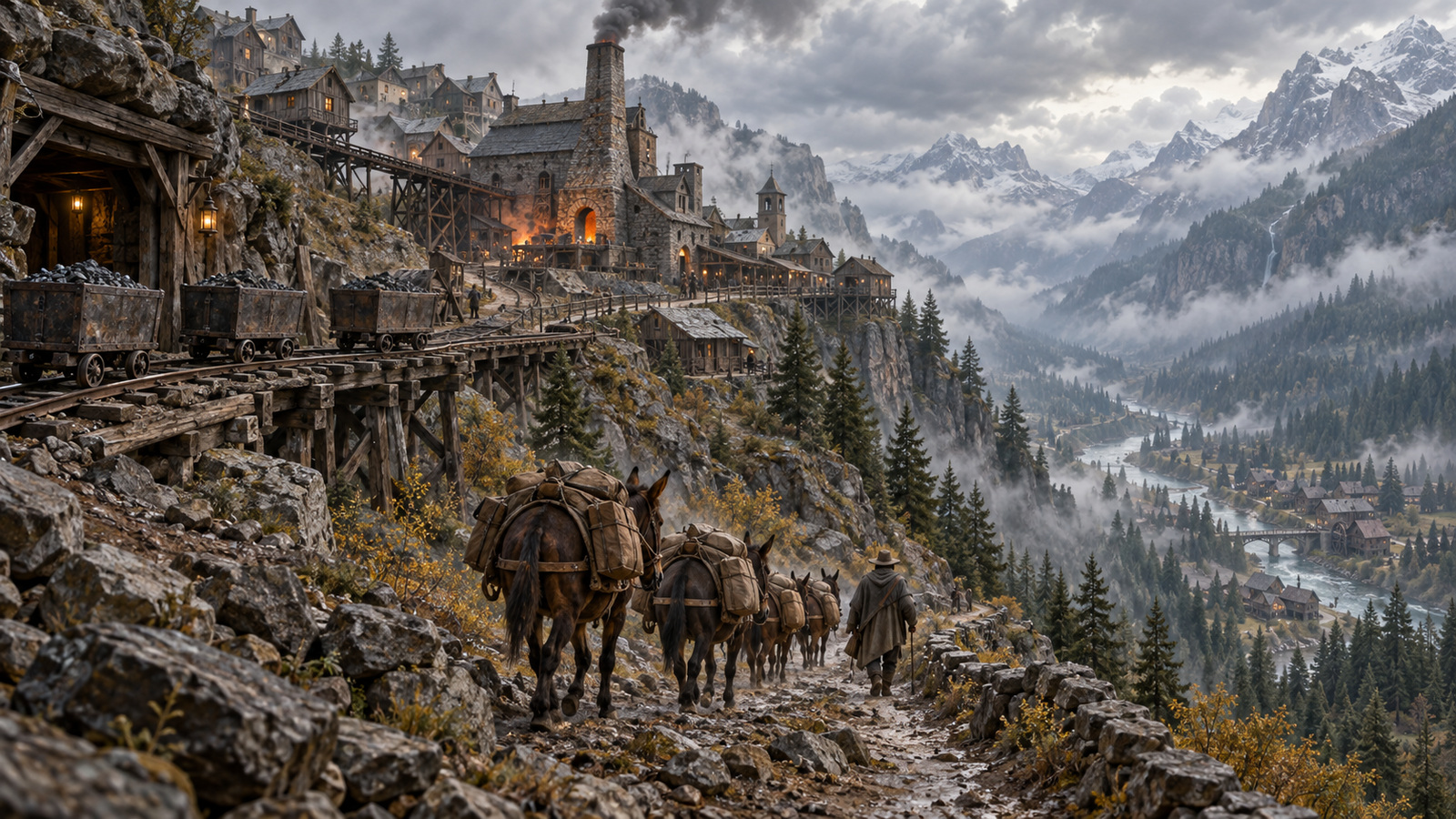
Arbitrary goods lists all sound the same
The usual approach starts at the market stall: the GM invents a few exports that sound colourful and moves on. The result is settlements that all sell a little of everything, where a mountain hamlet trades wine and a fishing port sells cheap iron, and no choice ever follows from the difference. Players stop asking where things come from because the answer is never load-bearing.
Working from the surroundings fixes this with less effort, not more. Land, skills, institutions, position, and rulers narrow the possibilities so sharply that the trade identity almost writes itself. A town above the treeline may import timber for its workshops; a town with one good harbour and poor soil may earn its keep by repairing ships, warehousing cargo, or serving travellers.
Six steps from surroundings to trade ledger
Answer each step with a phrase, not a paragraph. Stop as soon as the ledger lines are clear:
- Ground Name the geography, what it gives freely, and what the place controls or connects: thin pasture, deep woods, a workable seam of ore, a tidal flat for salt pans, a ford, deep-water harbour, caravan junction, border checkpoint, pilgrimage site, or seat of government. Local resources make some production cheaper, but imported inputs can support major crafts or industries when skills, tools, capital, or access make them worthwhile.
- Hands Count the people, skills, and institutions: fishing families who mend nets, miners and a smelter crew, weavers, scribes, lawyers, healers, shipwrights, scholars, mages, soldiers, priests, brokers, or entertainers. Skills decide whether goods leave raw or worked, and who can provide services. Processing can make a good more valuable, durable, portable, or useful before it leaves the settlement.
- Tools Note the infrastructure and capital that enable or limit work and exchange: a mill, a smelter, a deep-water quay, a dry storehouse, a maintained road, workshops, archives, or a court. One missing tool is often the whole story: grain without a mill must travel, ore without a smelter leaves cheap.
- Neighbours List the two or three nearest settlements and the path to each, with its season and risk. Ask who and what passes through: a river crossing, harbour, caravan junction, mountain pass, border checkpoint, pilgrimage site, or administrative seat may earn from traffic as much as from local goods. Trade follows the cheapest safe path, so a rich neighbour across a dangerous pass matters less than a poor one downriver.
- Rulers Name who takes a share or sets terms: a lord's toll, a guild charter, a temple due, a company that owns the barges. Control decides which surplus actually reaches market and which import the town must accept at another's price.
- Ledger First ask who consumes local output: residents, a garrison, mines or workshops, a court or temple, visiting traders, seasonal workers, ships, or caravans. Then write four short lines. Produces: goods and services made or provided here, including those made with imported inputs. Surplus: what remains after local demand. Imports: goods brought in for local use or as inputs for local work; a cloth town may import wool because its dyers and looms are exceptional, then export expensive cloth. Exports: surplus sold elsewhere, goods processed or passed onward, and services sold to travellers or neighbours.
Production is what the settlement makes or provides; surplus is what remains after local demand; exports include what it sells beyond its borders, whether made there, processed there, or passed onward. Imports can cover local needs or supply the work that creates exports. Keeping those four lines separate makes dependencies and shortages readable later.
Example
Worked example: Kettlebeck, a hillside mining town
Built with the six steps in about ten minutes, in the shape of a settlement generator result with the trade lines filled in.
- Ground, hands, and tools
- Kettlebeck sits above the treeline beside a workable iron seam. Two hundred miners and one smelter crew can raise ore and smelt bars, but thin soil grows little and the slopes give no timber. The single maintained track drops to the timber town of Ashford, passable from spring to first snow.
- The ledger
- Produces: raw ore and smelted iron bars, mutton, wool. Surplus: iron bars past the smith's need, wool past winter clothing. Imports: timber for pit props, grain and flour, lamp oil, rope. Exports: iron bars down the track to Ashford, raw ore when the smelter cannot keep pace.
- Dependencies worth pressing
- Timber is the binding constraint: no props, no deep working, so the smelter slows within weeks of a missed delivery. Grain is the second: the town eats what Ashford sends up, which means a dispute over bar prices is also a dispute over bread. The mine owners know both facts and price accordingly.
- Why it works
- Nothing on the ledger was chosen for colour; each line follows from ground, hands, or the single track. The party can read the town at a glance: coin from iron, hunger from the track, leverage in whoever controls timber. Any pressure on that track is immediately a Kettlebeck problem the players can see and touch.
A harbour can be the local resource
Bellhaven has poor soil and no important raw material, but it has the coast's only deep-water harbour. It imports timber, wine, and wool, repairs ships, warehouses cargo, and re-exports goods inland; its fragile dependency is keeping the harbour dredged and the sea route safe.
The ledger still follows the same six steps: Bellhaven's position and shipwrights turn imported supplies and passing traffic into trade.
Read dependencies as future play
Every import line is a question about what happens when the delivery fails, and every export line is a question about who cannot afford to lose it. Kettlebeck without timber slows the smelter; Ashford without Kettlebeck bars idles its forge. Mark one dependency per settlement as the fragile one, the delivery with the fewest alternatives, and you have the pressure point without writing a plot.
Rulers turn those pressures into decisions. The mine owners can accept Ashford timber at a higher price, send crews to cut illegally in the low woods, or run the deep levels without enough props and hope. Each response favours someone and angers someone else, which is where faction tension and table choices begin. The method for turning those responses into full situations continues in the adventure-hooks answer of this cluster.
Before the settlement trades
Confirm the ledger holds together before the party arrives:
- Can you name what the land gives and what the settlement controls or connects?
- Do local skills and institutions explain what it makes or provides, including with imported inputs?
- Who consumes local output, and what remains after their needs are met?
- Is production separated from surplus, and surplus separated from exports?
- Does every import have a named path and season attached to it?
- Which single dependency hurts fastest if its delivery fails?
- Who profits from the current arrangement, and who would profit from changing it?
Was this useful?
Keeping each settlement's ledger attached to its world
A trade ledger only stays honest while it sits next to the facts it came from: the seam, the smelter, the track, the neighbour, the charter. Scattered notes lose that attachment within a session or two, and the town quietly reverts to selling everything. Codex Cryptica holds the settlement, its resources, its routes, and the factions that tax them as connected entities, so the ledger lines keep pointing at the ground and hands behind them.
The settlement generator drafts the shell fast: surroundings, people, tensions, and places worth visiting. Working through the six steps above turns that draft into a ledger with named dependencies, ready to feel the strain when a route closes or a ruler changes terms.
Try the settlement generatorRelated
Tools
- Settlement generator Draft surroundings, people, and tensions, then fill in the trade ledger with this method.
- World generator Place neighbours, resources, and routes so each town's imports have somewhere to come from.
- Faction generator Create the owners, guilds, or companies that tax exchange and squeeze dependencies.
- Rumour generator Carry news of missed deliveries, price disputes, and substitute goods between towns.
Guides
- Codex Cryptica for fantasy worldbuilding Keep settlements, resources, routes, and the factions taxing them connected.
- TTRPG Economy & Trade Build believable prices, trade, scarcity, wealth, and economic pressures without simulating an entire economy.
Other answers
- How do I build a believable economy for a fantasy world?
- What should an RPG settlement contain?
- How do you create a fantasy city that feels alive?
- How do you create a fantasy faction?
- How do you create rumours for a fantasy town?
- How do trade routes shape cities and kingdoms in an RPG world?
- How do scarcity and shortages affect prices and conflict in an RPG world?
- How do I turn economic pressures into RPG adventure hooks?
- What can players actually buy and sell in a fantasy settlement?