How to
How do I prepare an RPG session step by step?
Prepare a situation rather than a script. Work out where play starts and what is changing tonight. Prepare the people who matter, places the players might visit and information they can act on; decide how the world reacts to success, failure or delay. Give critical information more than one route, keep a short reserve of names and complications, then put what you need on one page for the table. The plan should still work when the players choose a route you did not expect.
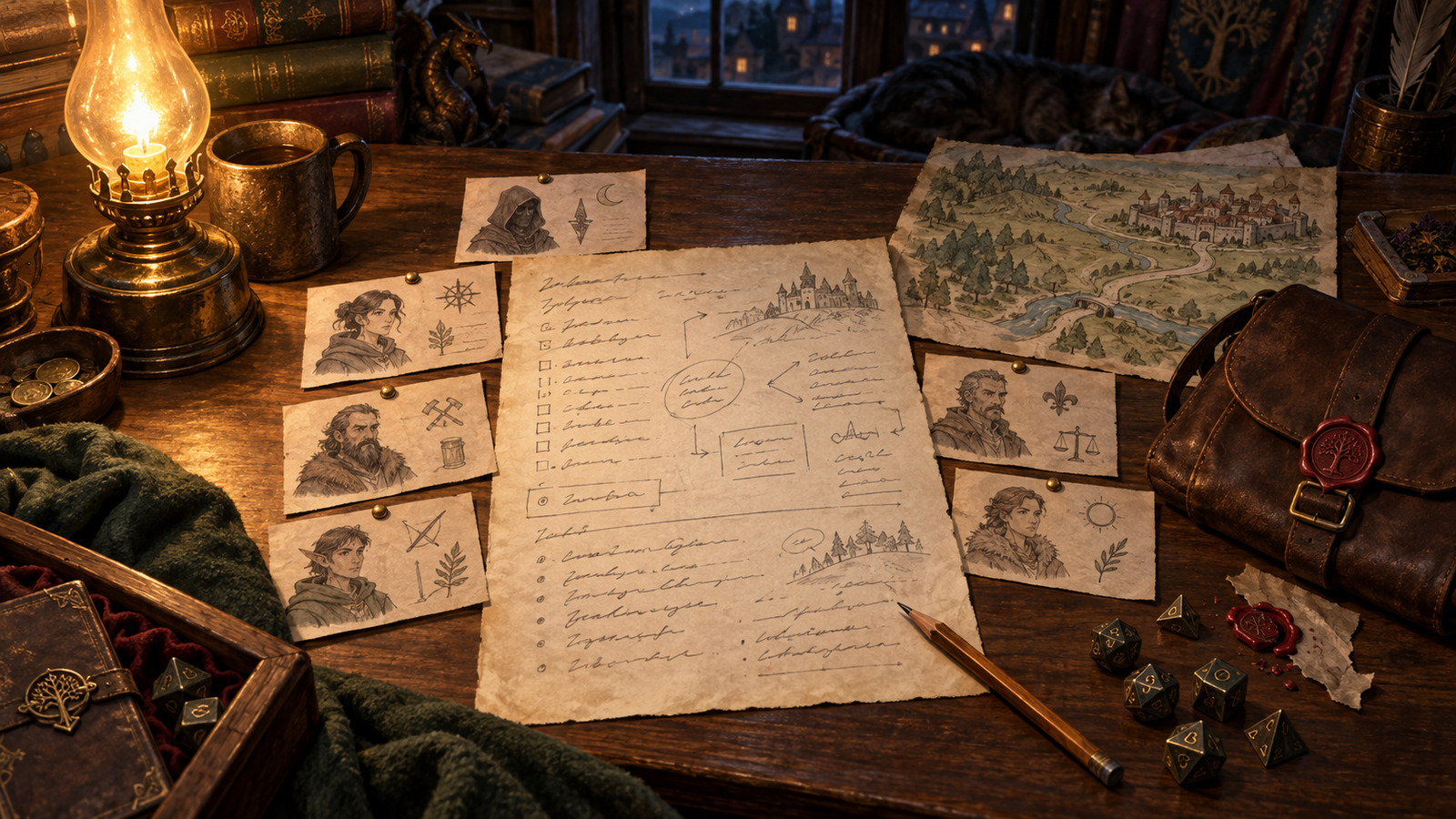
You do not need to write the whole session
Most newer GMs who get stuck here have already done the hard part. They have a hook, they can improvise a conversation, and they know the players will not follow a plan exactly. What they lack is a way to turn one hook into enough material for three or four hours without writing a story the players then have to walk through.
The answer is to prepare things that respond to the players instead of things that happen to them. People with goals, places with dangers and opportunities, information that can be found several ways, and a situation that changes if nobody deals with it. With those in hand, whatever the players try, you have something to say next.
Nine prep steps in three phases
Treat this as a checklist, not a quota. Prep in proportion to uncertainty: spend time on what you do not yet know how to run, and skip or compress what is already clear from the campaign. A combat-heavy session may need stats and terrain but little clue prep; a court session may need people and motives but one location; a journey may need routes, hazards and discoveries instead. Use the steps to find gaps, then stop when you can answer the players' next meaningful question.
The steps are a prep order, not the order scenes will happen in during play:
Understand the situation
- Start from where play begins What just happened, where are the characters, and what is demanding their attention in the first few minutes? For a continuing campaign, this comes straight from last session's ending.
- Define tonight's pressure Name what is changing whether or not the characters act. Pressure means motion, not necessarily danger or urgency: a threat getting worse, an opportunity closing, an NPC pursuing a goal, a journey changing, a social event approaching, or any situation that will evolve if nobody intervenes.
- Prep the important people Note what each important person wants, knows, fears and will do next if nobody stops them. The number depends on the session; skip the life story.
Prepare what the players can engage with
- Prep likely places and obstacles Choose the places that matter for this session. One may be enough; a journey may call for several. Give each enough to play: what is there, who is there, what can go wrong, and something worth finding. Leave the full history out.
- Prepare clues, information and opportunities If the session cannot move without a fact, do not make it depend on one exact action or one successful roll. Give critical information multiple routes; incidental information can stay discoverable in one place.
- Sketch a few likely situations Write down things that could happen depending on what the players choose: an ambush if they take the road, a bargain if they visit the official, a fire if they wait. These are possibilities, not a scene order.
Prepare to react
- Know how the world reacts For the main pressure, decide what follows if the players succeed, fail, delay, avoid it or try something you did not plan for. One line each is enough.
- Keep flexible material in reserve A handful of names, a spare complication, a minor NPC and a location you can place anywhere. Reserve material covers the moment the players go somewhere unexpected.
- Make a one-page run sheet Copy only what you need to see during play onto a single page: the opening, the pressure, the people, the places, the clues and the reserve. Everything else stays in your notes.
Scripted prep versus playable prep
| Area | Scripted prep | Playable prep |
|---|---|---|
| Story | Scene A leads to scene B, which leads to scene C | A situation that changes over time, with several ways in |
| NPCs | NPC X must reveal clue Y | NPCs have goals and know things, and act on them |
| Places | The players must visit location Z | Places hold dangers and opportunities the players can choose between |
| Clues | One clue in one place, found one way | Critical facts have multiple routes; incidental clues may have one |
| Encounters | A fight happens at a set moment | Threats are ready to appear when the fiction calls for them |
| Outcomes | The session ends at a planned climax | Consequences follow from what the players actually did |
Predicted beats are fine as long as they are not requirements
Structured prep is not the problem. Plenty of GMs run better sessions when they have imagined a likely opening, a likely confrontation and a likely ending. The difference is how you hold them. A predicted beat is a tool you can move, change or drop; a required beat is something the players must reach before the session can continue.
A quick check is to ask what happens if the players never meet this NPC, never enter this building or never find this clue. If the answer is that the session breaks, give that piece another route in or let the pressure bring it to them.
Example
Worked example: the missing courier
The hook is short: a courier carrying evidence against a local official vanished on the road into town. Here is that hook taken through the prep steps. This is what the GM prepares, not a record of how the session will go.
- Starting situation
- The characters arrive in Harrowgate as the courier's horse walks in riderless, saddlebags cut open. A crowd gathers at the gate.
- Active pressure
- The evidence is a ledger showing that Reeve Callan has been skimming the grain tax. Callan's men are searching for it too. The magistrate's circuit judge arrives in two days, and without the ledger Callan walks free.
- People
- Reeve Callan wants the ledger burned and fears the judge. Maren, the courier's sister, wants her brother found and does not trust the watch. Sergeant Dosh is Callan's man and is nervous about how far this has gone. Old Tebb, a hedge-trader, saw the ambush from the ditch and wants paying before he talks.
- Places
- The ambush site on the mill road, with churned mud and a dropped signet. The mill itself, where the courier is being held in the grain loft. Callan's counting house, where a copy of the tax rolls could prove the theft on its own.
- Essential information and ways to find it
- The courier is alive at the mill: Tebb saw the cart turn that way, the mud at the ambush site shows it, or Dosh admits it if pressed. Callan ordered the ambush: the signet is his household's, Dosh can confirm it, or the counting house letters show it.
- Likely complications
- Callan offers the party a generous job to leave town. Callan's men are already at the mill. Maren goes to the mill alone if the party takes too long.
- If the party delays
- By the next morning the courier has been moved and the ledger is ash. The party can still expose Callan through the tax rolls, but it is harder and Maren blames them.
- Plausible directions
- A rescue at the mill. A quiet search of the counting house. A deal with Dosh to turn witness. A public confrontation at the gate. The GM does not choose between these; the players do.
- Why it works
- Every direction has material behind it, and the important facts have more than one route. If the players do nothing, the pressure moves on its own and gives them something new to react to.
Example
The finished one-page run sheet
The same prep, cut down to what the GM needs to see during play:
- Open
- Riderless horse at the gate, saddlebags slashed, crowd forming. Maren pushes through.
- Pressure
- Callan wants the ledger burned before the judge arrives in two days. Morning: courier moved, ledger gone.
- People
- Callan (burn it, fears judge). Maren (find brother, distrusts watch). Dosh (Callan's man, nervous). Tebb (saw it, wants coin).
- Places
- Mill road ambush site (mud, signet). Mill grain loft (courier, two guards). Counting house (tax rolls, letters).
- Clues
- Courier at mill: Tebb, mud, Dosh. Callan behind it: signet, Dosh, letters.
- Complications
- Bribe offer. Guards already at the mill. Maren goes alone.
- Reserve
- Names: Wenna, Hob, Isolde, Garth. A travelling tinker with gossip. A washed-out ford on the mill road.
The 30-minute version
When time is short, run the same steps in small blocks. The timings are an example budget, not a rule; if one part is already clear, spend its five minutes where the session remains uncertain:
- Five minutes: situation and pressure Where play starts and what gets worse if nobody acts.
- Five minutes: important people The people who matter, each with a want and a next move.
- Five minutes: places and challenges The locations that matter, each with one challenge and one thing worth finding.
- Five minutes: clues and information What the players need to learn, and multiple routes to any critical fact.
- Five minutes: complications and consequences Two complications, and what happens after success, failure or delay.
- Five minutes: table-ready notes Copy it onto one page and add any stats and a short list of names.
Reusable session-prep template
Use this compressed version of the steps above as a reference. Fill in what is uncertain:
- Start: where are we, and what demands attention?
- Motion: what changes if nobody acts?
- People: who matters, what do they want, and what will they do next?
- Places: where might play go, and what is useful there?
- Information: what must be learnable, and where?
- Complications: what can change the situation?
- Consequences: what follows success, failure or delay?
- Reserve: what names, person or problem can I place anywhere?
- Run sheet: what must be visible at the table?
Was this useful?
Filling a blank prep slot
When one slot in the template is empty, such as an NPC, a complication, a rumour or a location, generate that one piece and then fit it to the situation you already understand. The generator gives you a starting point; you decide how it connects to tonight's pressure.
The Session Prep Builder walks through the same steps with your own hook. AI drafts only the steps you leave empty, suggests options for any single step, and points out needed facts that have only one way to be found. The result is a one-page run sheet you can copy or save to a vault, where the people, places and factions stay linked for next session's prep.
Open the Session Prep BuilderRelated
Tools
- Session Prep Builder Turn your hook into a one-page run sheet, with AI drafting only the steps you leave empty.
- NPC Generator A named person with a want and a secret when the people slot is thin.
- Encounter Generator A ready complication or threat for the reserve list.
- Settlement Generator A town or village with people and problems when play moves somewhere new.
- Rumour Generator Leads and gossip that give the players another route to a clue.
Other answers
- How do I turn an RPG idea into an adventure?
- How do I expand a simple RPG campaign idea?
- How much prep do you need for an RPG session?
- How do you prep a weekly RPG session quickly?
- How do I organise my GM notes and references when running an RPG in person?
- How do you write a one-shot adventure?
- How do I start GMing for the first time?
- How do you run a mystery without railroading?
- How do you improvise NPCs on the spot?
- How do I pace an RPG one-shot?