How to
How do you make a single-enemy boss fight interesting?
Give the party a changing tactical problem to solve together. Keep the boss active between player turns with limited, clearly triggered reactions, make position and terrain change what a character can safely do, telegraph its dangerous attacks so players can answer them, and let phases, damaged body parts and one secondary objective change the choices on offer. Two or three hooks that interact will hold attention longer than a large stack of unrelated abilities on one stat block.
Start here: the quick design pass
Use these questions as a menu, not a build order. Before you add hit points or another attack, choose the two or three questions whose answers interact in this encounter; a phase change and a secondary objective are options from that menu, not requirements. If an off-turn reaction or a body-part targeting procedure does not fit your game's existing action structure, either agree it as an encounter-specific rule before play or drop it:
- What can the boss do between player turns, what triggers it, and how many times can it happen before the boss acts again?
- Which positions are safe, exposed or useful this round, and what will change that in the next round or two?
- What is the boss's most dangerous attack, what visible tell comes before it, and what can players do in response?
- If you use a phase change, what changes at that point: the arena, the boss's tactics, a vulnerability, or what the party is trying to achieve?
- What could the party have scouted, overheard or worked out beforehand, and how does that information change a decision in the fight?
- If the fight needs a job beyond damage, what must the party protect, interrupt, expose, contain, lure or escape from?
- Can you name the chosen hooks in one sentence each? If a hook creates no distinct choice, cut it or merge it with another.
Keep the boss present between player turns
A single boss usually gets one turn against several party turns, so the gap between its turns is where the fight goes quiet. Fill some of that gap with responses the players can anticipate and influence:
- Reactions with readable triggers Tie the reaction to something the players did and can choose not to do again. When a character leaves the marked ground, the boss snaps at them. When a spell begins within its reach, it slams a limb down and the caster must move, lose cover or risk interruption under the normal rules for your system. A trigger the party understands becomes a choice: pay the cost, find another position, or bait the reaction with the character best able to withstand it.
- Interrupt windows Some abilities should take time. The boss rears up to breathe, digs in before a charge, or draws power from an exposed core. State what is happening and when it will resolve, then let players interrupt, break line of sight, move the target or accept the risk and keep attacking. The window only matters if more than one response can plausibly work.
- Environmental responses Let the boss's size and behaviour change the room without giving it another full turn. A tail sweeps loose scree into a corridor. A burrowing exit collapses one ramp. A missed heavy attack cracks the floor a character was counting on. Keep the effect visible and local, so players can plan around the new shape of the arena rather than track a separate hazard turn.
- A limited budget, spent openly Cap how often the boss can respond before its next turn, and track that cap where players can learn it from play. Scarcity is what makes baiting worthwhile: if the party draws out the snap attack early, the healer may move safely later in the same round. Unlimited off-turn attacks teach players that their choices about timing change nothing.
Optional Dungeons and Dragons (D&D) 5e example: in the 2014 rules, legendary actions let a creature act outside its turn, while lair actions resolve at initiative count 20; see the 2014 Monster rules. The 2024 creature rules also describe legendary actions, with their own stated use limits. Mythic actions are a separate feature used by specific monsters in Mythic Odysseys of Theros. These are distinct rules, not interchangeable extra turns. Use a creature's printed options and limits for the edition and source you are running. A legendary action that repositions the boss or changes the arena often creates more decisions than one that simply repeats its best attack.
Make position a decision, not a backdrop
One enemy can only be in one place, which is an advantage for the designer. Where it stands, faces and can reach should shape every round:
- Give reach a geography Mark where the boss can strike without moving, where it must expose itself to reach, and where it cannot reach at all. A ledge it cannot climb, a doorway too narrow for its bulk and a pool it avoids are all tactical facts players can use, provided you describe them before they become a trap.
- Make cover temporary Boulders, pillars and barricades should crack, topple or become dangerous as the boss acts on them. Players then choose between spending a turn moving early, staying for one more action behind weakening cover, or drawing the boss's attack towards the strongest obstacle.
- Reward diving in and out Put something worth reaching close to the boss: a weak point that can only be struck in melee, a lever, a wounded ally, a dropped weapon. Then give characters a reason to leave again before the telegraphed reply lands. Movement abilities, thrown tools and ranged attacks gain value when range itself changes the risk.
- Change one route at a time When the arena changes, alter the route, elevation or hazard the party is currently using, and leave another option open. If every exit closes at once, the players have received an instruction, not a problem. One broken ramp asks who crosses by rope, who stays to cover them, and who keeps the boss occupied meanwhile.
Telegraph the dangerous attack, then let players answer it
Describe the tell in terms a character can act on. The boss scrapes one forefoot and lowers its head towards the bridge. Heat builds in the cracks along its throat while the air begins to shimmer. A tail stops moving a breath before it sweeps. Say who or what appears to be targeted, how much of the arena the attack will cover, and when it will land if nobody intervenes. Players do not need the exact damage, saving throw or Armour Class (AC) values; they need enough to weigh moving against acting where they stand.
Offer several kinds of counterplay and let more than one succeed. A character might move out of the marked line, bait the charge into a pillar, interrupt the wind-up, protect the character who cannot move, or deliberately take the hit to finish freeing a trapped ally. If the only answer is the one saving throw the boss's attack already requires, the telegraph has added description without adding a decision.
Avoid the unavoidable surprise. The first use of a signature attack should establish its scale through a near miss, damage to the arena, a warning from a scout who has seen the creature hunt, or a weaker version the party can read. After that, a player who stays in the marked area has made a gamble with known stakes. That gamble can fail badly and still feel fair, because the table saw the choice being made.
Let phases change the question the party is answering
Set the phase trigger before the fight, and prefer a trigger the players can see coming or cause themselves:
- Change the arena The floor gives way, water rises, the boss burrows out through a wall, or the fight moves onto a slope of loose stone. Distances, cover and escape routes change, so the plan that worked in phase one needs revising rather than repeating at higher damage.
- Change the boss's behaviour A cautious predator becomes reckless once wounded; a controlled construct loses its handler's restraint; a duellist abandons honourable single combat and starts attacking the support characters. Telegraph the new priority through action, so players can exploit the recklessness or protect the new target.
- Change what is vulnerable Armour cracks, a ward fails, a previously guarded organ is exposed, or a body part the party damaged stops working. The new opening should reward the attacks and observations that created it. A phase that only restores the boss to full health while it becomes immune to the party's best tactic teaches players that their progress was provisional.
- Change the objective The boss stops defending the gate and tries to escape with the egg, the hostage or the artefact. The party's question changes from how to kill it to whether to pursue, block the exit, save what it has endangered, or let it go and deal with the consequences.
Run a phase change as an event inside the fight, not a pause in it. Resolve the attack or collapse that caused it, describe the new state briefly, and continue from the current positions, resources and initiative order. If a character was mid-plan, let the plan still do something useful under the new conditions. A long description while the party watches, followed by the boss acting from a reset position with its spent abilities restored, removes the agency the phase was meant to create. If the party kills or drives off the boss before a later phase, that is a result to honour, not a cue to hold the boss together until the remaining phases have been shown.
Pay off scouting, investigation and preparation
Before the fight, leave evidence the party can actually find: claw marks that show how the creature turns, a carcass with one foreleg torn in a rockfall, a hunter who noticed it favouring one side, tracks that avoid a particular mineral or sound. Put the same information in at least two places where you can, because a single failed check should not quietly delete the design work. During the fight, repeat the clue in observable form. The boss keeps weight off the cracked foreleg. It flinches from the ringing of the quarry bells. Its charge drifts slightly to one side.
Information should change a tactic, not merely add a damage bonus. Knowing the foreleg is weak gives the party a reason to bait a charge into the standing stones and then decide who risks the close attack. Knowing it hunts by vibration gives them a reason to throw tools as decoys, move carefully, or make noise in the wrong place on purpose. A destructible body part works the same way: breaking the horn removes the goring attack but may make the creature ram with its shoulder, so the party has traded one known danger for a different, manageable one. If the party never found the clue, let them learn the first part of it from what the boss does in phase one and act on it from phase two onwards.
Give the party a second job
One secondary objective is usually enough alongside the boss itself. Choose a job that pulls characters into different positions rather than one that simply absorbs attacks:
- Protect A guide, prisoner or wounded ally must survive the fight in a place the boss can threaten. Healing, cover and body position matter alongside damage.
- Interrupt or expose Someone must hold a mechanism open, ring the quarry bell, keep a light on the weak point or stop a charging-up ability while others keep the boss from reaching them.
- Contain or lure The boss must be kept inside the pit, drawn away from the settlement, or steered into ground the party prepared. Movement and baiting become attacks by other means.
- Take or escape The party came for the egg, the records or the antidote, or it only needs to cross the lair and get out. Killing the boss becomes one route among several, and a retreat that achieves the objective is a genuine success.
Stop at two or three hooks
A hook earns its place when it gives players a decision the other hooks do not. A telegraphed charge changes where characters stand. A breakable foreleg changes what they target. A closing gate changes how long they can afford to stay. Those three interact: baiting the charge may expose the foreleg, and striking it may cost a character their chance to reach the gate. By contrast, a boss that also summons minions, rotates elemental immunities, runs a puzzle lock, poisons the air and gains a new form at half health asks the Game Master (GM) to track five systems whose choices mostly reduce to working out which one is currently switched on.
Test each addition with one question: what will a player choose differently because this exists? If the honest answer is that they will make the same attack and note another number, fold the idea into an existing hook or save it for another encounter. Keep the running state short enough to say aloud in one breath: boss position, reaction spent or available, phase trigger approaching, one danger marked. In 5e terms, that discipline applies to legendary and lair actions too, which work best chosen for the choice they create in that round, not worked through in a fixed rotation. For the underlying numbers (how many effective actions each side gets, and whether one powerful enemy balances against a group at all) see the related answer on balancing one powerful enemy against many weaker enemies. For making the same boss matter to the campaign, rather than to each round, see the related answer on making a boss fight memorable.
Example
Worked example: the cliff predator
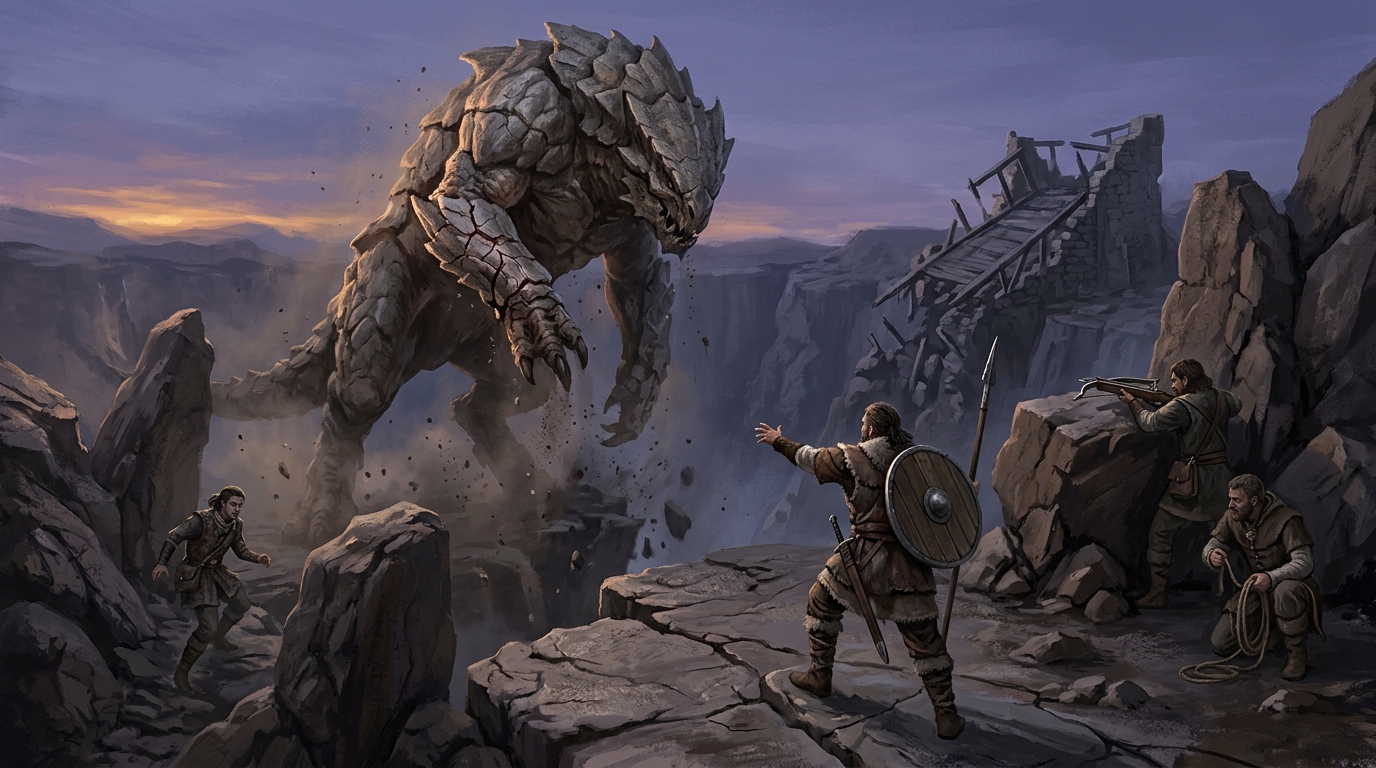
A burrowing predator has taken over a quarry ledge above the only road through the pass. It dragged the survey crew's chest to its burrow mouth and guards it as a food cache: salted rations are packed beside the medicines, and the foreman has watched it turn back whenever a load shifts near the chest. The party can fight it, lure it away from the road, or steal the chest back and leave. On the approach they can find claw marks curving left around the standing stones and a dead mule charged from above. The foreman volunteers that the creature keeps weight off its right foreleg since a rockfall last winter, and that it swung its head towards a pickaxe dropped on stone before anyone saw it move, so sound carried through rock draws its attention.
Use three hooks only: a telegraphed charge, a foreleg the party can damage in stages, and ledges that break. The timings and counts below are rulings for this encounter; adapt them to your system rather than treating them as general mechanics.
At the start of the predator's turn, apply only the first rule that matches and ignore the rest for that turn. If the foreleg already has two marks, cancel any marked charge and do not burrow; the fight moves straight to phase 3, and if burrowing has not happened yet the arrival ramp is still intact, so phase 2 is skipped. If it has exactly one mark and has not yet burrowed in response to that mark, burrowing cancels any marked charge and takes that whole turn as described in phase 2; on later turns with that same single mark, a marked charge resolves normally. If it has no marks, resolve any marked charge as described in phase 1. Successful play can therefore skip a phase, and no phase has to happen.
- Phase 1: observe and bait (the question is where to stand)
- Run the charge as one sequence. At the end of the predator's turn, it scrapes its left forefoot twice, lowers its head, and you mark the straight line from where it stands to a named stone, character or point on the far side. That line is now committed and does not track anyone who moves afterwards. During their intervening turns, characters can leave the line, shelter behind a standing stone, stand in the line to bait it, or use the pause to approach the chest. At the start of the predator's next turn, it charges along the marked line and you resolve hits, misses and collisions with your system's normal attack and movement rules. Aim the first charge at the strongest cover or the best-armoured character so the table learns the tell, the delay and the slight drift to the right. Its one reaction per round is a snap at a character who leaves cover next to it, so the party can draw that snap with a mobile character and then move the healer safely.
- Phase 2: the arena breaks (the question is how to move)
- Keep three states distinct and visible. Exposed: a charge that crashes into a standing stone knocks the loose slab off the right foreleg, so for this encounter the plating can be targeted until the end of the predator's next turn, when it turns the leg away again unless it has cracked. Cracked: the first successful targeted hit in that window widens the pale cracks and drops flakes of plating; the leg still bears weight, and the plating stays targetable from then on. Disabled is defined in phase 3. A targeted attack is declared before rolling and resolved normally, including any called-shot rule your system already has; a hit deals its normal damage and adds one foreleg mark, a miss adds none, so the first mark means cracked and the second means disabled. On that burrowing turn it dives where it stands and surfaces through the lower ledge. Nobody moves for free, the arrival ramp collapses and two standing stones drop, and play continues from the current positions and order. Any later burrowing uses the same whole turn, telegraphed the turn before by dust lifting and stones shifting where it will surface. Now the party can cross the broken ramp with rope and cover, climb to the high ledge the predator cannot easily reach, or stay low where the cracked foreleg can be struck.
- Phase 3: desperate counterplay (the question is what to finish)
- When the foreleg takes its second mark, it visibly buckles and will not bear a charge again. The predator then stays close, sweeps its tail at characters who gather behind it, and tries to pull its food cache back into the burrow, which is the guarded behaviour the foreman described, now urgent because it can no longer hunt the road. The party chooses under pressure: finish it at close range while managing the tail sweep, seize the chest and retreat across the ramp under cover, or bang tools on stone away from the burrow mouth, using the vibration response the foreman reported, to draw it off while somebody enters the nest. If the foreleg never reaches two marks, this phase does not arrive in this form: the predator keeps its charge, and if driven off it leaves the chest where its guarding failed. Either way the ending follows from what the players did to the creature and the ground, and a party that takes the chest and leaves has won the encounter they actually needed.
Was this useful?
Keeping the boss, its hooks and its arena together
Codex Cryptica does not design the encounter's mechanics or balance it for a system. What it does hold is the creature, the quarry ledge, the foreman and the survey crew as linked pages in the vault, so the foreleg clue planted in the foreman's account is still there when the fight reaches the table several sessions later. Recording the two or three hooks, the phase trigger and the tell alongside the creature entry keeps the design in the one-hook-per-decision shape this answer recommends, rather than growing a new ability each time you revisit the notes.
Try the creature generatorRelated
Tools
- Creature generator Give the single enemy an identity, a hunting behaviour and a weakness the party can scout, then add your two or three tactical hooks.
- Encounter generator Draft the arena, the secondary objective and the participants around the boss, then apply the design pass above before play.