How to
How do I save my party from an overpowered encounter?
Pause long enough to judge whether the fight is actually unwinnable, comparing what the enemies will do next with the progress the party can still make towards winning, escaping or ending the fight. Correct any rules mistake openly, and let the enemies act on goals they already have: guarding a place, finishing a ritual, taking a captive or protecting their own escape. Telegraph an opening, a negotiation or a retreat route the players can choose to use, and if the party still loses, give that defeat a consequence the campaign can continue from, such as capture, a lost relic or an unwanted bargain. If the numbers themselves are broken, say so briefly out of character and agree the fix with the table.
At-the-table decision aid
Work through these in order and stop at the first step that changes your next action. You can pause for a transparent out-of-character discussion at any step, as soon as you spot a genuine preparation mistake or the table raises a concern.
- Is this unwinnable? Compare the enemies' next turns with the progress the party can still make.
- Was there a rules error? Correct it openly and restate the result.
- What goal does each enemy already have? Show it through position, target or an action not spent attacking.
- What opening, negotiation or retreat can you telegraph, at what visible cost? Let the players choose.
- Put any GM-controlled ally on one supporting task and keep the decisive action with a player character.
- If the party loses, apply the consequence that follows from the enemy goal and the agreed stakes.
Triage before you intervene
A character at half hit points (HP) after one hit has taken a frightening hit. That hit on its own does not prove the party is about to suffer a total party kill (TPK). A single strong attack can be a critical hit, a high damage roll or an ability the enemy cannot repeat every round. The party may still have most of its healing, control effects and defensive abilities left, and the next two rounds may look very different from the first one. Intervening before you know which fight you are in can remove a victory the players were about to earn.
Take one quiet minute while the next player decides what to do, and compare survival against progress: how soon the enemies can drop or trap the party against what the party can still achieve before then.
The one-minute triage check
Work through these in order. Keep the answers short: a few numbers and names, not a full recalculation.
- Survival versus progress Set two warning signs side by side. First, what will the enemies plausibly do on their next turns, given position, available actions and last round's typical damage, and who could fall or be trapped as a result? Warning signs include two characters likely to fall before they act again, healing already spent, or an exit about to close. Second, what progress can the party plausibly make before then: meaningful damage or control on an enemy, a step towards the exit, an interrupted task, or terms the enemy might accept? No progress route is the stronger warning sign, however many rounds the party might merely endure. If neither side of the comparison is clear, pause and reassess rather than assuming time will help.
- Resources still in hand Note unused healing, potions, protective spells, reactions, movement abilities and any item the party has not yet used. An untouched healing spell and a character who has not acted yet can reverse a bad opening round. Empty slots and spent abilities cannot, and that difference decides whether you wait or act.
- Turn order and control Check who acts before the enemies act again, and whether any enemy is currently restrained, frightened, prone, concentrating on a spell or otherwise limited. Read the exact wording of each effect: which actions it prevents, whether it stops movement or reactions, and when it ends. A controlled enemy may deal no damage next round, which changes the survival count at once.
- Enemy output, honestly counted Count attacks or area abilities that can actually reach a target from current positions, not every attack printed on the stat blocks. Note whether last round's damage was typical or a spike: check your system's critical-hit rule before treating a high roll as the new normal. In 2014 D&D, for example, a critical hit rolls all the attack's damage dice twice, so compare the ordinary damage range with what was rolled.
- Player experience and decision load Inexperienced players who overthink combat often hold useful options they have not recognised, including equipment already on their character sheets. That is a prompt to surface information clearly on their turns, such as reminding the table which items and exits are in the room. It is not a reason to play their characters for them.
Correct actual mistakes first
Before changing the fiction, check the arithmetic and the rules you have already used. Re-read the enemy attacks, damage, resistances and vulnerabilities, saving throws, concentration requirements, conditions and how many actions each enemy actually gets. Confirm you applied character resistances, cover and disadvantage or advantage correctly, and that nobody has been charged twice for the same bonus. A surprising number of lethal rounds contain one ordinary error: an extra attack, a missed resistance, a condition that should have ended, or damage dice rolled one size too large.
If you find a mistake that matters, correct it openly and briefly. Say what was wrong, restate the corrected result, and play on. For example: that attack should have dealt half damage against resistance, so the character regains the difference.
Let enemy behaviour follow goals the enemies already have
An enemy who stops trying to win looks like a rescue. An enemy who pursues a goal the players already know about creates a different fight, one the party can interfere with:
- Defend a place or object A guardian holds a doorway, altar or coffin rather than chasing wounded characters across the room. Telegraph the boundary: the enemy advances to the threshold and no further. The party can then choose to break past, draw the guardian out, or withdraw and reconsider.
- Finish a task that takes time A ritual, summoning, escape preparation or act of destruction that needs further rounds splits enemy attention. Each round spent on the task is a round not spent attacking, and the party gains a visible target: interrupt the task, protect their own objective, or use the delay to leave.
- Take a captive or a prize Where greed, orders or a grudge support it, an enemy may grab a fallen character, a relic or a hostage and move to leave. Name the demand plainly so the players can resist, bargain or follow. Captivity must follow from that motive and from the table's agreed stakes, not appear because the dice went badly.
- Negotiate from strength A confident villain can offer terms mid-fight: surrender an item, swear an oath, leave and never return. The offer only works if refusal remains possible and the villain's behaviour after refusal was already clear. A scripted surrender demand that the players must accept is railroading with dialogue attached.
- Withdraw or protect itself An enemy that is hurt, exposed or has what it came for may retreat to a stronger position or leave entirely. That behaviour needs a trigger the players can see, such as a broken ward, a fallen ally or a seized prize, rather than sudden caution at the exact moment the party needs relief.
Offer openings the players can choose to use
Once goals are moving, surface one or two openings that follow from the room and the enemies in it. Useful openings include ground the enemies cannot easily cross, light or terrain that affects one side, a divided objective that pulls the opponents apart, a weakness the party can test, or equipment already in the room that the players have overlooked. Every opening needs a telegraph the players can act on without you announcing the solution: describe the cracked support, the uncovered window, the enemy glancing at the door, or the weapon catching the light on the table where it was left.
Then let the players decide. If they have overlooked an item that could help against the actual creature they face, describe it again in the room narration and let its owner choose whether to pick it up, what it does when used, and whether the moment is worth the action it costs. Do not force the item into a character's hands, declare that it works against a creature whose weaknesses you have not established, or count the fight as saved before anyone has spent a turn on it. An opening the players spot and choose teaches them the fight is winnable. The same opening imposed on them teaches them to wait for the next one.
The Game Master (GM) controlled ally, where the party has one, belongs in this supporting role. That ally can heal, hold a doorway, identify what a telegraphed feature might do, or keep one lesser threat busy. The ally should not out-damage the party, solve the main enemy alone, or produce the one effect the encounter secretly requires. If the ally has been overshadowing the player characters, triage is the moment to give the ally a necessary supporting task and return the main choices to the players.
Make retreat and surrender real options
Many parties die standing still because retreat was never described as available, or because an earlier scene implied the only honourable choice was to fight on. If an exit exists, describe its route, cost and threats. Under the 2014 D&D rules, speed and remaining movement determine whether a character can reach it this turn; Dash adds movement but uses the action, while Disengage uses the action to prevent opportunity attacks for that turn. Disengage does not let a character pass through a hostile creature occupying the route or stop an enemy following and attacking on its next turn. If a guard blocks the only way out, say so: clearing or bypassing it is a separate task with an uncertain outcome. The door might be barred behind the party at the price of the treasure room, or the enemies might let them leave without the relic they came for. Costs make retreat a decision rather than a failure screen.
Do not retroactively block the exit once the party chooses it, invent a pursuer who cannot be escaped, or require a string of successes the fiction never signalled. Run pursuit, surrender or capture by the same goals you established for the enemies. If the villains wanted the party gone, they let them go and take the consequences of that choice into the next session. If surrender was offered, honour its terms or show the betrayal as the villain's decision with consequences the party can respond to later.
Let defeat cost something without ending the campaign
If the party loses the fight, defeat does not have to mean every character dies and the campaign stops. Where the enemies' goals and the table's agreed stakes support it, the outcome can be capture, robbery, a lost ally taken elsewhere, the villain escaping with the prize, or a bargain the party accepted because the alternative was worse. The consequence should be specific and playable next session: a cell to escape, a debt to repay, a trail to follow. The players should be able to point to the choice or failed roll that produced it.
That differs from plot armour. Plot armour means the party discovers afterwards that they could never have died, whatever they did. A consequential defeat means they lost something real, the world moves on accordingly, and the next session starts from the new position. Agree the outer boundaries before you need them where you can: some tables welcome capture arcs, others do not want certain outcomes at all, and those agreements outrank any technique in this answer.
If the numbers are genuinely broken, say so
Sometimes triage finds a real error in preparation rather than a hard fight: the wrong stat block, a creature far beyond what you intended for this party size, or damage you misread by a wide margin. In that case a brief out-of-character pause is better than an elaborate in-fiction cover-up. Name the mistake in one sentence, propose the smallest correction that restores the fight you meant to run, and check the table is content to continue. Most players accept an honest correction readily because it protects the meaning of their own decisions for the rest of the encounter.
Reserve secret dice changes and silent hit point reductions for nothing. Even when undiscovered, they leave you unable to judge your own encounter design, and they make the next correction harder to offer openly. If your table has an explicit agreement that the GM may adjust dice behind the screen, that agreement governs your table. Without one, assume the players expect the numbers they see to be the numbers in play.
Fair adjustment or rescue: a quick comparison
| Choice at the table | Fair adjustment | Rescue or railroading |
|---|---|---|
| Enemy changes behaviour | Established goal, visible trigger | Sudden mercy when help is needed |
| New opening appears | From the room as described; players choose | Unforeshadowed rescuer settles the fight |
| Rules mistake found | Corrected openly, result restated | Dice or hit points quietly changed |
| Party retreats or bargains | Costs stated, choice honoured | Exit blocked, or terms forced |
| Party loses | Specific loss, carried forward | Survives unchanged; death ruled out |
Example
Worked example: the haunted manor, three ways it can end
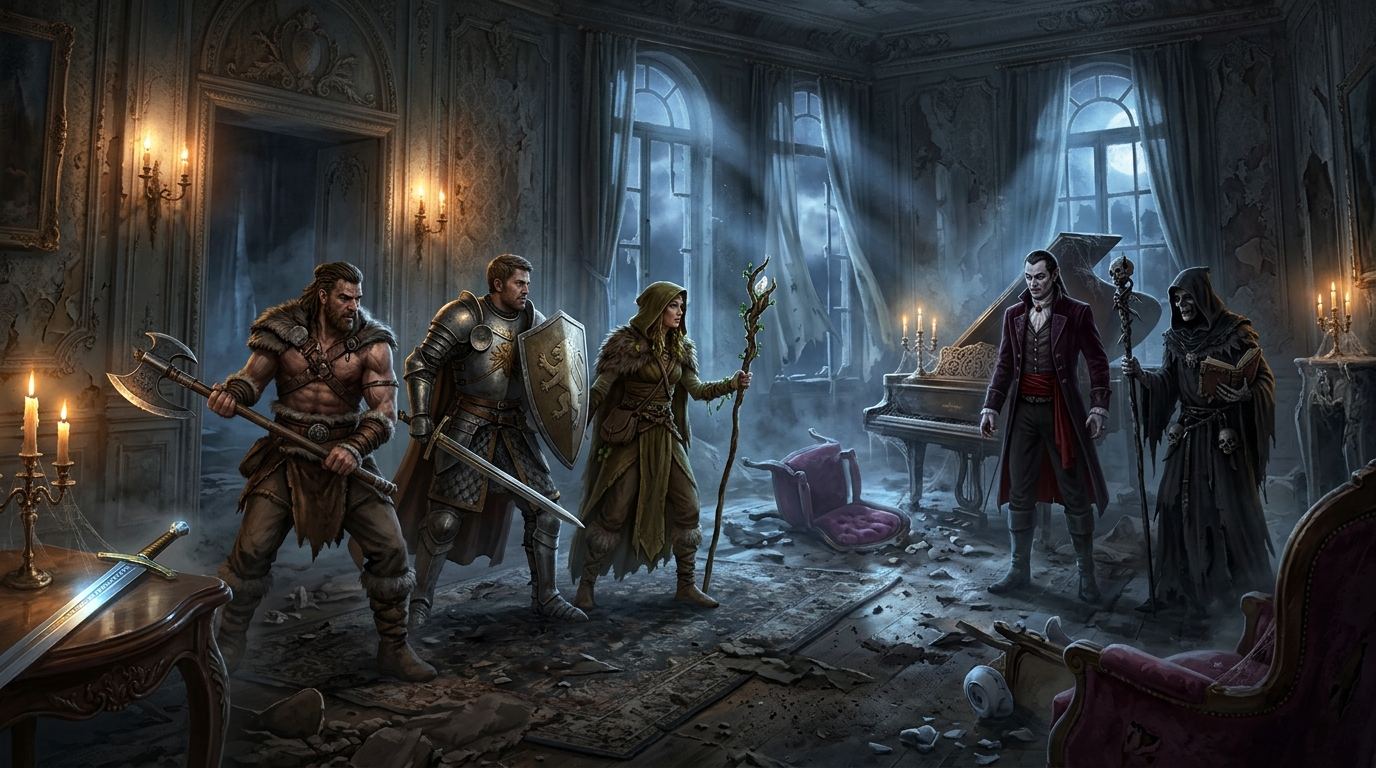
A new GM runs a short haunted manor adventure for three level 7 player characters in Dungeons and Dragons (D&D), a barbarian, a paladin and a druid, helped by a level 8 wizard the GM controls. They face a Dirge Master and an elf vampire whose full third-party stat blocks the GM has to hand. After one hit each, several characters are at roughly half HP. The players are inexperienced and taking a long time over each turn. This example uses the 2014 D&D rules and does not assume the vampire's Challenge Rating, HP total or weaknesses, because the outcome depends on the actual stat blocks and the party's remaining resources, not on the creature's name.
Three facts are established before the branches diverge. The paladin attuned to the Sun Blade's hilt during a short rest earlier in the manor and set the hilt on a side table to examine a lock just before the fight, so the hilt in the room is already attuned to the paladin. The wizard carries the party's one potion of healing. A second, unguarded side door opens from the fighting room into the corridor leading to the manor entrance; a bolt on its corridor side can be slid into place with an action. The adventure has also established that the vampire wants intruders taken alive so it can question them about who sent them into the manor and who else knows where its resting place lies, and the Dirge Master follows that order.
Applied to this party, the check comes down to facts already on the table: the potion has not been used, the hilt is attuned and within reach on the side table, and the take-alive order gives the party a route besides damage to test. The branches below follow from those facts and from where the players' own choices take the fight.
- They win: the party finds and uses an opening
- The GM re-describes the room as it already stands: the hilt on the side table, the tall windows with their heavy curtains, and the two enemies favouring different ground, one holding the doorway and one near the stairs by that table. On the paladin's turn the GM names those visible facts again without naming the tactic. The players choose to separate the opponents. The barbarian holds the doorway enemy. The paladin moves to the table, picks up the hilt, and uses a bonus action to cause the radiant blade to spring forth, as the 2014 Sun Blade description requires. If the vampire by the stairs is within reach, the paladin then uses an action to attack it. The GM checks the vampire's actual stat block before describing any extra effect: the blade's radiant damage and any additional effect against undead apply only as that block and the item description support, and sunlight matters only if the block gives the creature a relevant sensitivity. On the wizard's own turn, the wizard uses an action to administer the potion of healing to the wounded barbarian beside the wizard. With rolls of 3 and 2 on its 2d4 + 2, the barbarian regains 7 hit points. That is the wizard's action for that turn, so the wizard does not also hold or control the second enemy in the same turn. The party may still lose a character before the opening pays off, and if the blade proves irrelevant the players learn that from the result and fall back on the other branches.
- They escape or negotiate: the villains want living prisoners
- Early in the fight, before anyone has fallen, the vampire states the established order aloud where the party can hear it: take them alive, because dead intruders cannot say who sent them. The Dirge Master moves to cover the main door rather than pursuing the most wounded character, showing the party both the intention and the obstacle. The side door already established in the room opens into the corridor leading to the manor entrance and is unguarded, so the route past the Dirge Master is physically open; the party can head for it, but the guard may follow. The vampire offers terms from strength: drop your weapons, submit to questioning, and then leave the manor and do not return. If the party accepts, hold the vampire to those terms: the party is disarmed, questioned and then released from the manor as promised, losing their weapons and their errand for now, with no escape to plan afterwards. The party can instead bargain for better terms, or refuse and try for the side door. Under the 2014 rules, speed and remaining movement determine whether each character can reach it this turn. A character who leaves the Dirge Master's reach without Disengaging may provoke an opportunity attack if that enemy still has its reaction; Disengage prevents that attack for the turn, but normally uses the action that could have been spent on Dash for extra movement. It does not let a character move through the guard's occupied space or stop the Dirge Master following and attacking on its next turn. Once through the side door, a character can use an action to slide the corridor-side bolt into place; that may delay pursuit while the enemies open or break through the door, though it does not guarantee escape. The vampire may decide questioning the party is worth the pursuit, or stop to protect the manor and renew its offer. Refusal returns the fight to the victory branch at its current cost. The wizard can point out the route and its risks, but the choice belongs to the players.
- They lose, and the story continues
- This branch is for a party that refuses the offered terms, or never accepts them, and fights on: being knocked out is a different outcome from surrender under that bargain, and capture is not guaranteed. Under the 2014 rules, a melee attack, including a melee spell attack, can knock a creature unconscious and stable when it reduces them to 0 HP. Other damage normally leaves a surviving character unconscious, with death saves starting on their turn; check instant death and any specific creature effect first. So enemies acting on the take-alive order must use a qualifying melee attack and choose to knock out if they want a stable prisoner; otherwise survival depends on death saves, help from an ally or timely stabilisation. A character who has already died remains dead unless the table openly agrees to change that result. Only survivors forcibly captured in this way wake bound and awaiting questioning, with the wizard captured alongside them sharing the setback rather than freeing everyone alone, and confinement and an escape to plan. If you intend the vampire to break a promised release instead, present that as the vampire's betrayal and give the party a way to respond to it, rather than treating confinement as the bargain's normal ending. The GM checks this outcome against what the table has agreed about capture before using it, and states the consequence plainly rather than revealing that death was never possible.
After the session: fix the preparation, not the players
Write down what triage found whilst you still remember it: the damage that spiked, the party size and experience level the encounter actually faced, resources already spent before the fight, and any warning sign the players could not have read. Small parties have fewer actions and less spare healing, so an encounter that looks reasonable for four experienced players can overload three newer ones who need longer over each decision. Note also whether the GM-controlled wizard drew focus from the player characters, and reduce that ally's role or hand the character to a player next time if so.
Keep those notes brief and use them when you next build an encounter. For encounter construction, danger signalling and building pressure you can adjust before initiative, see the related answer on balancing encounters without a TPK. For choosing between one powerful enemy and several weaker ones, see the related answer on balancing a single enemy against a group.
Was this useful?
Related
Other answers
- How do I balance RPG combat encounters without causing a TPK?
- How do I balance one powerful enemy against many weaker enemies in a tabletop RPG?
- How do you make a boss fight memorable in a tabletop RPG?
- How do you handle character death in a tabletop RPG?
- How do you make a single-enemy boss fight interesting?