Framework
What can I do on my turn in D&D combat?
On your turn in D&D combat you can usually move up to your speed and take one action, and you sometimes have a bonus action if a class feature, spell, or piece of equipment gives you one. You can also interact briefly with something nearby and speak a few words. A reaction responds to a specific trigger, often on another creature's turn but sometimes on yours; after you use one, you cannot take another until the start of your next turn. Your class and features decide the interesting options inside those buckets, so describe what you want to accomplish and let the Dungeon Master tell you which action fits.
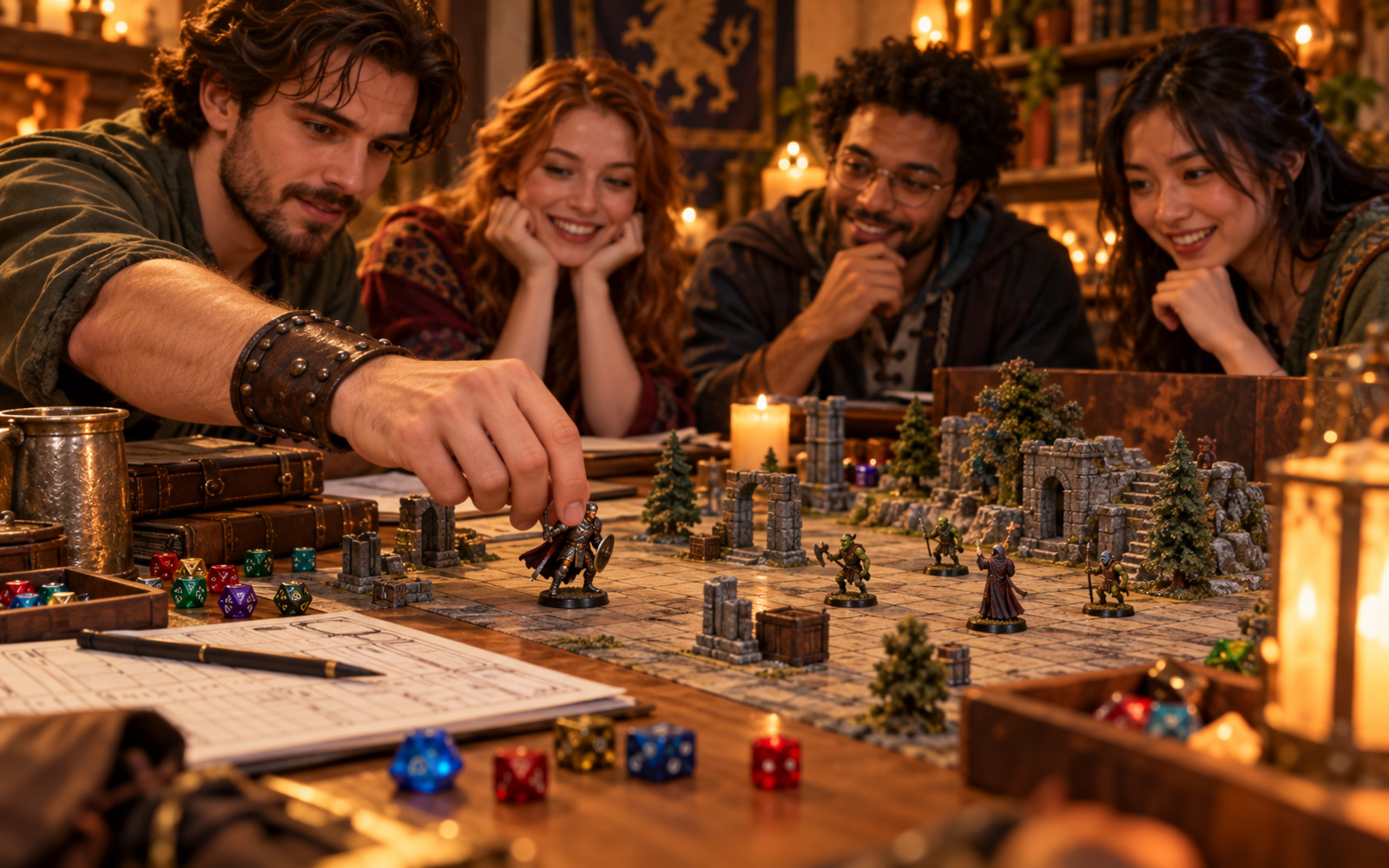
Think of your turn as a short menu
Combat in D&D pauses the free-form conversation and puts everyone in turn order. At the start of a fight each participant rolls initiative, usually a d20 plus Dexterity modifier, and the Dungeon Master arranges the results from highest to lowest. That order then repeats round after round until the fight ends, and the DM will tell you when initiative begins and when it is over.
On your turn you pick from a small, repeatable menu rather than recalling a long list of rules from memory. In the current rules that menu is usually movement, one action, a bonus action only if something gives you one, a brief free interaction with an object or the environment, and a few words of communication. A reaction responds to a specific trigger, often on another creature's turn but sometimes on yours; after you use one, you cannot take another until the start of your next turn.
That framing helps you decide quickly at the table. You do not need a perfect grasp of every option. You need to know that you can reposition, do one meaningful thing, and sometimes add a small extra if your character has a relevant feature. Everything else is a choice inside those buckets.
The buckets on a combat turn
The Player's Handbook describes a turn with the same few components. Learn what each one offers before you worry about the individual action names:
- Movement You can move up to your speed on your turn, and you can split that movement before, after, or around your action where the rules allow. If you move 20 feet, attack, and have 10 feet of speed left, you can keep moving. Difficult terrain, being prone, or other conditions can change how far that movement takes you.
- Action Your action is the main thing you do. For most characters it is often an attack, casting a spell, or one of the general actions described below. You get one action per turn unless a feature says otherwise.
- Bonus action You can take at most one bonus action on a turn, and only if a feature, spell, or item grants one. A rogue's Cunning Action, a cleric's Spiritual Weapon, or drinking or administering a Potion of Healing under the 2024 rules are common examples. Other items follow their own descriptions. Under the 2014 rules, drinking or administering a Potion of Healing takes an action. If nothing on your sheet says you can do something as a bonus action, you simply do not have one that turn.
- Free object interaction You can usually interact once with something simple as part of your movement or action, such as opening an unlocked door, drawing a weapon, picking up an item, or handing something to an ally. The DM decides what is reasonable without spending your action.
- Brief communication You can speak a short sentence, call a warning, or answer a question. Longer speeches or trying to deceive or persuade someone in detail normally requires an action, and the DM will tell you when a roll is needed.
- Reaction A reaction responds to a specific trigger, often on another creature's turn but sometimes on yours. Once you use it, you cannot take another until the start of your next turn. Making an opportunity attack when a foe leaves your reach, casting Shield or Counterspell, or using a feature such as Uncanny Dodge are all reactions. Check your sheet for options that say 'as a reaction'.
Movement and action are flexible
Beginners often imagine a turn as a rigid sequence: move, then act, then stop. In practice the rules let you break movement around your action and combine them in the way that fits your intent. You can move, act, and move again; you can act first and then move; or you can stay still if holding your position matters. The DM and the battlefield layout decide whether a particular combination is possible right now.
Intra-turn flexibility is also why describing intent matters. If you say 'I want to run to the altar, grab the sigil, and duck behind the pillar', the DM can tell you whether that fits within your speed, whether grabbing the sigil needs your action or just your free interaction, and whether the pillar gives you cover. You do not need to pre-select the correct action name before you speak.
You do not have to attack every turn
Attacking is common, but many of the most useful turns change the situation another way. Consider the purpose behind the action before you choose it:
- Create space or close it Dash lets you move further when reaching a wounded ally or an objective matters more than dealing damage this round. Disengage lets you leave a threatening position without provoking opportunity attacks, which is often better than staying to attack while surrounded.
- Make the next roll more reliable Dodge makes you harder to hit when you need to hold a doorway or survive until help arrives. Help can give an ally advantage on an attack roll against an enemy within 5 feet of you. For an ability check, choose one of your skill or tool proficiencies; an ally close enough for you to assist has advantage on their next check using it. The DM decides whether the help is possible, and either benefit expires at the start of your next turn.
- Control what the enemies can see or reach Hide lets you use available cover to become unseen when the rules and the environment support it. Ready uses your action to prepare a response to a perceivable trigger you name, such as 'I will shoot the runner if he moves towards the door'. If the trigger occurs before your next turn, you can use your reaction to respond; you can also ignore the trigger.
- Learn or change the environment Search lets you look more carefully when the initial description was not enough. In the current rules, dealing with an object often uses the Utilize action, such as pulling a lever, opening a stuck chest, or using tools. Ask the DM what handling a particular object will require.
- Cast, support, or steady the group Casting a spell, using a class feature, or steadying an ally can be the right choice even when an attack would be possible. Under the 2024 rules, drinking or administering a Potion of Healing uses a bonus action; other items follow their own descriptions. Your character sheet shows which options your character can actually use, so glance at that short list rather than the full rulebook.
A note on 2014 and 2024 terminology
D&D's fifth edition has two widely used presentations: the 2014 Player's Handbook and the revised 2024 rules. The turn structure described here, movement plus action plus a conditional bonus action, is the same in both.
Where the wording differs, the main text of this answer follows the current 2024 presentation. Two points are worth noting if your table still uses the 2014 books. First, what the current rules call Utilize is named Use an Object in the 2014 book, but the idea is similar: spending your action to operate an item or piece of gear. Second, a few actions have updated detail in the 2024 rules, notably Hide, Search, and the handling of Influence and Study, which split social and recall tasks more clearly than the single Search or generic ability check the 2014 text leans on. In either version you can play the same way at the table: state what you want to accomplish, and the DM will tell you which action and roll now apply.
If you do not know the action name, describe the intent
New players often stall because they are searching for the right term to say aloud. The table does not need the term from you. It needs a clear picture of what your character tries to do and how.
A useful shape is goal plus approach: what you want to happen and how your character attempts it. 'I want the guard to look away so the rogue can slip past, so I knock over the brazier and shout that the stables are on fire' is enough. The DM can then decide whether that is a Help, a distraction that calls for a check, or an improvised action, and will ask for the relevant roll if one applies. You do not need to memorise the eight common actions as a quiz before you can participate.
This habit also keeps the game moving while you learn. You will pick up the names naturally as the DM frames your intentions back to you: 'Use your action to Help, so your ally has advantage.' After a few repetitions, the shared vocabulary builds without anyone needing to study it in advance.
Example
Worked example: the same round, two levels of preparation
A goblin stands beside an unconscious ally 25 feet from a fighter. The fighter has a speed of 30 feet, a clear route, and a Potion of Healing. The table uses the current rules with theatre of the mind and a rough sense of distance.
- The hesitant version
- The player is unsure what actions exist, worries about picking the wrong one, and spends the turn re-reading the sheet. They move within reach and attack the goblin, then end their turn. The attack is a valid choice, but the ally remains unconscious because the player did not realise they could administer the potion as a bonus action.
- The menu-driven version
- The player thinks in buckets: movement, action, conditional bonus action, and free interaction. They say, 'I move 25 feet to the ally, administer my Potion of Healing as a bonus action, then take the Dodge action.' The potion restores hit points, and attack rolls against the fighter have disadvantage if the fighter can see the attacker until the start of the fighter's next turn. It does not guarantee the fighter's safety, but the player has chosen actions that directly address the danger and the ally's condition.
- Why it works
- The second approach treats the turn as a small set of slots and lets the player's stated goal choose the action, rather than waiting for the rules term to come to mind. The player used language the table already had, not a rule citation they had to memorise. An ordinary attack would still be a valid choice; the menu simply makes other options easier to spot.
What to do when your turn starts
Run through this short loop when the DM calls your name:
- Check where you are and what has changed since your last turn.
- Decide whether you need to reposition and roughly how far you can move.
- Pick one meaningful action, remembering that helping, dodging, or searching can be stronger than attacking right now.
- Use a bonus action only if your sheet gives you one for this situation.
- Keep any object handling or speech brief, and ask the DM if it needs your action.
- Name your movement and action aloud so the table and the DM can confirm the choice.
- Note any reaction you might have before your next turn, so you remember it when the trigger occurs.
- If you are unsure, describe what you want to accomplish and let the DM name the action and roll.
Was this useful?
Track the moments that made combat matter
You do not need software to take your turn. When the group wants to remember how a fight changed the campaign, Codex Cryptica gives those details a place to live: who was present, what objective the fight served, which threats or locations became important, and what the party promised or lost as a result.
Linking a combat's outcome to the characters, factions, and places involved makes the next session easier to start, because the table can see why the fight happened and what it left unresolved.
Explore tools for D&DRelated
Topic Hubs
Tools
Guides
Other answers
- What should a new D&D player know before their first game?
- How do I read a D&D character sheet as a beginner?
- What should a new D&D player learn first?
- Where do I start if I have never played a tabletop RPG before?
- How do I keep players engaged during other players' turns in combat?
- How do I make combat faster without making it less exciting?