Framework
How do I balance RPG combat encounters without causing a TPK?
Encounter balance isn't only a monster-versus-party maths problem. A fight rated 'appropriate' by the book can still read as unwinnable if the action economy is lopsided, the party is already worn down, or there's no way to retreat, negotiate or achieve the objective some other way. Use your system's encounter-building rules as the starting point, then layer judgement on top: compare effective actions on each side, telegraph anything unusually dangerous, give the fight a goal beyond zeroing every enemy's HP, and build in pressure you can turn up or down as play reveals how the party is actually doing.
The rating on the box isn't the whole answer
Every system with an encounter-building formula (challenge rating, XP budgets, threat levels) is answering a narrower question than 'will this fight go well': roughly, how much raw statistical firepower is on each side. That's a real and useful number. It's also blind to several things that decide whether a fight actually feels balanced at the table.
Use the system-specific formula where one exists; don't throw it out. What follows is the judgement layer that sits on top of it, for the things no formula captures on its own.
What the formula usually misses
- Action economy Four enemies acting once each often hits harder than one enemy with four times the stats: more actions means more chances to land the bad roll, and less chance for the party to shut down a single threat and be done.
- Party resources and current condition The same encounter is a different encounter depending on whether it's the party's first fight of the day or their fourth, at full resources or running on fumes.
- Signalling danger An unusually dangerous threat should read as unusual before it acts, not only after someone drops. A visibly different monster, an NPC's warning, an obviously wrong scene: give the players something to notice.
- Objectives beyond zero HP A fight with a goal (hold the door for three rounds, protect the prisoner, reach the altar) gives the party ways to succeed or fail that don't run through grinding every enemy down, and gives you room to end it before it becomes a slog either direction.
- Terrain and positioning Cover, elevation, hazards and chokepoints that create choices are doing their job. Terrain whose only function is extra unavoidable damage is just a harder fight wearing scenery.
- Retreat, surrender or alternate success If running away, negotiating or achieving the goal some other way is fictionally plausible, make sure it's actually available. A fight the party can't leave is a fight you'd better be certain they can win.
- Adjustable pressure Reinforcements that are delayed or conditional, morale that can break, an environmental threat that escalates: these let a fight run harder or softer depending on how it's actually going, instead of being fixed the moment initiative is rolled.
Adjust the situation, not the numbers behind the screen
When a fight is clearly going worse than intended, the honest lever is something already established in the fiction: reinforcements that were conditional don't show up, the enemy's morale breaks and they flee, the environmental hazard the party spotted earlier becomes relevant. These were true possibilities before the fight went sideways; using them isn't rescuing the party, it's the encounter behaving the way it was built to.
Secretly changing a monster's HP or fudging a roll mid-fight is a different thing, and it has a cost even when nobody notices: it teaches you nothing about whether the encounter was actually balanced, and if it's discovered, it teaches the table that the dice don't matter. Build the pressure valves in ahead of time so you never need the secret version.
Example
One encounter, several ways to soften without feeling fake
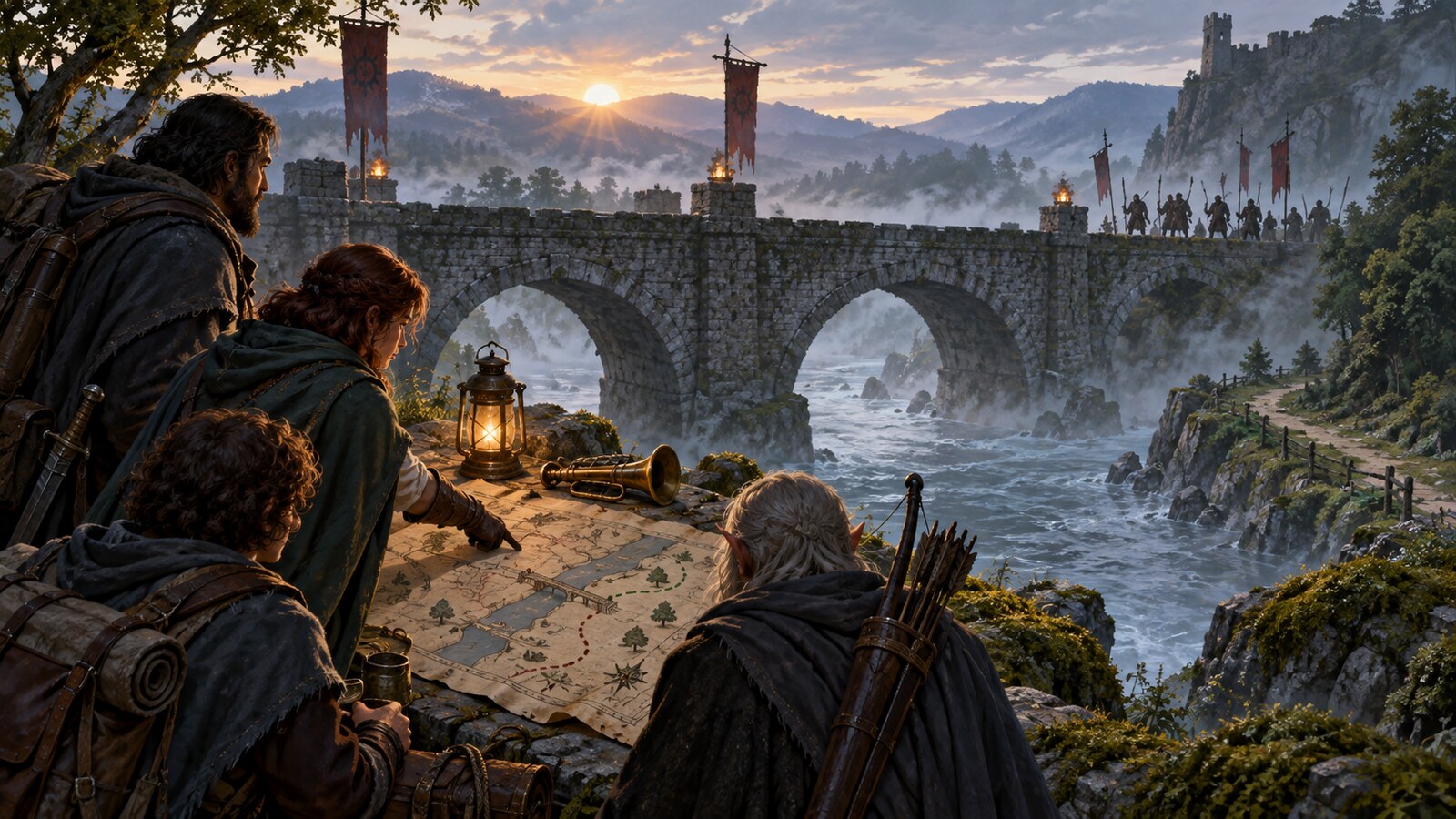
A raiding party ambushes the group on a bridge, built dangerous on purpose, with pressure valves designed in from the start rather than invented mid-fight.
- Objective, not annihilation
- The raiders want to drive the party off the bridge and take their cargo, not fight to the death.
- Conditional reinforcements
- A second raider group is one turn away, but only comes if the raiders' horn signal goes unanswered; the party can prevent it by reaching the horn-blower first.
- Telegraphed hazard
- The bridge is visibly damaged; anyone can see it before the fight starts, not discover it by falling through.
- Breakable morale
- The raiders scatter once their leader drops or a third of them are down, whichever comes first.
- An exit
- Retreat down the riverbank is open the entire fight: costly, but never blocked off.
Was this useful?
Systems built for this
- Pathfinder 2e
The XP Budget system assigns every creature a numeric cost and rates the whole fight Trivial, Low, Moderate, Severe, or Extreme against the party.
- D&D 5e (2024 rules)
The 2024 Dungeon Master's Guide uses a per-character XP budget and three difficulty bands (Low, Moderate, High) to size encounters.
- 13th Age
Building Battles gives explicit monster-count and level targets per party tier, plus a mook-equivalence table for folding weaker or stronger monsters into the same budget.
How Codex Cryptica handles this
The Encounter Generator can produce a starting point fast, and creature, NPC and faction entries carry the motives and details ('wants to capture, not kill' is exactly the kind of thing worth writing down once) that make the judgement calls above easier to make consistently across sessions.
None of this is CR or XP-based mechanical balancing; Codex doesn't score an encounter's difficulty for a given system. What it's built for is holding the encounter's participants, terrain and consequences as connected campaign entities, so the context above (what does this enemy actually want, what happened last time the party met them) is a lookup rather than something you have to remember.
Try the encounter generatorRelated
Tools
- RPG encounter generator A fast starting point for an encounter's participants and shape, before layering the judgement calls above on top.
- Creature generator Gives an unusual threat a concrete identity worth telegraphing, rather than an unnamed stat block.
Other answers
- What makes a good random encounter?
- How much prep do you need for an RPG session?
- How do you handle character death in a tabletop RPG?
- How much Rule of Cool should a DM allow?
- How do you make a boss fight memorable in a tabletop RPG?
- How do you run D&D for a large group of players?
- How do I make combat faster without making it less exciting?
- What RPG should I use for tactical combat?
- How do I run a large battle when the player characters are part of an army?
- How do I upgrade a player character's weapon without replacing it?
- How do I keep players engaged during other players' turns in combat?
- How do I prepare a D&D session?
- How do I combine multiple enemies into one squad in a tabletop RPG?
- Which tabletop RPGs have useful squad, unit and mass-battle rules?