Framework
How do I upgrade a player character's weapon without replacing it?
Let the weapon earn upgrades instead of swapping it: refine its physical qualities, add situational properties rather than flat damage, unlock abilities through training or story milestones, fit modular parts that can be swapped, and let its name and reputation grow with use. Reserve a flat damage increase for rare, story-earned moments and keep most upgrades about interesting choices, so the axe the fighter has carried since session one stays competitive without warping your numbers.
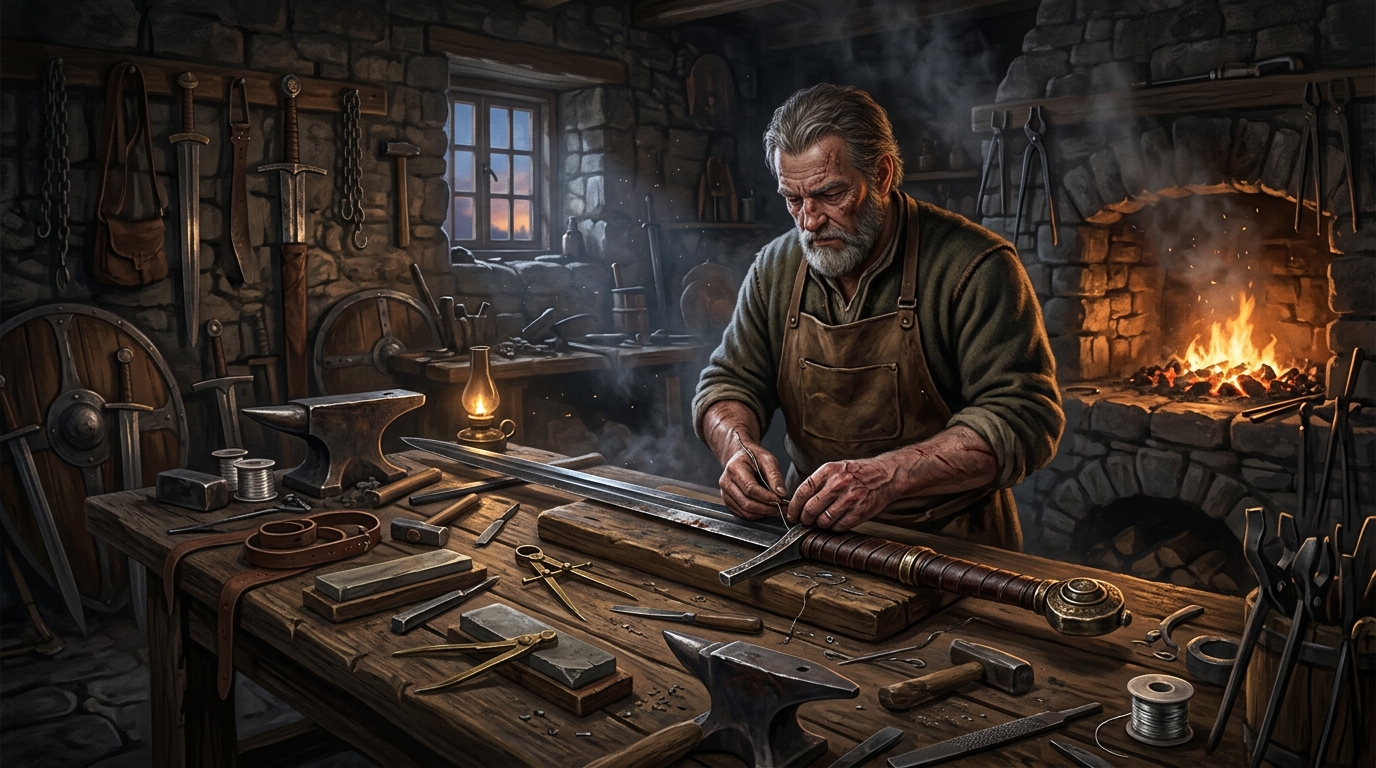
Why the starting weapon sticks
Players get attached. The sword that survived the first dungeon, the battered rifle patched after every firefight, or the bow strung on the road to the capital carries more story than any stat block. If every improvement means handing that item back and taking a bigger number, the campaign quietly tells the table that history does not count.
Constant replacement also narrows your reward design. When the only way to mark progress is a larger damage die or a higher bonus, the numbers climb until you must inflate every opponent to keep up.
Core principle: make the weapon better at specific jobs
Treat each upgrade as an answer to one question: what new choice, option or reliable edge does this weapon give its wielder that they did not have before? If you can describe the situation where the character will reach for this weapon because of the upgrade, it is pulling its weight. If the only answer is that the number is larger, look for a more specific improvement.
Six upgrade paths that work across genres
Use one or two of these at a time, choosing paths that fit the campaign and the player's priorities:
- Incremental physical refinement A better edge, truer balance, reinforced haft, tighter grouping, improved sights or a cleaner action. In fiction: reforging with better steel, re-stringing with superior cord, machining a tighter chamber. At the table, handle this as improved reliability, easier maintenance, or a small situational edge such as ignoring poor weather or bad light on the first shot, rather than a flat bonus that applies everywhere.
- New properties instead of raw damage Add a quality the character can choose to use: armour penetration against heavy targets, reach or control against closing foes, a manoeuvre bonus when setting up an ally, better critical effects on a well-placed hit, or steadiness under pressure. These reward positioning and timing and keep the weapon from outshining every other option.
- Unlockable abilities earned in play Tie a new capability to a deed, lesson or milestone: a veteran teaches a disarming bind, a trial in the ruins proves the wielder worthy, or a field armourer certifies the character on a new firing mode. The weapon itself has not changed shape, but what the character can do with it has. Record the requirement so the upgrade feels earned.
- Modular parts you can swap Runes, fittings, grips, pommels, blades, stocks, scopes, chokes, magazines, tech modules, monofilament edges or spirit bindings, depending on genre. Modularity gives the player real build choices: a rune of binding for control, a long barrel for range, a compact stock for close quarters. A module can be moved, lost or traded, which also makes it easier to balance.
- Narrative evolution and reputation Give the weapon a name, a mark and a history. Let its earlier deeds change how the world treats it: a guard recognises the blade from the siege, a fixer trusts the rifle that held the pass, a scavenger pays more for the pistol that killed the warlord. Reforging from significant material, such as salvaged hull plating, a fallen foe's weapon or a gifted alloy, turns an upgrade into a story landmark.
- Attunement and cost that creates choice Where the setting supports it, require something to keep an upgrade active: training upkeep, a power cell, a spirit's favour, calibration time or a visible tell that makes stealth harder. A light cost invites the player to think about when the weapon is at its best, rather than assuming every improvement is always on.
What each path looks like at the table
| Path | Fantasy example | Sci-fi or post-apocalyptic example |
|---|---|---|
| Physical refinement | Reforged edge from mountain steel; steadier in wind and rain | Re-barrelled rifle with tighter grouping; reliable in dust and cold |
| New property | Half-sword grip for close control; bonus when pinning or disarming | Armour-piercing tip or focused burst; trade rate of fire for penetration |
| Unlocked ability | Master's bind taught after defending the bridge | Breaching drill unlocked after the breach-team qualification |
| Modular part | Oath rune, weighted pommel or carved grip that can be changed | Swap scope, stock or overcharge module between jobs |
| Reputation | Named blade recognised at the border fort | Marked pistol that gets the crew through a checkpoint without a fight |
| Attunement and cost that creates choice | A spirit's favour powers the binding rune until dawn | An overcharge cell enables a focused burst, then needs time to recharge |
Balance without the damage spiral
Keep flat increases rare and clearly telegraphed. When the group can see that the next damage step is two upgrades away and tied to a major undertaking, they plan around the capabilities they already have instead of waiting for a number.
In some systems, encounter maths assumes weapons scale numerically as characters advance. Keep that required scaling, then layer situational or narrative upgrades on top.
A practical habit is to offer two good properties to choose between: penetration or reach, steadiness or quick handling, a quiet shot or a harder hit. This keeps opposition design stable while giving the player something to weigh.
When you do raise damage, do it once and make it memorable. Let it follow a reforge from meaningful material, a field promotion, or a repair using tech no one in the sector can replicate. Then return to utility for the next few steps.
Example
Worked example: the same axe, two campaigns later
A fighter has carried a plain wood axe since the first session. By mid-campaign the table needs the axe to keep up, but the player does not want to trade it for a generic +3 weapon.
- The flat-numbers approach
- The GM hands out a +1 axe, then a +2 axe, then a flame axe that replaces the original. Each step hits harder, but nothing about how the fighter plays changes. By the third swap the player stops describing the weapon and just reads the bonus. To keep combat tense, the GM raises every foe's hit points to match.
- The layered upgrade approach
- The original axe stays. First, the party smith reforges it with ore the fighter secured from the hill road; a new haft and better balance make it easier to control in cramped spaces, while the reforged head holds an edge longer. Next, a veteran teaches the haft-bind, letting the fighter pin a shield or weapon on a solid hit. After the defence of the mill, the axe earns its name, Mill-Ward, and guards at the valley fort wave the bearer through. A carved grip fitted later can be swapped for a heavier pommel when the fighter expects armoured foes. Damage rises once with the reforge; later changes come through training, reputation and loadout.
- Why it works
- The fighter still describes the same axe, with changes tied to a material quest, a training scene, a public deed and preparation for a job. The weapon's history gives the GM rewards to build on without inflating the whole bestiary.
Example
The same pattern off the fantasy road
The method is not tied to swords. Keep the core move, which is to attach an upgrade to a story and a situational edge:
- Sci-fi carbine
- The crew's pointman keeps their battered carbine. A new barrel and cleaner action make it dependable in poor conditions, an armour-piercing magazine trades volume for penetration, a qualification unlocks a controlled burst that can pin a target, and a stamped mark from the station defence makes local militia more cooperative.
- Post-apocalyptic shotgun
- A scavenged shotgun gets a reinforced breach, a choke that tightens its spread at medium range, a sling and grip that let the wielder move and shoot in tight ruins, and a name earned when it held the water-tower stairwell alone. Each step came from a person, a place or a price the player chose.
- Why these hold up
- In both cases the weapon gained a reliability story, a property choice and a reputation, long before anyone changed the damage line. The players can point to when each improvement happened.
When a new weapon is the better call
Endless upgrades can become clutter. Hand out a genuinely new weapon when one of these is true:
- The fiction has changed the job The campaign has moved from duels to a battlefield, from alleys to open desert, or from quiet infiltration to vehicle chases. A different tool fits the new problem, and keeping the old one would require pretending the world has not changed.
- The character has changed direction The player wants a different role or style: reach instead of close work, precision instead of volume, non-lethal options instead of stopping power. A fresh weapon makes the new direction visible.
- The old weapon's story has closed It broke holding the gate, was given away to seal a truce, or was laid down when its bearer took a new oath. Ending the arc cleanly respects the attachment better than adding a fifth rune no one remembers.
- You need rarity to mean something If every keepsake can become legendary, nothing is. Let most cherished weapons become excellent, and reserve true artefact status for one or two pieces earned across the campaign.
Upgrade checklist for the next session
Before offering an improvement, run through this at prep:
- Name the weapon and one deed already tied to it, so the upgrade has something to build on.
- Pick one of the six paths and name the situation where it will matter at the table.
- Write the requirement: who teaches it, what material or module is needed, or what deed unlocks it.
- Note what choice or cost the upgrade asks the player to weigh.
- Note who in the world will recognise or react to the change.
- Save flat damage increases for story-earned reforges and keep them infrequent.
- If the campaign's needs have shifted, consider a new weapon instead and mark the old one's retirement properly.
Was this useful?
Keep a weapon's history where you can see it
A weapon that grows across a campaign is an entry with history: the ore road where its steel was found, the veteran who taught the bind, the fort that knows its name, and the modules fitted for the next job. Codex Cryptica keeps each of those as its own linked entry, so when you plan the next upgrade you can see what the weapon has already earned and who will notice the next change.
Start with the weapon as an item, then add the people, places and materials behind each improvement. The checklist above becomes a short tracker on the weapon's page: path, requirement, situational edge and reputation.
Generate an itemRelated
Tools
- Item Generator Weapons, gear and curios with hooks and histories to build upgrades from.
- Magic Item Generator Enchanted properties, runes and relics that suit modular or narrative upgrades.
- Artifact Generator Legendary pieces for those rare, story-earned steps when the weapon itself becomes famous.
- NPC Generator Smiths, armourers and trainers who can teach, reforge or calibrate the improvement.
Guides
- Codex Cryptica for Fantasy Worldbuilding Track legendary weapons, forges and the factions that covet them.
- Codex Cryptica for Starship Campaigns Keep ship arms, modules and crew qualifications linked across jobs.
Other answers
- How do I balance RPG combat encounters without causing a TPK?
- How do you create a magic system?
- What can players actually buy and sell in a fantasy settlement?
- How do you make a boss fight memorable in a tabletop RPG?
- How do I give specialist characters spotlight without sidelining the party?
- How do I make a player base matter in an RPG campaign?