Framework
How do I improvise NPCs in D&D?
Use a tiny six-part sketch you can produce in seconds: role, want, attitude, one memorable detail, useful knowledge, and a boundary or secret they will not give away cheaply. Most improvised NPCs need motives and information more than a stat block, and Charisma checks should influence how far cooperation goes rather than function as mind control. Connect the NPC to an existing faction or location so the improvisation feels intentional, and only expand them into campaign canon if the party returns.
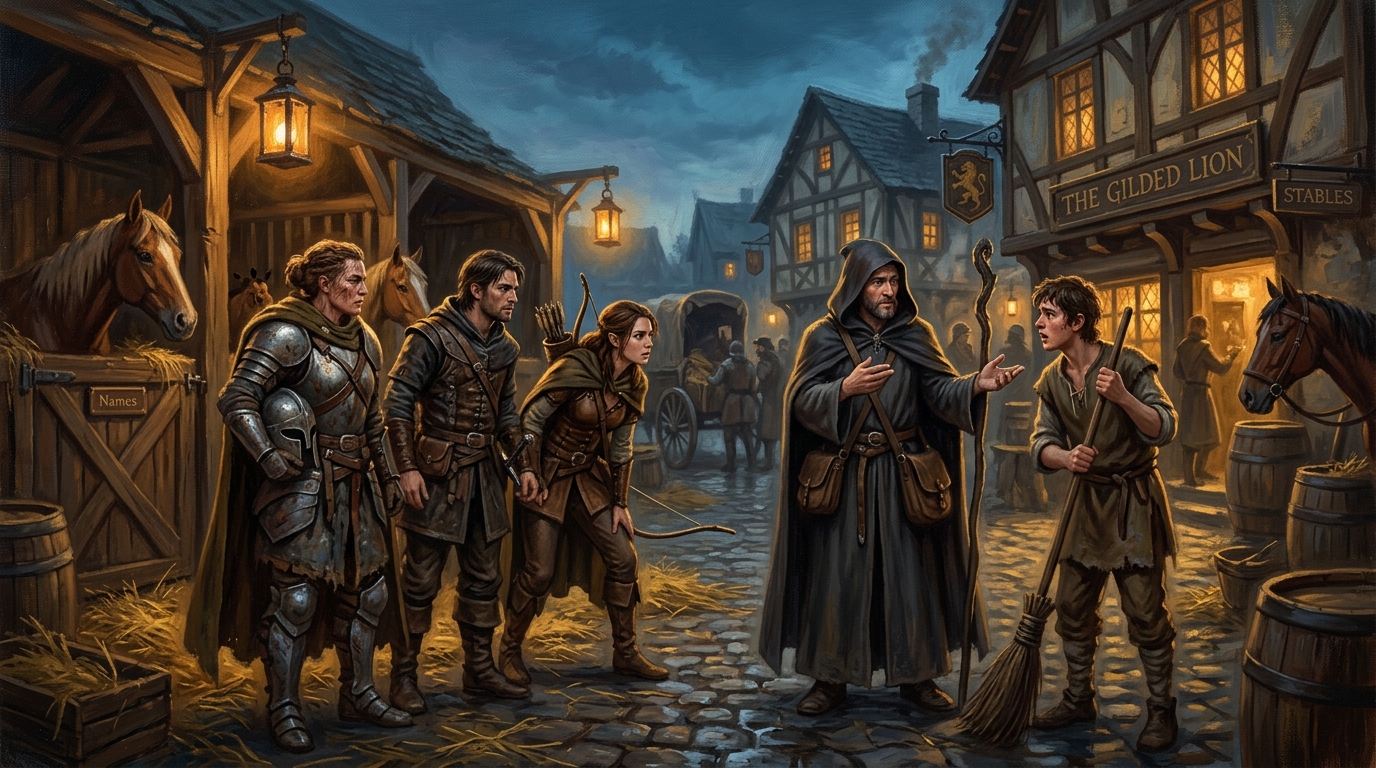
The party walks somewhere you did not prepare
The party turns down the alley you never mapped and starts talking to someone you never named. Every D&D group does this, and it is not a failure of preparation. The problem is that biography writing does not help at the table: a full backstory with bonds, ideals, and a stat block takes longer to produce than the conversation itself, and most of it will never be used.
What helps instead is a sketch small enough to hold in your head while you talk, and concrete enough to give the players something to react to. Six short notes are usually enough to play the NPC convincingly for the next few minutes without committing yourself to lore you will regret later.
A six-part NPC you can build in seconds
When the party addresses someone unexpected, pick one quick answer for each of these. A scribbled line or a single mental sentence per point is plenty:
- Role Why this person is here right now. Stable hand, kitchen porter, junior scribe, watch corporal, pilgrim with a sore foot. The role tells you what they are busy doing when the party interrupts them, and what they can plausibly interrupt in return.
- Want What they want in the next hour, not in life. To finish before dusk, to avoid trouble, to impress a superior, to be left alone, to sell one more thing before closing. A present-tense want gives you their first line and their price for cooperation.
- Attitude How they initially react to armed strangers. Wary, bored, hurried, helpful, nervous, flattered, quietly hostile. Set it once and let the conversation move it; do not decide the whole relationship before anyone has spoken.
- One detail A single appearance, mannerism, habit, or voice cue the players will remember. Chews cloves, wipes hands on an already dirty apron, never meets anyone's eye, speaks in short clipped sentences, wears a too-large watch cap. One strong detail lasts longer than five vague ones.
- Useful knowledge One or two things they could plausibly know because of their role and location. Who passed through, what changed today, what the local talk is, what they saw from their post. Keep it situated: the scullion knows the kitchen gossip, not the baron's battle plans.
- Boundary or secret Something they will not give away cheaply. A loyalty, a fear, a piece of information that could get them into trouble, or a line they will not cross without trust, leverage, or a good reason. This is what makes a Charisma check meaningful: it determines whether the boundary moves, not whether the NPC suddenly wants to help.
D&D-specific judgement at the table
These habits keep improvised NPCs useful without dragging the game into unnecessary mechanics:
- Skip the stat block until combat is real Most improvised NPCs will never roll initiative. If the party starts talking to a clerk you invented thirty seconds ago, they need motives and information more than an armour class. Note a rough sense of competence only if it matters for the scene (a veteran guard holds a line differently from a nervous recruit) and leave numbers alone until a fight actually begins. When combat does become relevant, a standard guard, commoner, or scout stat block borrowed from the rules is usually enough; you can adjust from there if the NPC has survived long enough to deserve something more specific.
- Treat Charisma checks as influence, not compulsion A successful Persuasion, Deception, or Intimidation check changes how far the NPC is willing to go given their wants and circumstances, not whether they abandon every prior loyalty. A guard who likes their job might accept a small favour or a quiet look the other way for a good reason; they will not hand over the keys because someone rolled well. Set a clear DC in your head against what the NPC actually values, grant advantage or a lower DC when the party offers something the NPC genuinely wants, and use failure to add cost or complication rather than to end the conversation entirely.
- Do not gate essential progress behind one roll If the party needs a piece of information to continue the adventure, do not make a single successful social check the only way to obtain it. Let a basic version of the useful knowledge be available through ordinary conversation, helpful context, or a different approach, and let the check determine secondary benefits: extra detail, a safer route, an introduction, or a reduced price or risk. This follows the same principle that keeps investigation scenes moving: the vital clue has a reliable route, and better rolls improve the method of obtaining it.
- Connect the new NPC to something that already exists An improvised NPC feels intentional when they are visibly part of the world the players already know. Tie them to a faction, location, or ongoing quest with a single line: they work for the harbour guild the party crossed last session, they pray at the shrine whose priest has gone missing, they were hired by the merchant whose warehouse the party is investigating. One connection turns a random conversation into continuity, and it gives you something to pull on later if the NPC matters again.
Example
At the table: from blank stare to playable NPC
The party leaves the planned route to the guild hall and heads for the stables to ask about a courier who rode out late last night. You have nothing prepared for the stables.
- The slow approach
- You pause to invent a name, a backstory, and a personality trait from a table, then try to decide the NPC's full stats in case a fight starts. By the time you are ready, the momentum of the scene has stalled and you have committed to details you may not want later.
- The six-part sketch
- Mara, stable hand. Wants to finish mucking out before dark. Wary of armed strangers. Chews cloves. Saw the baron's courier leave after midnight with a sealed satchel. Will not mention that her brother went with him unless she trusts the party. That is enough to play the next three minutes: she answers reluctantly, volunteers the courier's departure because it is directly relevant to the question, and holds back the brother until the party does something to earn it.
- Why it works
- Each part did a distinct job. Role and want gave Mara a reason to be short with the party. Attitude set the starting point for the social interaction without fixing the outcome. The clove detail made her memorable with no extra description. Useful knowledge answered the party's actual question. The boundary turned a natural Charisma check into a decision about trust rather than a test of whether the players guessed the right phrase. If the party returns tomorrow, you already know what Mara cares about and what she is protecting.
When the check happens
Name the cost or condition before the dice hit the table. If Mara wants to protect her brother, the party might need to offer reassurance, coin, or a reason to believe they will not get him into trouble. A character proficient in Persuasion or with a relevant background might have advantage or a lower DC because their approach fits the situation, while Intimidation might get a fast answer at the price of future cooperation. Let the roll decide whether the boundary moves and what new cost or consequence appears, not whether the NPC suddenly reverses their entire situation. If the roll fails, the information is not permanently locked away; it simply requires a different approach, more trust, or help from another source.
From improvisation to campaign canon
Most improvised NPCs are a single conversation and that is fine. When one proves useful, promote them with the smallest possible record:
- Give them a name if they do not have one Mara is easier to recall than 'the stable hand'. A name is the cheapest form of continuity you can add.
- Capture only what was established Write down exactly what the players heard and saw: role, want, attitude by the end of the scene, the detail they noticed, what was shared, and what was held back. Do not invent additional backstory that never appeared at the table.
- Connect them to a place, faction, or quest Link the NPC to the stable, the baron's household, the courier's route, or the guild that hired the courier. One link turns a floating name into a node the rest of the campaign can pull on.
- Expand only if they recur If the party seeks Mara out again, then add a little more: a family tie, a debt, a habit, a reason she might ask for help. Let recurrence earn depth rather than assigning it in advance to every person the party passes in a corridor.
Before your next session
Keep these where you can see them during play:
- Keep a small scratch area on your notes labelled 'new faces' with columns for role, want, attitude, detail, knowledge, and boundary.
- Decide in advance which factions and locations are nearby, so any improvised NPC can be tied to one in a single line.
- When the party approaches someone unexpected, give yourself ten seconds to fill the six parts before the NPC speaks, rather than pausing to build a stat block.
- State the stakes before any Charisma check: what the NPC would need to see or receive to move past their boundary.
- After the session, only keep the NPCs the party actually engaged with: name them, note what was said, and link them to the relevant place or faction.
Was this useful?
Keep improvised NPCs connected
A good improvisation lives beyond the moment it was invented. Codex Cryptica lets you generate an NPC in seconds when the party goes off your prepared path, then save the useful ones so the stable hand who mattered is still findable next session. Link them to the location where they were met, the faction they work for, and the quest they touched, and the random conversation becomes part of the campaign graph.
The next time the party asks after that same NPC, you are not reconstructing them from memory. You are picking up a thread that is already on the table.
Generate an NPCRelated
Tools
- NPC generator Create a quick NPC with a role, motive, and memorable detail when the party talks to someone you did not prepare.
- D&D NPC generator Generate a D&D-flavoured NPC with ancestry, role, and hooks suited to a fantasy settlement or roadside encounter.
- Faction generator Give an improvised NPC a faction to belong to so the conversation connects to the wider campaign web.
Guides
Other answers
- How do I handle players asking an NPC to "tell us everything you know"?
- How do I make interviewing NPCs interesting in an investigation?
- How do I give specialist characters spotlight without sidelining the party?
- How do I make a campaign threat feel urgent without railroading the players?
- How do I get players to engage with my campaign world?