Framework
How do I roleplay NPCs if I'm not good at acting?
You do not need acting talent to roleplay believable NPCs: speaking in third person such as "The guard explains the gate stays shut until sunrise" is full roleplay, not a lesser version of it. Give each NPC a want, an attitude toward the party, and one small behavioural or speech habit, then use simple signals like tempo, word choice, or posture to mark who is speaking and name the speaker when you switch.
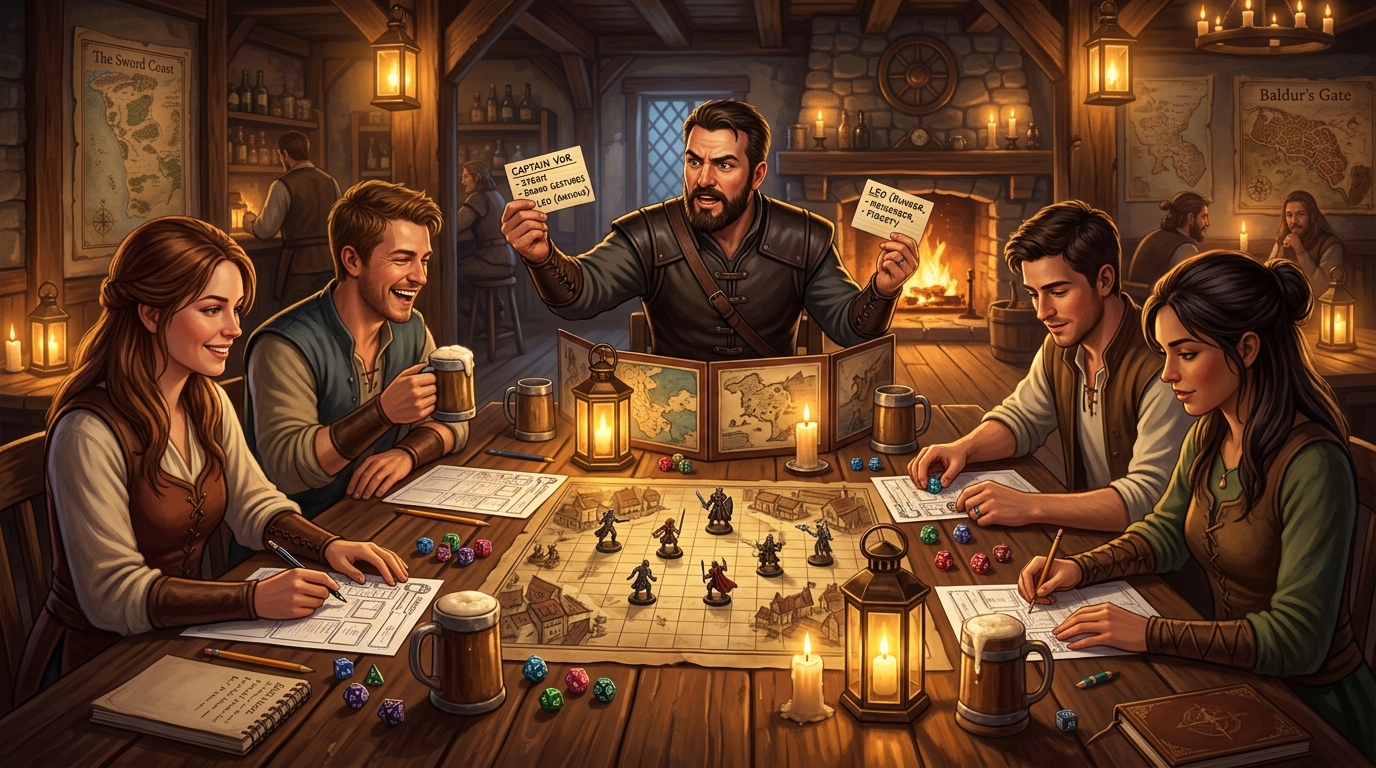
Roleplaying is not voice acting
Many new DMs assume that running an NPC means performing a character voice, holding eye contact, and improvising dialogue that sounds like a scripted scene. When that does not come naturally, the whole task feels exposed and the safest move seems to avoid dialogue altogether or to hand the NPC to someone else at the table.
The game asks for less than that, and counts more of what you already do. If you say "The guard explains she cannot open the gate until sunrise, but she can send word to the captain if you leave a name", you have roleplayed the guard: you established what the character knows, what she wants, and what she will offer. First person speech, third person narration, and a mix of the two are all legitimate, and players can respond in kind with "My paladin thanks her and asks whether the night patrol saw anything" without anyone needing to act.
A playable note gives you something to return to when the situation changes. An innkeeper who is nervous about the watch can respond to an offer of coin in a way that reflects both that worry and what the party has offered.
A three-part cue that keeps any NPC playable
For each NPC who will speak for more than a moment, note one short line for each of these before they open their mouth. A single phrase per point is enough to carry the scene:
- Want What this person wants in the next few minutes, in concrete terms. To finish their shift without trouble, to sell the last loaf before close, to keep the strangers away from the cellar, to get a letter delivered quickly. A present-tense want gives you their first line and the price of their cooperation.
- Attitude toward the party How they initially react to armed strangers showing up. Wary, relieved, rushed, bored, flattered, quietly hostile. Set it once and let the conversation move it; do not decide the whole relationship before anyone has spoken.
- One behaviour or speech habit A single observable cue you can reproduce without strain. Speaks in short clipped sentences, repeats the last word of a question before answering, never meets anyone's eye, wipes hands on an apron while talking, uses formal titles for everyone, or pauses to check a ledger before each answer. One steady habit does more work than an accent you have to sustain.
You do not need a unique voice for every NPC in town. Most shopkeepers, guards, and passers-by only need the want and attitude; save the full three-part cue for the handful of characters whose decisions affect the party's goals.
Separate characters without accents or costumes
The table needs to know who is speaking and what changed between speakers. Small, repeatable signals carry that information with less effort and more clarity than impressions:
- Name the speaker Say the name before the line or summary: "Mara says", "The sergeant explains". Naming is the most reliable cue at the table and costs nothing to sustain. Use it every time you switch, especially online where posture and gesture do not read well.
- Change tempo and word choice, not pitch An unhurried councillor who uses long, careful sentences feels different from a tired cook who answers in three-word bursts, even in your normal voice. Tempo and vocabulary are easier to hold than a new accent and less likely to drift into caricature.
- Add a small physical marker A posture you can return to helps the table track the switch: hands folded when you are the clerk, leaning back when you are the guard captain, glancing at a note card when you are the nervous apprentice. Keep it simple enough to reset between lines.
- Use a name tag or token for crowded scenes In a room with two or three NPCs, a folded name card, a distinct die, or a token placed forward marks who has the floor. Move or tap it when you switch so players see the change before they hear it.
Make switching clear and keep the party in the conversation
Two patterns quietly undermine NPC scenes. The first is the GM holding an extended exchange between two NPCs while the players watch. The second is switching speakers without signalling, so the party spends its energy working out who just spoke rather than deciding what to do.
Avoid both by narrating rather than performing NPC-to-NPC interaction. If two characters disagree, summarise the friction in one or two lines and turn to the party immediately: "The reeve insists the grain stays sealed; the baker cuts in that half the lower ward went without bread yesterday. Both look to you. What do you do?" That keeps the players as the camera and the decision makers, not an audience for a dialogue you rehearse alone. When you do need a brief back-and-forth, keep each line short, name each speaker, and hand off to the party after at most two exchanges.
If you lose track mid-scene, say so plainly and reset: "Sorry, that last line was the reeve, not the baker. The baker is the one who..." Players prefer a clear correction to sustained confusion, and a quick reset preserves the social pressure you set up better than pressing on with mixed signals.
Example
Same gatehouse, three workable ways to play it
The party reaches a locked town gate after dark and needs entry. Sergeant Brenn decides whether it opens; he wants an uneventful watch and is wary of strangers. Mara, a kitchen runner who wants to get back inside before she is noticed, is nervous but eager to help. She saw an unmarked cart leave through the postern at dusk, without lights or papers. In each version Brenn says the gate stays shut until sunrise but offers to send a name to the captain; Mara shares what she saw. When a player asks if she saw anything else, she glances at the door and says, "That is all I saw, and I need to get back inside before anyone notices." The party can ask Brenn to send a name, follow up on what Mara saw, or try something else.
- First person with light cues
- In a steady, clipped voice: "Brenn: The gate stays shut until sunrise. Orders. Leave a name and I will send it to the captain." In a quicker, softer voice: "Mara: I was on the wall at dusk. I saw an unmarked cart leave through the postern, without lights or papers." After the player asks if she saw anything else: "Mara glances at the door. That is all I saw, and I need to get back inside before anyone notices."
- Third person narration
- The GM narrates: "Brenn explains the gate stays shut until sunrise on standing orders, but he will send a name to the captain if you leave one. Mara, a kitchen runner, says she saw an unmarked cart leave through the postern at dusk, without lights or papers. Asked if she saw anything else, she glances at the door and says that is all she saw and she needs to get inside before anyone notices." No dialogue performance or voice change is needed.
- Low-effort character markers
- The GM places a die forward for Brenn and taps it while saying, in a steady, clipped voice: "Brenn: The gate stays shut until sunrise. Orders. Leave a name and I will send it to the captain." For Mara, the GM leans forward, glances at a note card and speaks more quickly: "Mara: I was on the wall at dusk. I saw an unmarked cart leave through the postern, without lights or papers." Asked if she saw anything else, the GM glances at the door and repeats Mara's response: "That is all I saw, and I need to get back inside before anyone notices."
- Why it works
- Brenn's offer follows his wish to keep the watch uneventful. Mara answers the request, then signals that she wants to get inside unseen; that shapes her reaction without deciding what the players can persuade her to do.
A small, optional exercise for next session
Starting with two contrasting NPCs is a manageable default, not a limit. For each one you expect to speak, prepare these cues:
- Write the NPC's name and role.
- Note what they want in this scene and their starting attitude toward the party.
- Choose one simple speech or behaviour cue you can repeat without strain.
- Write one useful thing they know or can offer, plus a boundary they will keep.
- Rehearse one greeting, one offer or request, and one response to a player question.
Should you bring in a guest to play NPCs?
Asking a friend to drop in as a barkeep, informant, or rival delegate for a session can be enjoyable, and it is not a cop-out to try it. A guest performer can bring energy to a single conversation and give you a break from switching, which some tables find fun for a special occasion.
It does not solve the underlying table flow problem on its own. Someone still needs to decide what each NPC wants, when to bring the party back into the conversation, and how to keep extended dialogue from becoming a performance the players watch. If the guest and the GM fall into a long exchange between two characters, the party is still waiting for a turn.
If you try it, set boundaries before play: which NPCs the guest will play and for how long, what that NPC actually wants and will not give away cheaply, how you will signal an exit or a hand-off back to the main GM, and that any promises or information the NPC offers count as established fiction. Agree that the GM can step in, summarise, and return attention to the players at any point. A guest can be an occasional addition for a single scene; regular co-GM arrangements can also work when everyone has clear responsibilities.
Was this useful?
Keep the NPCs the party actually met
The cues above are most useful when they survive beyond the conversation they were written for. Save the NPCs your players met as entities, record their cues, and link them to the locations, factions, and quests they touched. The runner who saw the cart and the sergeant who held the gate will then be easier to find next session with their wants and boundaries intact.
Generate a quick NPC for tonight, then save the ones your players engaged with and link them to relevant entities. This gives you a starting point for their next appearance instead of leaving you to reconstruct your notes from memory.
Generate an NPCRelated
Tools
- NPC generator Create a quick NPC with a role, want, and mannerism you can use straight at the table.
- D&D NPC generator Generate a D&D-flavoured NPC with ancestry, role, and hooks suited to a gatehouse or tavern encounter.
- Faction generator Give an NPC a household, guild, or patron to be wary of, so their hesitation has a visible source.
Guides
Other answers
- How do you run a scene with multiple NPCs without talking to yourself?
- How do I make roleplay more engaging in a tabletop RPG?
- How do I start GMing for the first time?
- How do I improvise NPCs in D&D?
- How do you make NPCs memorable without lots of prep?
- How do I handle players asking an NPC to "tell us everything you know"?
- How do I make interviewing NPCs interesting in an investigation?