Framework
How do I make a campaign threat feel urgent without railroading the players?
Give the threat a goal, a next move and visible consequences that happen whether the players intervene or not. Show those consequences through the world rather than through a forced deadline, and make sure every stage creates new choices instead of closing them down. The threat should keep acting and pressure should be legible, but the players remain free to oppose it, exploit it, ignore it for now, or deal with it later on changed terms.
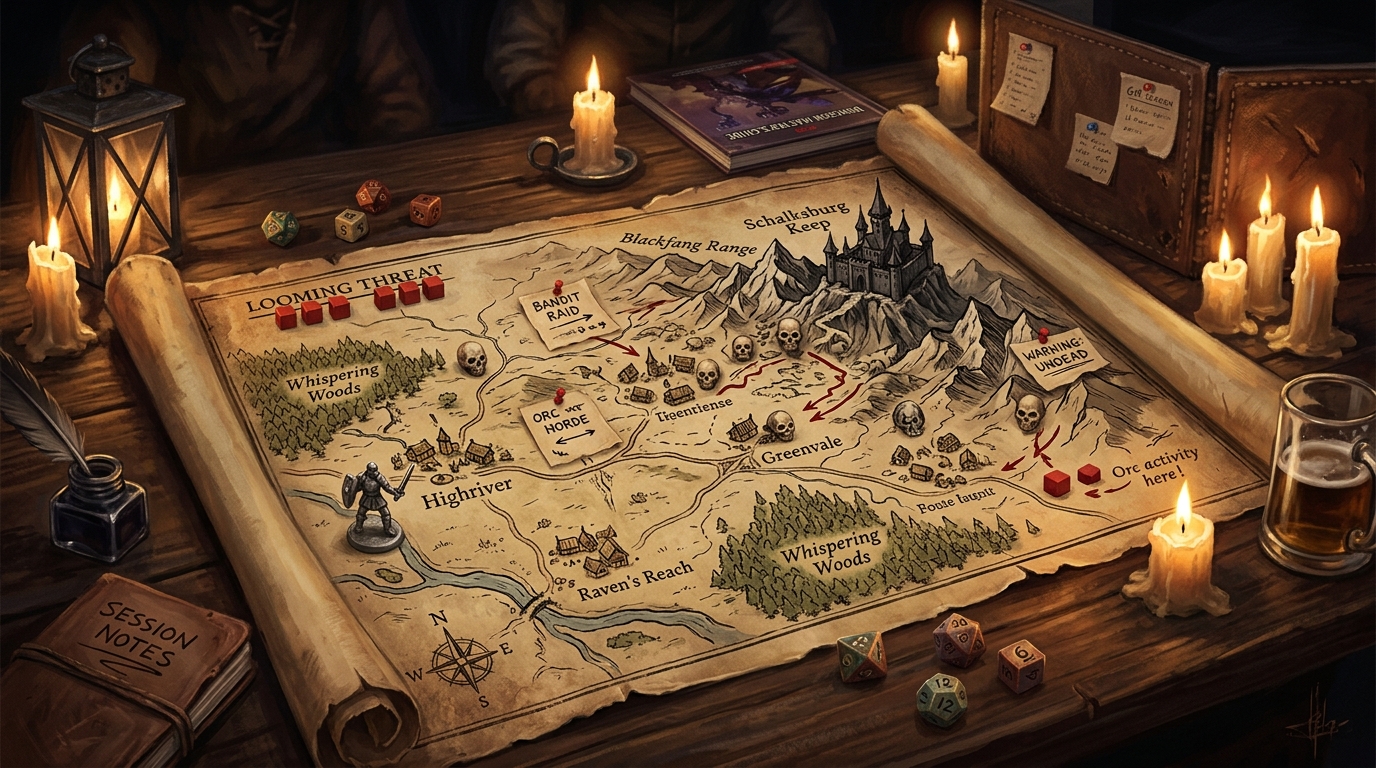
The world should move when the players look away
The tension in most campaigns with a looming threat is not that the villain is hidden, it is that the world feels paused until the party returns to the main plot. If nothing changes while the group explores a ruin, helps a village, or follows a personal goal, the threat feels decorative. If everything collapses the moment they take a side trip, the players learn that only one choice is ever permitted.
A threat that preserves agency keeps acting on its own schedule while leaving the response open. The Game Master defines what the threat wants, what it will do next if nobody interferes, what signs of that move become visible, who else in the world reacts, and what new opportunities appear because of the pressure. The players can then make an informed decision about what matters to them right now, with a clear sense of what waiting will cost and what it might gain.
Urgency and railroading are not the same thing
| Urgency | Railroading |
|---|---|
| The world changes visibly | Only one response is ever accepted |
| Opportunities may close, others open | Player choices are undone to force a return to the plan |
| Enemies gain ground somewhere the party can see | Consequences exist only to punish deviation |
| Allies and rivals react on their own initiative | The party is told what their characters must care about |
| Costs rise and new complications appear | Delay always means automatic failure |
| Pressure creates more decisions | Pressure removes decisions |
Give the threat an agenda the table can use
Write the threat down as a short operational record before you decide when or how the players meet it. Seven lines are enough to keep it acting without turning it into a script:
- Goal The concrete outcome it wants, specific enough that you can tell when it has succeeded or failed. Not "gain power" but "restore the buried fortress on Grey Ridge and hold it through winter" or "force the council to grant the harbour concession".
- Why now The reason it is acting in this season and not earlier or later. A thaw that exposes the old road, an expiring treaty, a successor who is weaker than the last ruler, or a resource that is about to run out.
- Resources What it can actually deploy: coin, followers, territory, secrets, spells, ships, legal authority, or a single dangerous ritual it can only attempt once.
- Constraint What stops it from winning immediately. A rival who watches the road, a lack of supplies, a ritual that needs three sites, or a faction that would intervene if the move were too open.
- Next move The one thing it will do if nobody interferes before the next session. Recruit in the border villages, buy the grain surplus, or seize the mountain pass. One active move is easier to run than three vague plans.
- Escalation What changes after that move succeeds. New territory, higher prices, a changed law, a fortified position, or a faction that finally picks a side.
- Visible signs How the players will notice without needing exposition. Missing caravans, new patrols, refugees, altered prices, damaged settlements, changed faction behaviour, rumours, letters, proclamations, or a road the party can no longer use safely.
Use soft clocks more often than hard deadlines
Pressure works best when players can see the situation worsening without feeling they chose the wrong activity. Two models help:
- Hard deadline Something definitely happens at a fixed time: an eclipse, an election, a ritual, an invasion fleet arrival, or a court date. Use these sparingly, because they make every other choice feel like a delay to be punished. One hard date per arc is usually enough.
- Soft clock The situation worsens in stages that are visible but not instantly catastrophic. The threat recruits allies, a trade route becomes unsafe, prices rise, patrols increase, rumours spread, or faction support shifts. Each stage changes the world the party moves through, but the campaign remains playable and side content still has value.
- How to choose If the appeal of the campaign is open-ended exploration, favour soft clocks and keep hard dates rare and clearly telegraphed. If the table has asked for a tight countdown, make the date public, explain how it can be influenced, and avoid punishing preparation.
Escalate consequences that create choices, not punishment
When the party does not engage, change the situation rather than lecturing the players. Useful consequences add new problems and new opportunities:
- Territory and access A rival occupies a pass, a route becomes dangerous, a district falls under the threat's control, or a settlement the party relied on starts fortifying. The map the players use changes.
- People and standing An ally loses influence, a neutral faction chooses a side, refugees arrive, or an NPC takes action without the party and handles it badly. Relationships shift and debts move.
- Economy and resources Prices rise for what the party needs most, supplies are diverted, caravans go missing, or a resource the group wanted becomes politically important. Routine tasks now carry a cost.
- Preparation of the threat The enemy becomes better equipped, better informed, or better allied. A later confrontation is harder, but also better understood because the signs have been visible for sessions.
- New opportunities from the pressure Chaos creates openings: a faction offers alliance, a cache is left unguarded, a defector seeks help, or a community asks the party to solve a problem the threat created. This is how a campaign avoids "you did a side quest, so the world ends".
Let other people act without the party
The player characters should not be the only people who can respond. When factions and NPCs act on their own, the world stops feeling like it waits for the save-world button:
- Resist or negotiate A town council fortifies, a guild organises a strike, a temple offers mediation, or a rival faction tries to buy off the threat. Some of these attempts help, others make things worse.
- Flee, profit or realign Merchants reroute caravans, families leave a valley, a company sells supplies to both sides, or a neutral power finally declares for one faction. Players who return find a changed balance.
- Fail or mishandle it An NPC expedition goes missing, a hasty alliance betrays another, or a well-meaning defence creates a secondary problem. These failures give the party meaningful ways back in, not just a scolding for absence.
- Solve part of it badly Another group does contain the threat somewhere, but at a price: a harsh law, a burned district, a debt owed to a patron the party distrusts. Now the players react to a solution they did not choose.
Protect side quests by letting them matter
A common mistake is to treat everything outside the main threat as filler that deserves weaker rewards and louder hints to get back on track. Players notice quickly, and they either chase the main plot resentfully or ignore hooks altogether because they no longer trust that their own goals will be respected.
Side content stays meaningful when it connects to the same living world through ordinary consequences. A frontier exploration might earn a guide who knows the threatened pass, reveal that the cult is buying supplies in the same villages the party trades in, or secure a safe route that matters precisely because another road just became dangerous. A personal quest might simply matter because the character chose it, and that is enough. The standard is not whether every side trip helps against the looming threat, but whether the campaign treats side achievements as real gains that the world remembers.
When a side quest does touch the threat, keep the intersection natural rather than forced. Displaced creatures in the dungeon, a merchant route now controlled by the enemy, a local dispute worsened by refugees, or a resource that has suddenly become politically important all feel like consequences of a world that kept moving, not like the Game Master dragging the main plot into every scene.
Make escalation legible through the world, not just exposition
An invisible clock that only the Game Master understands does not create pressure, it creates surprise. Players do not need exact numbers, but they should be able to perceive what is getting worse, who is gaining power, and which opportunities may not stay open.
Surface change where the party already looks: rumours that name a specific village or road, refugees who can say where they came from, prices on the sheet the group actually uses, patrols on the routes they travel, letters and messengers that interrupt routine, public announcements in the places they visit, altered faction attitudes, and visible changes to settlements, roads and terrain on the map. One or two of these per session, tied to the threat's last move, are more effective than a lore dump explaining the whole arc.
Open sessions with a short recap of what moved since last time. When each threat has a single next move on file, that recap writes itself and the players start the evening with informed choices.
Decide in prep what happens if the players never engage
This is a worldbuilding question to answer before it becomes a table argument. If the party never seriously opposes the threat, what is the plausible outcome, and can the campaign continue afterwards?
Common outcomes include a partial success where the threat takes a region but not the whole campaign area, intervention by another power that then becomes the new problem, a fallen area that becomes a resistance setting, a threat that changes goals once a lesser prize is secured, or a world that enters a new phase and the original "main plot" stops being the main plot. None of these requires ending the campaign on the spot. The requirement is only that the world has an answer and the next session has a situation to play.
Write that answer down alongside the agenda. If you cannot describe a next phase without the players, the threat's design is too brittle. Add a constraint, a rival, or a limited goal so the world can absorb the choice.
Example
Worked example: a cult restoring a buried fortress while the party works the frontier
The party is mapping frontier settlements and has no immediate reason to care about old fortifications. An ancient warlord's cult wants to reactivate a buried fortress on Grey Ridge. The agenda is tight enough to run, but the table is free to approach the frontier on its own terms.
- Setup the GM writes down
- Goal: hold the restored fortress through winter and use it to control the high road. Why now: a dry summer has exposed the old causeway. Resources: coin from a sympathetic mine owner, a small core of veterans, and a ritual that needs three ridge shrines. Constraint: the cult cannot hold the road without supplies from the lowland villages, and the border garrison watches the main pass. Next move: recruit labour and buy grain in the villages below the ridge.
- Stage 1: rumours and missing caravans
- Visible signs: traders complain that hill caravans are late, a shrine keeper reports strangers asking about old stonework, and the garrison posts a notice seeking information. If the party investigates, they find a cult quartermaster buying grain at above-market prices. If they ignore it, the cult secures its first supply cache and a frontier hamlet notes higher prices. Factions: the garrison increases patrols, the hamlet elders argue about selling, the mine owner quietly funds a second buying trip. New choice: the party could track the caravans, warn the hamlet, or use the price spike to profit and learn who is buying.
- Stage 2: recruitment and stolen supplies
- Visible signs: young labourers leave for paid work on the ridge, a supply wagon is found ransacked, and ridge shrines show fresh offerings. If the party intervenes, they can protect a shipment, persuade workers to stay, or follow recruits to the first shrine. If they ignore it, the cult finishes work on shrine one and starts moving stone. Factions: the garrison blames the hamlet for losing workers and threatens a levy, the guild offers the party a contract to guard shipments. New choice: guard work, mediation, or a quiet reconnaissance of the ridge.
- Stage 3: nearby settlements fortify
- Visible signs: the hamlet raises a palisade, refugees from a smaller steading pass through, and the road toll doubles to pay for militia. If the party helps, they choose which settlement to fortify, earn a safe base, and gain guides who know the ridge. If they stay elsewhere, the hamlet still fortifies but diverts grain that would have fed the winter market, so prices rise in the lowlands. Factions: the temple organises relief, the mine owner pressures the hamlet to keep selling to the cult. New choice: fortify, relieve, or exploit the grain shortage politically.
- Stage 4: one route falls under cult control
- Visible signs: the high causeway is now patrolled by cult banners, lowland merchants reroute through a longer, more dangerous valley, and the garrison posts that the causeway is closed. If the party acts, they can contest the causeway, scout the valley route, or negotiate passage for a price. If they ignore it, the cult holds the road and moves material for shrine two without interference. Factions: the garrison plans a costly spring offensive, lowland traders offer the party a share to reopen the road. New choice: strike, smuggle, negotiate, or let the cult hold it and prepare for a harder spring.
- Stage 5: the fortress reactivates
- Visible signs: lights on the ridge at night, a proclamation that the road is now taxed by the restored garrison, and displaced patrols camping in the lowlands. If the party acted earlier, they face a weaker or partially held fortress with allies and inside information. If they ignored it, they face a supplied fortress that controls the high road, but also a resistance network, rival claimants, and defectors the earlier stages produced. Either way the campaign continues, because the fortress is a new regional power rather than a world-ending switch.
- Why it works
- Every stage has a visible sign, a faction reaction, and a new choice that exists whether or not the party opposed the previous move. Side work remains valuable because guides, supplies, safe bases and political standing all matter more once the road changes. Pressure is legible without a lecture, and the campaign can absorb any pattern of engagement. The threat kept acting, the world kept moving, and the players kept deciding what mattered to them.
Looming threat checklist
Run through this before the next session and after any session where the party was elsewhere:
- What does the threat concretely want, in terms you can tell have succeeded or failed?
- Why is it acting now, and what stops it from winning immediately?
- What is its single next move if nobody interferes before next session?
- What changes if that move succeeds, and what new problem or opportunity does that create?
- What visible signs will the players actually encounter that show the change?
- Which NPCs or factions react on their own, and how does that reaction help, hinder or complicate things?
- Which consequences open new choices rather than simply removing options?
- How can side quests the party already cares about still produce allies, information, resources or standing that remains valuable?
- What happens if the players never engage, and can the campaign continue in that changed world?
- Can you describe all of the above without a lore speech, through a price, a patrol, a rumour, a refugee, or a road that works differently?
Was this useful?
Track a moving threat without losing the rest of the campaign
A looming threat is easier to run when its agenda, next move and visible signs live alongside the rest of your world rather than in a separate countdown. Codex Cryptica lets you keep the threat, its rival factions and the frontier settlements in the same linked graph, so a change to the road, a price, or a relationship updates the map the players actually use. Pair that with quick generators when you need a new face, rumour or complication on short notice and you can keep pressure legible without scripting what the party must do next.
Build factions and rumours for your threatRelated
Tools
- Faction Generator Create factions with goals, resources and rivalries to serve as the threat and its rivals.
- Faction Roster Generator Populate a faction with members, roles and tensions that react when the threat moves.
- Rumour Generator Produce true, half-true and planted rumours that surface escalation through play.
- Villain Scheme Generator Sketch a villain's goal, resources and next move as a starting agenda.
- Council Vote Generator Model formal votes, blocs and hidden agendas when the threat plays politics rather than sieges.
Guides
- Sandbox Campaigns Keep a living world moving while players roam, with factions that act between sessions.
- Conspiracy Campaigns Run layered threats and hidden agendas where information itself is leverage.
Other answers
- How do I run political intrigue and faction play in an RPG?
- How do you run factions in a sandbox campaign?
- How do you create quest hooks without railroading?
- How do you track faction turns between RPG sessions?
- How do you prepare a sandbox RPG campaign?
- How do you handle players going off script as a GM?
- How do you manage a campaign timeline in an RPG?
- How do you create a fantasy faction?
- How do you keep track of NPCs in a long campaign?
- How do you run a conspiracy campaign?