Framework
How do I run a pirate campaign that feels like exploration rather than a series of naval battles?
Structure a pirate campaign around a flexible voyage, discovery, and consequence loop: offer a few competing rumours or maps as a useful starting point, while keeping the chart open to destinations and goals the players choose for themselves. Let discoveries change what the crew knows and what they find on later voyages; use deadlines selectively, and let rivals act when their motives and opportunities give them cause. Treat the sea as terrain and connective tissue, not empty travel between fights.
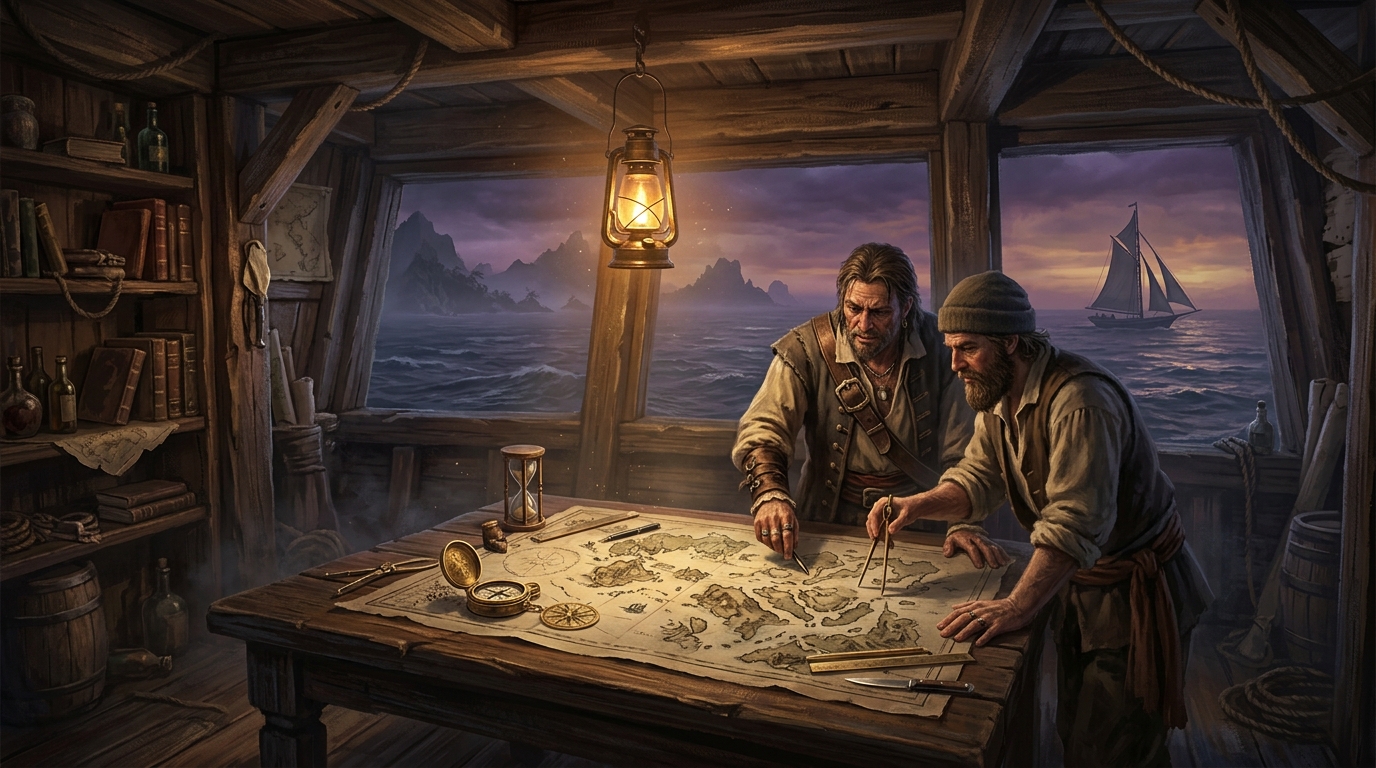
Why pirate campaigns drift into back-to-back ship fights
Most pirate campaigns start with an open sea and a promise of freedom, then settle into a narrow pattern. The crew sails, the table rolls for a random encounter, ships meet, cannon fire, and the voyage resets at the next harbour. After three repetitions the ocean feels smaller, not larger, because the only question it asks is whether the party wins the next fight.
The sea is not short of action, but a campaign that treats every voyage as a combat delivery loop turns exploration into commuting. Players stop caring where they sail because every destination offers the same loop: arrive, hear a hook, sail, fight, return. Exploration returns when the sea asks where the crew wants to go and what they are willing to leave unexplored, and when the answer changes what the coast looks like next time they pass it. The structure below keeps naval combat available as one tool among several, without letting it set the rhythm of every session.
The voyage, discovery, and consequence loop
Use this as a campaign rhythm, not a session schedule. A short voyage may complete the loop in half a session; a long expedition may cross several destinations before its consequences become clear.
- Voyage as a choice between destinations Two or three competing leads are a useful default, not a menu of permitted choices. They can suggest a wreck, a paid job, or a rival's next move, each with a source the crew can judge and a clear possible gain or cost. The players may instead follow an unmarked coastline, revisit a reef, hunt a known convoy, seek a safe anchorage before storm season, pursue their own fragmentary map, shadow a rival, or look for timber, water, powder, or repairs. Support a declared voyage even when it was not prepared: ask what they hope to find, then use the same loop to discover what the chart and current conditions reveal. Leads suggest possibilities; the chart remains open.
- Discovery as a place, a route, or new knowledge A discovery can be a distinct site, but it can also be a current, seasonal wind, hidden shipping lane, shoal passage, convoy timetable, migrating hazard, signal code, political relationship, or the true allegiance of a harbour. Knowledge itself can change where the crew can sail, who will deal with them, and what they can risk on the next voyage.
- Consequence that rewrites the chart and the welcome Carry forward changes that follow from what happened: a corrected sounding, a moved reef marker, a new flag over a fort, a pilot who refuses the crew, or a price changed by a broken monopoly. Let players annotate their own chart with corrected depths, safe water, dangerous tides, harbour control, hidden supplies, a rival's last sighting, uncertain rumours, renamed landmarks, and places to revisit. Consequences should follow causes, not the fact that the players chose something else.
- Use encounters to reveal the sea, not fill travel Random encounters can reinforce exploration when they reflect the route, season, factions, weather, ecology, shipping density, or current regional state. Let a sighting or encounter teach the crew something about the sea or alter the voyage. Avoid rolling merely to fill routine travel time; the loop gives each voyage a direction and lets its discoveries and consequences carry forward.
Make islands distinct adventure sites
Keep this summary light; the full framework for creating interesting islands and ports is in the related answer. Islands can matter beyond their harbour, and each should offer a different reason to explore.
- Assign one primary mode of play per site Tag each island before it reaches the table. Grey Harbour is a social site: a harbour council that taxes powder and a fishing guild that will guide the crew for a share. Ash Cay is an exploration site: a mangrove maze whose channel only opens at half tide. The Saint Elmo wreck is a survival and mystery site: a reef that sinks boats at flood and a pay chest whose log names a patron. A single tag stops you preparing five interchangeable harbours and forces the chart to offer real variety.
- Start from pressure already in motion Locals are already responding to an active pressure, such as scarce water, a dangerous reef, or a dispute over company protection. Different people may control law, harbour access, trade, pilotage, violence, or legitimacy. The crew enters a situation in motion, and their choices can change its balance.
- Let the island matter beyond its harbour A cove, inland spring, reef, wreck, or ruined battery can shape who visits the port and what happens there. Give the crew reasons to explore the island as well as to land, trade, and leave.
- Update the return state from what changed and how much time passed On a return, account for what the crew actually changed and what happened while they were away: who gained leverage, what resource or service shifted, and who remembers them. A guarded well, missing pilot, or new flag can show the result. Note likely consequences, not a preset branch for every choice.
Rumours, maps, and treasure leads that compete
Exploration needs more destinations than the crew can visit at once, and rumours are how the table learns what exists beyond the horizon.
- Tie every lead to a named teller who can be tested A chandler who wants the fort's garrison evicted, a pilot who will guide the bar at night for a share, a clerk who will pay for a diver to raise a pay chest. A rumour with a source can be bargained with, checked at sea, or disproved when the party finds the place it described. Two such leads per harbour is enough to create choice without flooding the chart.
- Keep maps partial and in conflict Offer one chart that is accurate about reefs but vague about cays, one sketch that marks a wreck by a landmark that has since been taken for timber, or one log that names a lagoon but warns of fever. When maps disagree, the crew decide whose correction to trust and which older sounding to verify. Invite them to mark confirmed details, uncertainties, and their own names for places on the chart; a corrected sounding makes the next passage safer and may be valuable to sell or withhold.
- Let treasure leads point to different kinds of prize Not every lead should promise gold. One points to a pay chest, one to a water source that restores a dry port's goodwill, one to a palm grove that can refit a sprung spar, one to a set of letters that shift a faction's standing. Variety gives different characters a reason to argue for different destinations and stops the campaign from becoming only a hunt for coin.
- Use deadlines when they create a real trade-off Some leads are urgent: a tide window closes or a patron hires another crew. Others persist, though their context may change; a slow mystery can deepen while the crew is away; open exploration may have no outside deadline beyond supplies, weather, or the crew's priorities. Deadlines should create meaningful trade-offs, not become a tax on every destination.
Rival crews and factions that move between sessions
A coast feels explored when someone else is exploring it too. Rivals turn the chart into contested ground rather than a list of places that wait for the party.
- Give each rival a reason and a next move Rivals act for reasons independent of the party: a squadron may try to blockade a strait before a convoy sails; a company may pursue a wreck to fund a well; a captain may seek powder before chasing a ruin. Track a clear next move, an objective and its resources, a scheduled event, a simple faction state, or an optional clock when escalation matters. See the related answer on making rival captains and pirate factions matter for the deeper framework.
- Let the world move when someone has motive and opportunity When an actor has the motive and means to act, show the result in the world: a changed price, patrol route, flag, bounty, or rumour. A rival may claim a wreck the crew left alone; nobody may find it; weather may bury it deeper; locals may strip part of it; or it may remain untouched. Progress should follow established causes and circumstances, not happen automatically because the crew chose another destination.
- Show rival activity through evidence A cay flying a rival's signal, a wreck missing its spar, or a pilot guiding another crew can reveal what happened. Use such changes when an actor's motive, resources, and opportunity support them; some leads remain available, and some places change for other reasons. The aim is a world that moves credibly, not automatic loss whenever the crew looks elsewhere.
- Evolve a rival after contact When a rival wins or loses against the party, change one visible thing before the next appearance: a new ship, a shifted goal, a lost ally, a harder bargain, or a grudge that narrows their options. A captain who returns visibly changed signals that encounters have lasting weight and that the relationship will not reset to a neutral harbour exchange.
Mix social, exploration, mystery, survival, and combat
A campaign that mixes modes of play stops naval combat from becoming the default way every session matters.
- Social: bargain for entry, pilotage, and price Let a harbour's law, custom, and price be negotiable with the right person. Present casks for inspection to keep goodwill with fishing elders, pay the well tithe or break it by negotiation, secure a factor's charter or smuggle around it. When law and custom set real costs, talking in port becomes part of the exploration, not a pause before the next sail.
- Exploration: read water, coast, and landmarks Turn reefs, channels, and headlands into navigation puzzles that reward charts, local pilots, and landmarks rather than a single sailing check. A reef cut that only a shallow-draft vessel can use, a bar that covers at half tide, or a lighthouse that flashes on storm nights all turn the sea into terrain the crew can learn. A corrected sounding or a renamed headland then carries forward as a discovery that makes later voyages different.
- Mystery: piece together what the coast has buried Leave logs, wreck marks, ruined batteries, and temple ruins that point to a sequence rather than a single treasure. A battery log that names a cove, a cove chart that marks a reef, a reef wreck whose manifest points back to a harbour ledger create a thread that requires visiting several sites in an order the party must deduce. Each visit answers one question and raises the next, which keeps discovery moving without needing a new fight to justify the voyage.
- Survival: make water, food, and hull condition decisions Track supplies and hull simply: how many days before resupply becomes urgent, and what single condition will worsen if ignored, such as a cracked spar or fouled rigging. Low water is interesting when it forces a choice between a dry but safe island and a brackish but convenient one, not when it is a silent countdown. A patched hull that still needs timber in port commits the crew to a destination without needing an encounter to enforce it.
- Combat as one handle among several Ship-to-ship combat, duels, and boarding may be the safest, most profitable, or only viable response; they can also be deliberate piracy, a political statement, or a reaction to failed negotiation. Let combat arise from what the crew wants and what the situation allows, rather than because a voyage needs an encounter. Offer papers, payment, parley, pilotage, or a favour owed as alternatives where they make sense.
Keep the sea as connective tissue, not empty travel
The sea should link discoveries rather than filling time between them. On any voyage that deserves attention, name the wind, one hazard the chosen route must handle, and one sighting that teaches the region: a sail showing a known flag, cut rigging in the water, or lights on a headland that should be dark. Each sighting points to a faction, a recent event, or a place the party may visit next, not to an isolated stat block.
Decide in advance when to play the sea in detail and when to montage. Montage the routine passage on a familiar coast in settled weather, playing only the leg that carries a real choice or a deadline: the strait with contrary winds, the shoal only a local pilot can read, or the open-water crossing where water is short. Even on a full crossing, frame the passage as three or four linked legs with distinct wind and decision, so the middle of the voyage does not sag. Reserve close attention for passages where reaching the destination is itself the test, such as a storm season crossing or a blockade run.
Carry discoveries forward as seamanship. A corrected channel, a tide table bargained from a pilot, a reef named after events, or a harbour whose price shifted because the crew acted all become seamanship the party can use next time they weigh anchor. When a past sighting returns as a landmark or a cost at the harbour bar, even a montaged passage feels sequenced rather than repeated.
Example
Worked example: the same archipelago, two ways
The crew sails the sloop Mercy's Wake from Greyhaven with two known leads. Old Joss the pilot offers a tide-bound reef cut past the wreck of the Saint Elmo for a share of whatever they raise. Mistress Varl's clerk at the factor's store will pay for a diver to recover the same pay chest and use it to fund a new well. A third sail, rival captain Selene Varga, is known to be short of powder and last seen taking on shot at Skerry Cove; she wants enough powder to reach and claim the Elmo wreck. The archipelago holds Greyhaven, Saltmouth behind the white Jaws cliffs, Ash Cove in the mangroves, the Elmo wreck on the outer reef, and the ruined battery on Widow Hill. The crew could ignore all three leads and follow the strange current south of Widow Hill; the GM can use the same voyage, discovery, and consequence framework to improvise what that choice uncovers.
- The naval battle loop
- The GM offers a single destination and rolls for a sea encounter en route. A naval cutter demands inspection. The crew fights, win or lose, then reaches Saltmouth where prices are unchanged. Next session the same structure repeats: a new harbour, a new patrol, another fight on the same water. The wreck remains on the chart because nothing removes it, the rival never moves, and Saltmouth has no reason to remember the crew. The sea is distance to be crossed between harbours, not terrain that changes.
- The exploration loop
- Before casting off, the GM offers two competing leads to the same wreck and one option to resupply: sail the reef cut on Joss's tide window and dive the Elmo, run to Saltmouth to take Varl's paid recovery contract, or resupply at Ash Cove where fever is low this week but no pay chest waits. Each lead shows a possible gain, a price, and a landmark. The crew also know Varga's current move: she is securing powder at Skerry Cove and may attempt the Elmo when she has the means. The leads offer direction; the strange current or another crew-declared goal remains open.
- Playing the voyage and discovery
- The crew choose the reef cut for secrecy and the chance to keep the whole chest. The detailed leg is the channel past the Elmo: a cracked foremast that complains in any blow, a lee shore if they miss stays, and the white rock on the headland as a leading mark. The lookout character gets the wind warning, the navigator plots the channel, and the carpenter steadies the spar with a jury brace that will need proper timber in port. Mid-leg they sight oil and cut rigging near the Elmo with a drifting launch flying the company flag. The situation offers parley or inspection rather than only a fight. They take survivors aboard, learn the cutter dragged the channel markers after the last smuggling incident, and mark a corrected sounding on their own chart.
- Consequence that rewrites the next voyage
- They dive the Elmo and raise the chest, but spend two days doing it. Varga secures powder and reaches the wreck too late; with the chest gone, she returns to Skerry Cove to seek another opportunity. Varl's factor has not received the recovery payment, so the new well remains unfunded. If the crew had taken Varl's contract, they would have had a legal claim to the chest and Varga would have contested their recovery. The corrected sounding stays on their chart, making the reef route safer next time, while the unpaid well gives the crew a reason to revisit Varl's offer. The next voyage begins with a real choice: follow the strange current south of Widow Hill, find another way to fund the well, or run to Greyhaven for timber to properly repair the jury-braced mast.
- Why it works
- The table chose a destination, then played a leg where different roles shaped the passage and a sighting revealed the coast's trade and patrol story. The discovery was not interchangeable: the reef cut demanded seamanship, the wreck demanded a tide-bound dive, and the harbours offered different patrons and prices. The players corrected their own chart, while the unfunded well showed what the missed contract meant and the hull remembered the blow it took. Even the sea between the cays taught them about the region. The rival's move followed her goal and available resources; choosing another lead alone would not have made the wreck disappear.
Before the next voyage in your pirate campaign
Run through these checks for the current chart and season.
- Have you offered a few useful leads while leaving room for the crew to set a destination or goal of their own?
- What pressure is already in motion at each island or port, who controls the relevant needs, and what can the crew explore beyond the harbour?
- What deadlines are genuinely time-sensitive, and which opportunities or mysteries can wait?
- Which rival has a motive and opportunity to act, and what evidence might show its next move? Would a clock help track it?
- If the crew delays a lead, what would actually cause it to change, remain, or become harder to reach?
- What one encounter, social negotiation, or mystery thread will give non-martial and non-nautical characters a directed choice on this leg?
- What knowledge, relationship, or world change follows from what happened and may matter on a later voyage?
- Which voyage scope will you use for the next passage: montage, single detailed leg, or full crossing, and which landmark and hazard anchor the detailed leg?
Was this useful?
Keep the chart, the coast, and the contest connected
Save islands and ports with their active pressures, relevant power holders, and places worth exploring beyond the harbour. Tie rumours, charts, and player annotations to the people, factions, and routes they concern, and record rival moves in whatever form suits the campaign.
When a voyage ends, update the chart and return state from what actually changed and the time that passed. A missing spar, shifted water supply, or new flag can show the result without rebuilding the coast from memory; the sea remains the thread that joins discoveries rather than empty water between set pieces.
Generate an island harbourRelated
Tools
- Settlement Generator Build island harbours, hidden coves, and port towns with landmarks, law, trade, and nearby dangers.
- Faction Generator Create rival crews, navies, and trading companies with goals, pressures, and moves that shape the coast.
- Rumour Generator Draft wrecks, treasure leads, and harbour gossip tied to named tellers who can be checked at sea.
- Ship Generator Give the crew and their rivals vessels with handling quirks, damage history, and secrets the party can recognise at distance.
- Encounter Generator Sketch situation-first sightings and negotiations at sea with handles beyond combat.
Guides
Other answers
- How do I make sea travel interesting in a TTRPG?
- How do I create interesting islands and ports for a pirate campaign?
- How do I make rival captains, navies, and pirate factions matter?
- How do I run ship-to-ship combat without sidelining half the party?
- What kind of ship should a pirate crew start with?
- How do you make travel interesting in a tabletop RPG?
- How do you generate useful RPG rumours?
- How do you build a point crawl for an RPG?
- What is a point crawl?
- How do you run factions in a sandbox campaign?
- What should an RPG settlement contain?
- How do trade routes shape cities and kingdoms in an RPG world?
- How do you run a chase in a tabletop RPG?
- What makes a good random encounter?
- What TTRPG should I play for a pirate or high-seas campaign?