Framework
How do you make travel interesting in a tabletop RPG?
Travel becomes interesting when a journey is structured around genuine decisions rather than random combat interruptions. Rather than rolling for wandering monsters or hand-waving the trip in a single check, give players competing routes with distinct hazards, active travel roles that grant agency, tangible resource trade-offs, and environmental discoveries that reveal the world they are crossing.
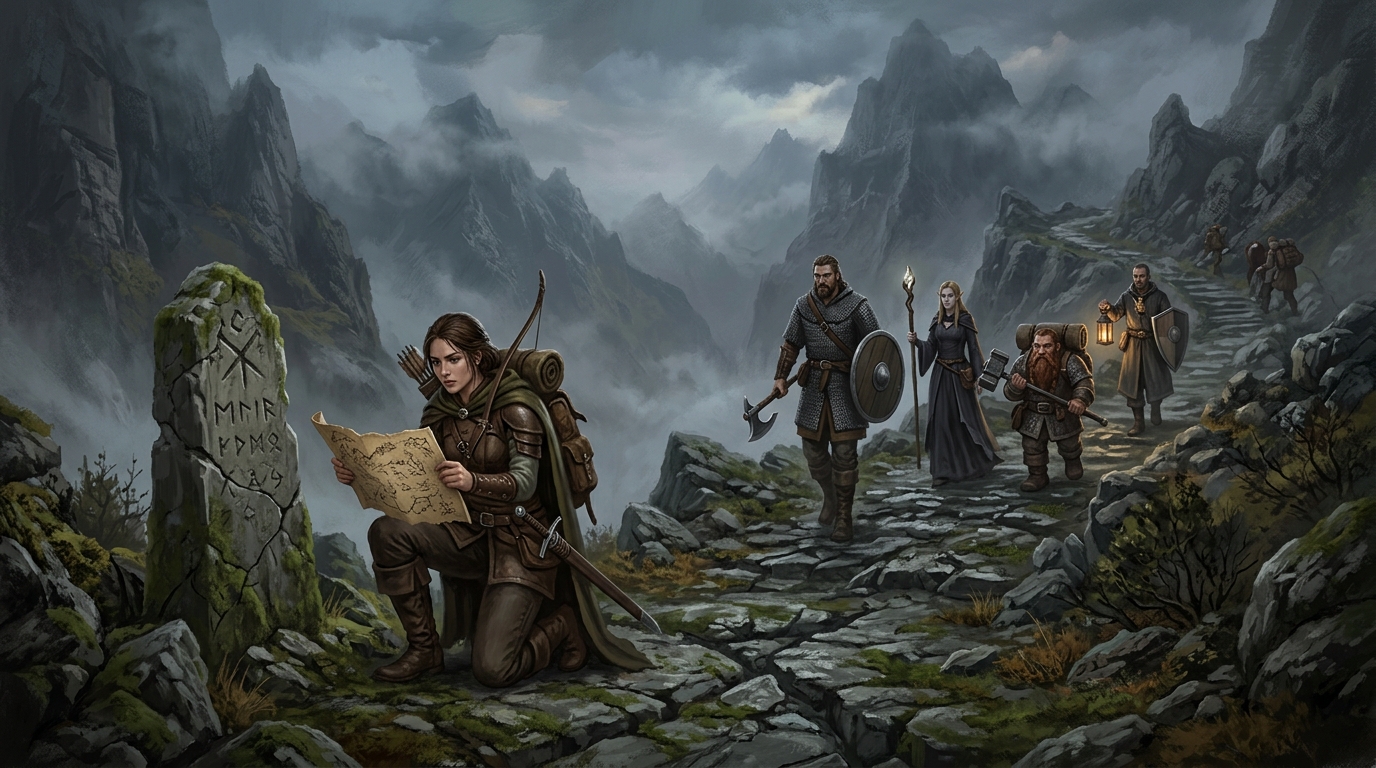
Why default travel feels like an obstacle rather than an adventure
In many campaigns, overland journeys collapse into one of two extremes: the fast-forward montage where three weeks pass in twenty seconds, or the attrition grind where the game pauses every sixty miles for an arbitrary skirmish with wild beasts. The montage drains the campaign map of scale, making distant citadels feel like neighbouring rooms. The attrition grind drains player patience, because a combat encounter unconnected to the local factions or current stakes merely taxes hit dice and spell slots without altering the narrative.
Neither extreme works because neither asks the players to make a consequential choice. Travel engages a table when the journey presents dilemmas: taking the paved Imperial highway exposes the party to tax collectors and bounty hunters, whilst cutting through the bramble fen risks lost rations, spoiled gear, and treacherous footing. The interest lies in the cost of the decision, not in rolling initiative against wolves.
The five pillars of engaging overland travel
Structure wilderness movement using these five practices to turn travel into an active phase of play:
- Branching routes with visible trade-offs Never offer only one road. Present at least two distinct paths between points of interest: a faster route carrying clear danger or scrutiny, and a slower route demanding heavier supplies, navigation skill, or physical endurance.
- Active party travel roles Assign specific responsibilities during every travel leg: the Scout searches ahead for ambushes and trails, the Navigator tracks landmarks to prevent veering off course, the Quartermaster rations food and fresh water, and the Lookout keeps watch over camp. This gives every character an active mechanical and narrative voice during the journey.
- Meaningful time pressure Distance only matters if time has value. When a rival faction is marching, an auction has a fixed date, or winter storms threaten to close the mountain passes, choosing between a six-day safe detour and a two-day perilous crossing carries genuine tension.
- Environmental storytelling and traces Before introducing a threat, show its aftermath. A column of smoke on the horizon, rutted cart tracks veering sharply into a ravine, or claw marks across an ancient waystone tell players about the region and give them time to prepare, investigate, or alter their course.
- Situations in progress, not isolated stat blocks When an encounter occurs on the road, ensure it involves a situation with non-combat handles. A broken merchant axle, territorial herds contesting a ford, or pilgrims stranded by spring floods yield far more memorable roleplay than an unprovoked ambush.
Example
The Sunken Pass: before and after
Contrast how two different Game Masters handle a four-day journey through the Cragtooth foothills towards the mining town of Oakhollow.
- The roll-and-fight approach
- The GM asks for a single Survival check. On a success, the party covers thirty miles. On night two, the GM rolls a wandering encounter: "Four giant spiders drop out of the canopy while you rest. Roll initiative." After forty-five minutes of combat, the party heals up, resumes marching, and reaches Oakhollow with no lasting changes to their plans.
- The choice-and-consequence framework
- The GM lays out two options: the Ridge Road takes two days but is patrolled by aggressive mountain toll-wardens; the Sunken Gorge avoids tolls and takes four days, but recent snowmelt has turned the trail marshy. The party chooses the gorge to preserve their coin. The Navigator rolls to read the swollen waterways, while the Scout spots a timber cart abandoned in the reeds with a broken axle. Investigating reveals barrel markings from an Oakhollow brewer who went missing a fortnight ago, offering a crucial investigative lead before the party ever reaches the town gates.
- Why it works
- The players drove the outcome through deliberate risk assessment. Time and provisions mattered, the scout's role yielded concrete information, and the roadside discovery directly enriched an ongoing faction plot instead of acting as disposable filler.
Running camp and downtime between travel legs
The end of a travel day provides natural pacing for character interaction. Rather than simply declaring that everyone sleeps and recovers resources, invite one or two camp vignettes. Ask who helps prepare the evening meal, what two characters discuss by the fire, or what memories the terrain evokes.
Establishing a clear camp procedure (setting watches, securing beasts of burden, and checking rations) grounds the physical reality of the expedition. When complications arise during the night, they should challenge camp security or supply reserves rather than always triggering midnight combat in armour.
Before your party sets out on the road
Use this checklist to ensure your next wilderness trek feels purposeful:
- Provide at least two plausible routes with contrasting advantages and hazards.
- Establish an in-world deadline or consequence for prolonged travel time.
- Assign distinct travel duties (Scout, Navigator, Quartermaster, Lookout) to the party.
- Seed at least one piece of environmental foreshadowing or setting lore along the way.
- Prepare encounter prompts with social, navigational, or tactical alternatives to direct combat.
Was this useful?
Systems built for this
- The One Ring 2e
Journeys split the party into named roles (Guide, Hunter, Look-out, Scout): the Guide makes a Pathfinding check each leg to see how far the Company travels before an event, and the event then tests whichever other role it strikes, so every member has a defined job during the trip rather than a single shared roll.
- Forbidden Lands
Each leg of a journey is broken into assignable activities, one character leads the way and rolls Survival to navigate each hex, others keep watch, forage, hunt, or fish, and failing those rolls has concrete costs such as getting lost or going hungry, turning travel into a set of parallel character duties rather than narration.
- Ironsworn
The Undertake a Journey move sets a difficulty rank for the trip, then resolves each leg as a roll against a progress track: a strong hit advances the track toward the destination, a weak hit advances it but costs supply, and a miss can send the party astray and raise the journey's difficulty, giving overland travel its own dedicated progress-and-setback structure.
Connecting routes, waypoints, and wilderness encounters
Journeys feel memorable when road encounters connect back to the factions and settlements of your wider campaign world. Rather than rolling on generic tables, Codex Cryptica links travel hazards, waymarkers, and roadside discoveries directly into your campaign lore graph.
Use our free encounter generator to spark unexpected situations with built-in activities and non-combat handles, then tether them to your regional maps.
Try the encounter generatorRelated
Tools
- Encounter generator Generate dynamic wilderness and road encounters with active motivations and non-combat options.
- Adventure idea generator Create rich hooks and complications for long expeditions and regional conflicts.
- Settlement generator Flesh out roadside waystations, frontier hamlets, and destination towns.
Guides
- Codex Cryptica for West Marches Track wilderness exploration, expedition logs, and regional discovery graphs.
- Codex Cryptica for Sandbox Campaigns Manage open worlds where route choices and player agency determine the adventure.
Other answers
- What makes a good random encounter?
- What is a point crawl?
- What should an RPG settlement contain?
- How do you build a point crawl for an RPG?
- How do you prepare a sandbox RPG campaign?
- Point crawl vs hex crawl: which should you use?
- How do you create a sci-fi star system for an RPG?
- What kind of ship should a sci-fi RPG party start with?
- How do you run a chase in a tabletop RPG?
- How do I run common character roles in a sci-fi or space-opera RPG?
- How do I run common character roles in a fantasy RPG?
- What RPG map-making tool should I use?
- How do I run exploration in a huge ruined city?
- How do I make rival captains, navies, and pirate factions matter?
- How do I create interesting islands and ports for a pirate campaign?
- How do I run ship-to-ship combat without sidelining half the party?
- How do I make sea travel interesting in a TTRPG?
- How do I run a pirate campaign that feels like exploration rather than a series of naval battles?