Framework
How do I make rival captains, navies, and pirate factions matter?
Give each rival captain, navy, company, or pirate faction a concrete goal, an asset or dependency, and a move that can change the sea around the crew. Review factions at natural breaks in fictional time, often between sessions, and advance only moves that had the time, means, and opportunity to progress. Show the results in prices, patrols, routes, port access, and local reputation; let recurring rivals change their relationship with the crew as well as their plans.
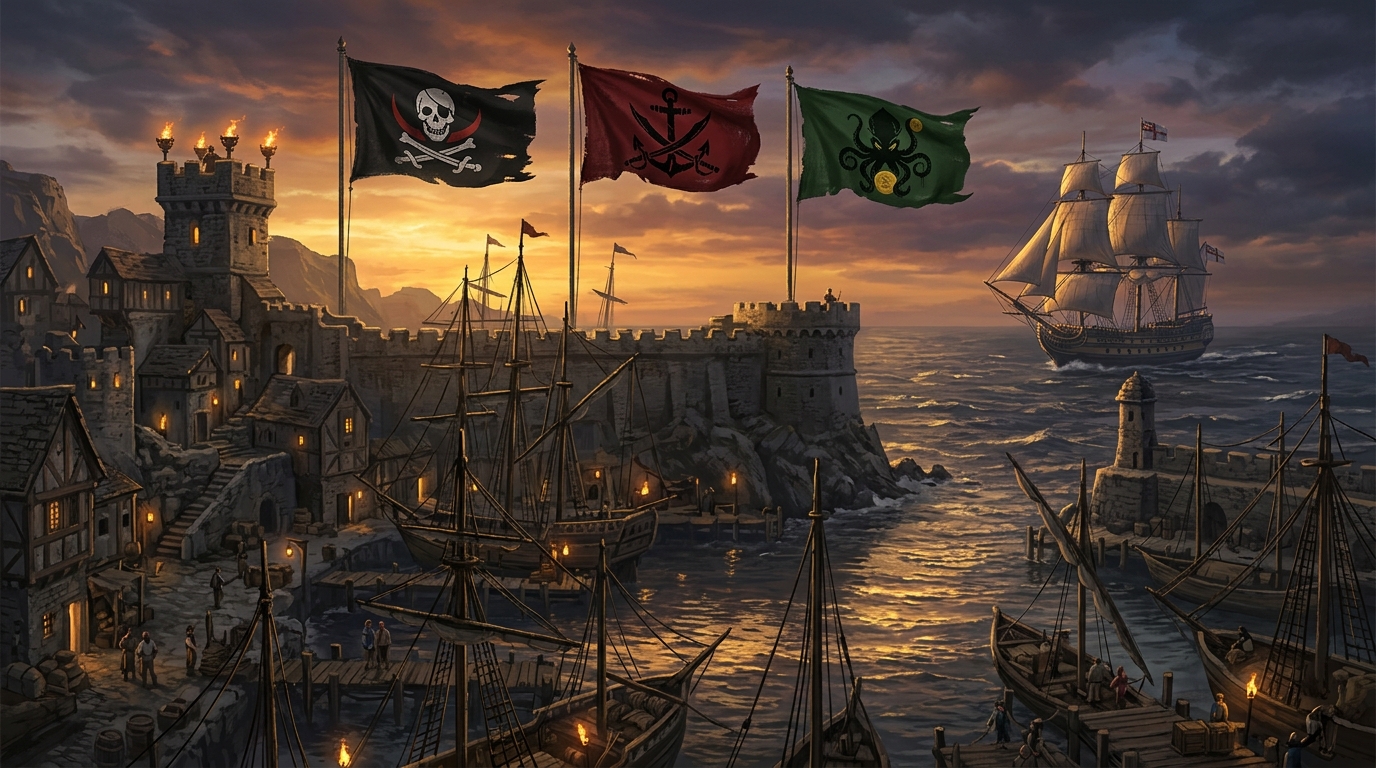
Why rivals and factions slip into the background
Most pirate campaigns introduce a navy, a trading company, and two or three rival captains in the first session, then quietly forget them until the plot needs an enemy. The faction exists as a paragraph of lore and a stat block, not as something that holds territory, needs money, or wants a specific port before the season turns. When nothing changes without the party in the room, the sea feels like a series of disconnected encounters rather than a contested region.
The fix is to treat each faction as an actor with goals, limits, and opportunities. A navy squadron, a trading company, and a rival captain may all want the same channel, but they do not have the same means or pace. Ask what each can plausibly attempt as fictional time passes, what could stop it, and how the players would notice the result. A week-long voyage may give several plans time to move; three scenes in one afternoon may give none.
Six lines that turn a faction into an engine
Before a rival or faction reaches the table, give it six facts you can use without notes sprawl.
- Goal narrow enough to finish Name one thing it wants this season, such as lifting a blockade on Grey Harbour, seizing the wreck of the Saint Elmo, or securing a letter of marque from the governor. A goal you can tell has succeeded or failed creates a natural moment to change the map when it resolves.
- Asset, leverage, or dependency Name something it cannot easily replace: a naval station, convoy charter, safe cove, monopoly on salt and timber, governor's protection, stolen chart, crew loyalty, fair-share reputation, debt held by a merchant house, or a navigator who knows the shoals. This is something the crew can take, block, expose, or bargain over.
- Pressure that forces action now Add a current squeeze: mounting debts, a rival closing in, a bounty expiring, orders from the admiralty, or a harbour running out of provisions. Pressure explains why the faction cannot wait indefinitely and why it might accept a risky deal with the party.
- Clock with visible steps Track a move with a simple 4-step clock if that helps (for example: rumour, preparation, attempt, outcome). The clock is a reminder of pressure, not a metronome: a move can advance, stall, lose resources, change direction, branch into a new goal, be abandoned, or resolve early when circumstances change. A setback can move the clock backwards when it undoes an achieved step; for example, scattered ships may have to regroup before a blockade can proceed. Keep its steps concrete enough to show later as a changed patrol or a new flag over the fort.
- Relationship to at least one other faction Place it in tension or alliance with another power: a grudge with a rival captain, a blockade against a company, or a bounty. Ask who inside the faction disagrees about its goal or methods: an admiral and governor, company directors and a local factor, junior officers and their commander, or pirate captains dividing prizes. A letter of marque authorises named private actors to seize enemy shipping under the issuing authority; it does not grant that authority's navy permission to act.
- Signature that players can recognise Choose one detail that travels ahead of the faction: a flag, a hull colour, a style of patrol, a price it pays for sugar or powder, or a kind of warrant its officers carry. When the same detail shows up two ports later, the players recognise the reach of the faction without a lore reminder.
Give each kind of rival its own habits
Keep the six-line framework, then tune its pressures to the kind of actor. These are tendencies, not extra bookkeeping.
- Rival captain A captain often depends on crew loyalty, ship condition, information, personal reputation, debts or promises, and one patron or safe harbour. Their moves are personal and quick; one encounter can change their course, priorities, or relationship with the crew.
- Navy or state force A navy often depends on orders, logistics, bases, jurisdiction, political legitimacy, and available ships. It tends to move more slowly, but can reshape routes, laws, patrols, and port access. Its officers and political sponsors may want different outcomes.
- Trading company A company often depends on credit, warehouses, contracts, insurers, investors, monopolies, and political protection. It may use prices, lawsuits, debt, hired agents, or port influence before risking ships and cargo in a direct fight.
- Pirate faction or brotherhood A pirate faction often depends on safe anchorages, shared rules, fair loot distribution, charismatic captains, and fences or buyers. It may be a loose alliance rather than a single command, able to agree on sanctuary while its captains compete over prizes.
How to keep them active without a timetable
A faction that only moves when the party visits it is set dressing. Review its situation at natural breaks in fictional time; between-session prep is often a convenient moment to do that.
- Advance only what had time and opportunity For each active move, ask whether enough fictional time passed, the faction still had the means, its route or opportunity remained open, opposition failed to stop it, and the goal still mattered. Advance it only if those conditions support progress. Storms may scatter a squadron; a captain may abandon a wreck hunt after learning the chart was sold; a governor's escorts may accelerate a convoy plan. A move can stall, change, lose resources, split, or resolve early. Note what changed and why.
- Resolve opposition only as much as needed Assess the goal, means, opposition, and current circumstances, then choose the most plausible outcome or use your game's faction procedure. Avoid rolling through NPC-versus-NPC actions the players will never see; roll when uncertainty is genuinely useful. For a detailed faction-turn procedure, use the general faction guidance linked below. Bring the consequence into play.
- Turn outcomes into port-level changes Translate a resolved move into a change the crew can encounter: prices, patrols, flags, routes, freight or insurance terms, crew and specialist availability, repair priority, intelligence, prize buyers, legal status, recruitment, convoy schedules, neutral-port restrictions, or a newly unsafe anchorage. Players track factions through evidence, not announcements; show how their plausible options have changed.
- Let reputation follow the crew Keep reputation local to each port, not as one global score, and give information a carrier: merchant traffic, navy dispatches, wanted posters, tavern gossip, surviving witnesses, or broadsheets if the setting has them. Stories can arrive late, be wrong, differ by port, or be deliberately manipulated. Ask who carried the story here and what version they had reason to tell; it may outrun the crew on a trade route and lag in an isolated cove.
- Evolve recurring captains after contact After contact, change the relationship as well as the captain's circumstances. They might return with reluctant respect, a debt to the crew, a temporary common enemy, an imitation of the crew's tactic, embarrassment they want hidden, an offer to recruit or ally, or a new priority that makes the old feud irrelevant. A scar, lost ally, or grudge can matter too, but each return need not escalate hostility.
- Use conflicts to create choices, not rails Prepare the faction's pressure, constraints, and likely reactions, then accept any player response that fits the fiction. A blockade matters because of patrol coverage, jurisdiction, shoals, political purpose, and the consequences of breaking it. The crew might run it, negotiate, find another route, exploit it, or invent an approach you did not anticipate; those are examples, not a prepared response menu.
Making change visible through the world
Players rarely remember a briefing about faction politics, but they notice when the price of powder doubles, the harbour flies a different colour, or a patrol that once waved them through signals them to heave to. Tie each move that actually progresses to evidence the crew can encounter: a rumour naming who took the cove, a posted bounty describing their ship too accurately, a friendly wharf closed to them, or a warrant whose jurisdiction is clear. A letter of marque authorises licensed privateers to seize enemy shipping for its issuer; a state's navy acts under its own authority.
Spread signals across different channels. Rumours carry intent and reputation; prices, freight, and insurance show who controls trade; patrols and flags show presence; services, law, recruitment, and port access show what the crew can do. When a faction's signature appears in more than one channel, players can recognise its reach and decide which pressure to answer.
Example
Worked example: the same sea, with and without active rivals
The crew has taken a modest prize and put into Port Charity to sell, repair, and reprovision. Three powers have interests in this stretch of coast: Commander Hale's naval squadron, the Vesper Trading Company, and rival captain Selene Varga. Compare a static version with one built on goals, clocks, and visible consequences.
- The static version
- The notes list each faction's history and a symbol. Nothing has changed since the last visit. Port Charity offers the same prices and the same harbour master. The GM improvises a patrol encounter on the way out because the voyage needs an event. The players treat every faction as a quest board to visit when they want work, and ignore them otherwise.
- The active version
- Hale's squadron is preparing to blockade the northern channel (step 2: its cutters have moved into position and are warning merchants away from the passage). Vesper is pursuing the reopening of the sugar route and has posted a bounty on Varga for raiding its last convoy. Varga, short on powder, has allied with the smugglers at Skerry Cove. On a week-long voyage, Hale has time, ships, and orders to close the channel, while Vesper has the credit and political support to seek state backing. Vesper secures state backing, a warrant against Varga, and letters of marque authorising licensed privateers to seize her ships for the issuing state. The crew arrives to find sugar dear, powder scarce, Vesper's flag over the company wharf, Hale's cutter signalling them to heave to, and a fresh rumour that Varga was last seen taking on shot at the cove they had planned to use. If storms scatter Hale's ships or the governor withholds support, those moves stall or change instead; the clock does not advance by itself.
- Why it works
- The factions acted only where time, means, and opportunity made progress plausible, and left evidence the players can read without a lecture. The blockade, prices, flag, patrol, and rumour change what the crew can plausibly do. They might run the blockade, bargain with Hale or Vesper, find another route, or pursue a different plan that fits the situation. The factions create pressure and reactions; the players choose what to do with them.
Before the next session at sea
Set up rival captains and factions so the sea changes even when the crew looks the other way.
- Write one goal, one asset or dependency, and one current pressure for each active captain, navy, company, or pirate faction.
- Use a 4-step clock if useful; make steps concrete enough to show as preparation, an attempt, or a changed port.
- Name a relationship, an instrument of pressure, and any internal disagreement that could change the faction's method or goal.
- At a natural break in fictional time, note which moves had the time, means, and opportunity to progress, and what opposition or changed circumstance affected them.
- Record what each port has heard about the crew, who carried the story, and what version they had reason to tell.
- Note how each recurring captain's priorities or relationship with the crew might have changed after contact.
- Prepare the faction's pressure, constraints, and likely reactions; accept any player response that fits the fiction.
- Copy and fill in this compact faction-state block when useful: Actor type: captain / navy / company / pirate faction | Current goal: | Why now: | Asset / leverage / dependency: | Current move: | Time / means needed: | Opposition: | Internal disagreement: | Relationships: | Recognisable signature: | What changes if it succeeds: | How players may hear or see it:
Was this useful?
Connect rivals and sea pressure in your campaign
Save each navy, company, rival captain, or pirate faction with its goal, asset or dependency, pressure, and current move, then tie it to the ports, routes, and captains it affects. When circumstances change its move, update the relationship graph and campaign timeline so a later port visit can show the result in prices, patrols, routes, access, and rumours.
Generate a rival factionRelated
Tools
- Faction Generator Create navies, trading companies, and pirate brotherhoods with goals, dependencies, and rivalries.
- Ship Generator Give a rival captain a vessel with a crew, complication, and secret that the party can recognise at a distance.
- Settlement Generator Build ports, island harbours, and hidden coves with the trade, law, and pressures that factions contest.
Guides
Other answers
- What kind of ship should a pirate crew start with?
- How do you run factions in a sandbox campaign?
- How do you track faction turns between RPG sessions?
- How do you create a fantasy faction?
- How do you make travel interesting in a tabletop RPG?
- How do you generate useful RPG rumours?
- What should an RPG settlement contain?
- How do trade routes shape cities and kingdoms in an RPG world?
- How do I create interesting islands and ports for a pirate campaign?
- How do I run ship-to-ship combat without sidelining half the party?
- How do I make sea travel interesting in a TTRPG?
- How do I run a pirate campaign that feels like exploration rather than a series of naval battles?
- What TTRPG should I play for a pirate or high-seas campaign?